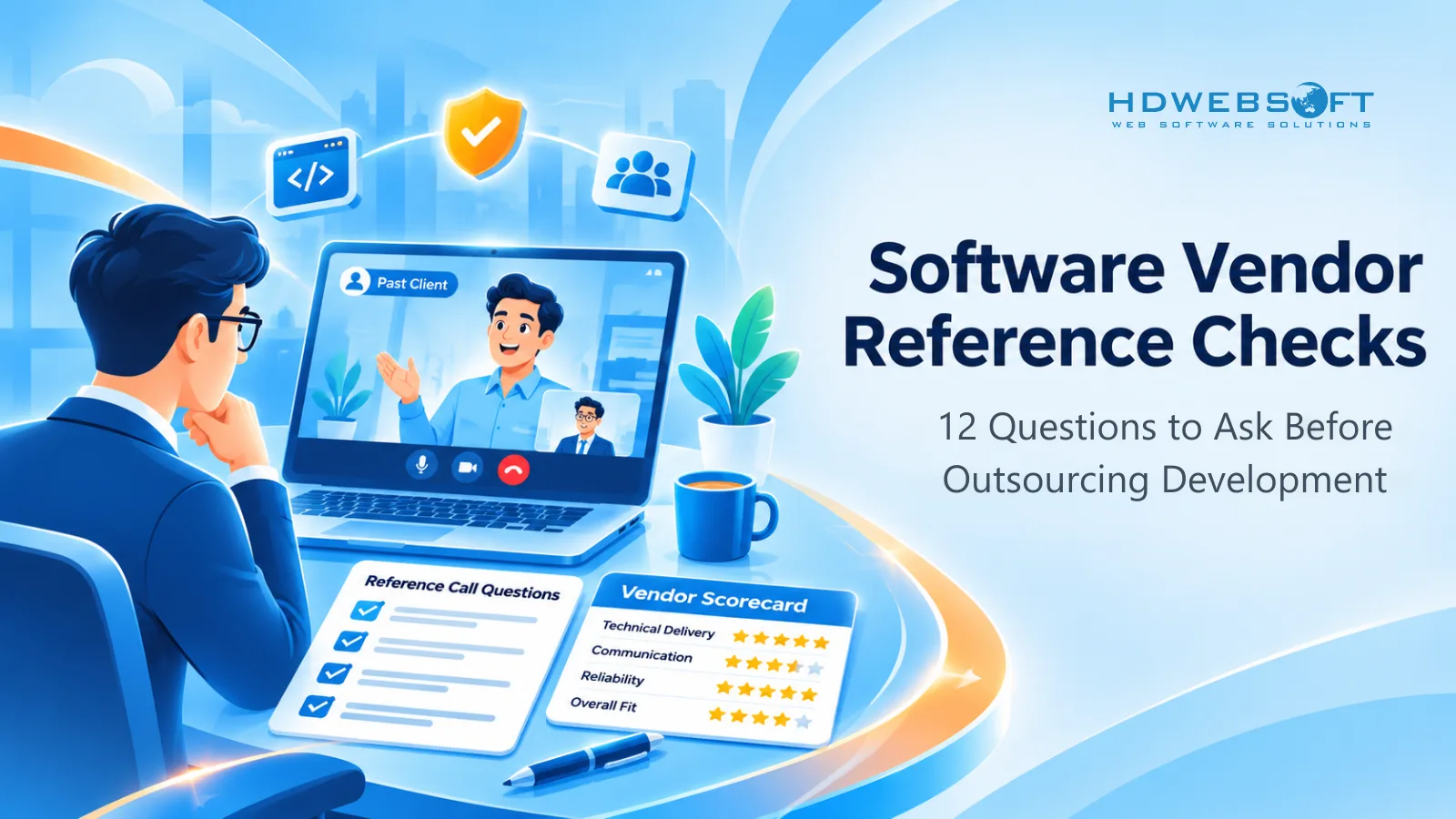
A software vendor reference check is a structured conversation with a vendor’s past or current clients. Its purpose is to verify — not just hear — the claims made during the sales process. Those claims cover delivery reliability, engineering quality, communication habits, and post-launch behavior. It belongs after you have shortlisted vendors and before or alongside a paid pilot, and it provides a direct way to probe and verify vendor claims through client experiences.
Most buyers skip it or treat it as a courtesy call where the vendor’s happiest client says nice things for twenty minutes. Done properly, it is an interview you control: you choose the questions and decide what counts as a good answer. You record what you hear in a form you can compare across vendors.
This guide gives you twelve questions in four groups: delivery performance, engineering quality, communication, and post-launch support. Each question comes with listening cues and a follow-up probe. It also separates genuine red flags from answers that only need clarification. A scorecard at the end records evidence confidence across calls. Where reference checks fit among the other verification layers, see our verification framework for offshore service providers.
Key Takeaways
- A reference check is structured verification, not a courtesy call — testimonials are marketing; reference calls are evidence you can probe.
- Match references to your project by recency and relevance — a recent, similar project beats an old marquee name.
- Every question needs a purpose, listening cues, and a clear split between genuine red flags and answers that simply need clarification.
- Multiple independent references are preferable, not a mandatory threshold — convergence of evidence is what matters.
- Confidentiality restrictions are not automatic disqualification — but they require verifiable alternative evidence.
- The scorecard records evidence confidence per criterion — a decision aid, not a vendor ranking.
What Is a Software Vendor Reference Check?
A software vendor reference check is a live conversation with a past client of the vendor. It typically covers a custom engagement: a dedicated team, a fixed-scope build, or a modernization project. The purpose is to verify specific claims before you sign. The vendor brokers the introduction, but the client controls the answers and you control the questions.
That is what separates it from the other evidence sources you already have:
| Reference check | Online review | Case study | |
|---|---|---|---|
| Who controls the story | The client, live | Mixed; often anonymous | The vendor |
| Can you probe deeper | Yes — follow-up questions in real time | No | Only within what is written |
| Context | Your questions, your project’s concerns | None | Vendor-selected framing |
| Best used for | Verifying claims before contract | Early-stage filtering | Generating questions to verify |
The distinction matters most in custom software development outsourcing, where the outcome depends on how the vendor’s team behaves week to week. Whether you’re evaluating software outsourcing services for a dedicated team or a full project build, reference checks should focus on delivery performance, engineering collaboration, and accountability. Unlike SaaS selection, where buyers typically assess product reliability and support, custom development requires understanding how the team handles scope changes and technical challenges.
Reference checks also have a formal place in structured procurement. Professional vendor assessment methodology treats client references as one verification input among several, alongside capability review and commercial evaluation. It is not a formality tacked onto the end.
How to Prepare for a Software Vendor Reference Call
The quality of a reference call is decided before the call starts. Three preparation steps determine whether you get evidence or pleasantries.
Ask for the full client list, not a curated one
Ask for a list of clients the vendor has worked with in recent years — not only the one or two references they offer to connect. Vendor-selected references are, by construction, the vendor’s best cases; the broader list lets you choose who to talk to.
Prioritize references that are recent and relevant to your project. A project that finished last year on a similar stack and team size tells you more than a logo from five years ago — but there is no fixed qualifying window. A three-year-old engagement similar to yours beats a six-month-old project that shares nothing with it.
Public-sector procurement guidance makes the same point from the other direction. The Australian Digital Health Agency’s structured reference check guidance recommends requesting the client list rather than vendor-chosen references alone. It also recommends using the same questionnaire for every vendor, so feedback stays comparable.
Match references to your project
Project similarity determines how much weight each answer can carry. The dimensions that matter for custom software development:
- Tech stack — a React Native reference cannot vouch for a .NET team’s depth.
- Team size and engagement model — a two-person augmentation behaves differently from a twelve-person dedicated team.
- Contract type — fixed-scope and time-and-materials projects expose vendors to different pressures.
- Industry and regulatory context — healthcare or fintech work changes how process questions get answered.

Prepare the questions and ask for consent
Book twenty to thirty minutes and prepare your question set in advance. The twelve below are a starting point — trim them to the ones that matter for your project. Ask the vendor to arrange the introduction. A vendor comfortable being verified brokers the call without friction, and how easily it gets arranged is itself a signal.
During the call, take notes against your question list rather than freeform. Complete your scorecard immediately after, while details are fresh. Where possible, talk to the person who worked day to day with the vendor’s team. That means the engineering lead or product manager, not only the executive sponsor.
12 Software Vendor Reference Check Questions
Each question follows the same structure: the purpose, what to listen for, and — where most reference guides stop — the difference between a genuine red flag and an answer that needs clarification. An ambiguous answer is not automatically a red flag. Probe first; conclude after.
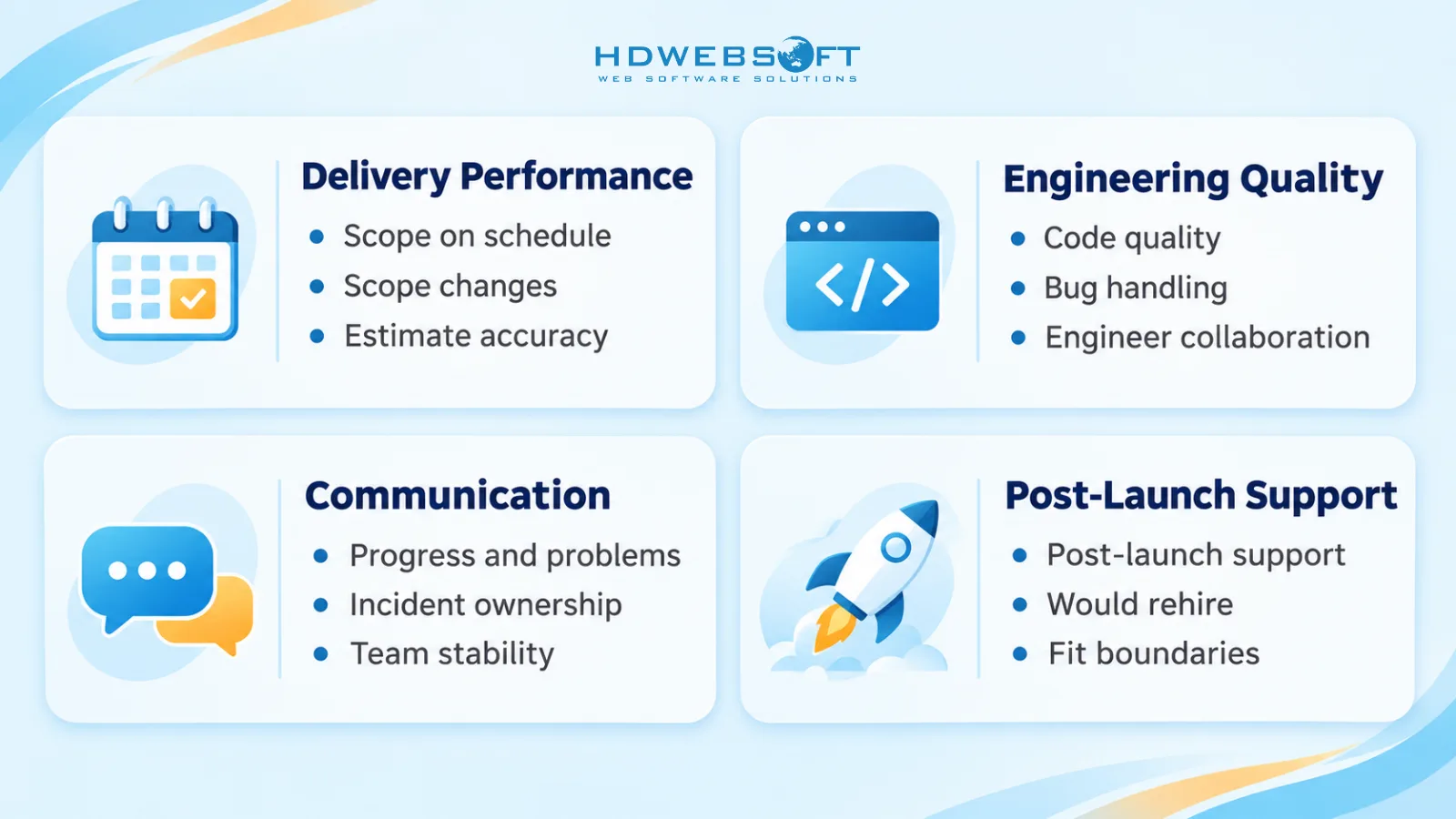
Delivery performance
1. “Did the team deliver the agreed scope on the agreed schedule?”
- Purpose: Separate on-time-delivery claims from delivery reality on a real project.
- What to listen for: Named milestones and dates; slippage flagged early with a revised plan, not discovered late.
- Red flag: The reference consistently avoids discussing delivery outcomes or cannot provide any meaningful project context, even after follow-up questions.
- Needs clarification: “We slipped once” — common in custom development; the cause and how it was communicated matter more.
- Follow-up probe: “What caused the delay, and how did the team communicate it?”
2. “How did the team handle a major scope change mid-project?”
- Purpose: Reveal the change-management process under real pressure.
- What to listen for: Impact analysis, re-estimation, a revised plan — a process, not a mood.
- Red flag: Change requests absorbed without any impact assessment — a yes-vendor pattern that resurfaces as budget overrun.
- Needs clarification: One heated disagreement about a change; how it was resolved is the signal, not the conflict itself.
- Follow-up probe: “Walk me through the last change request — from request to revised plan.”
3. “How accurate were the estimates compared to actuals?”
- Purpose: Test estimation honesty, which predicts how budget conversations will go.
- What to listen for: A variance figure and a reason, plus whether the vendor flagged drift early.
- Red flag: Refusal to discuss overruns, or attributing all of them to the client.
- Needs clarification: A 10–20% overrun with a coherent explanation — normal territory in custom software.
- Follow-up probe: “Which phase drifted most, and what did the vendor change afterward?”
Engineering quality
4. “What was the code quality like — and did it hold up after handover?”
- Purpose: Assess maintainability — the quality that shows up months later, not in the demo.
- What to listen for: How long the client’s own developers took to become productive in the codebase, straight talk about technical debt, documentation quality.
- Red flag: The vendor resisted handover or kept documentation internal.
- Needs clarification: A non-technical reference who cannot describe the codebase — route this question to their engineer instead.
- Follow-up probe: “How long did your developers need to become productive in the codebase?”
5. “How did the team handle bugs found during and after release?”
- Purpose: Evaluate QA discipline rather than the absence of bugs.
- What to listen for: A triage process, regression testing, root-cause analysis, realistic fix timelines.
- Red flag: Defects were hidden until production surfaced them.
- Needs clarification: A few post-launch defects fixed quickly — that is normal software.
- Follow-up probe: “Tell me about the worst defect — how was it found, fixed, and prevented from recurring?”
6. “Did your own engineers work directly with theirs?”
- Purpose: Measure the technical depth of the team actually assigned to you.
- What to listen for: Code reviews in both directions, architecture discussions, engineer-to-engineer channels.
- Red flag: Every technical exchange routed through a PM or BA — the gateway pattern that hides the real team.
- Needs clarification: A small project with limited direct contact — ask about scale before concluding.
- Follow-up probe: “Who joined your architecture discussions, and what did they push back on?”
Communication and project management
7. “How did the team communicate progress — and problems?”
- Purpose: Test information transparency — the difference between reports and reality.
- What to listen for: Bad news arriving before you ask, and direct access to Jira, GitHub, or equivalent tooling.
- Red flag: The client discovered problems the team had not reported.
- Needs clarification: A communication cadence that did not match expectations — a fixable mismatch, not dishonesty.
- Follow-up probe: “When did you last hear bad news from them before you asked?”
8. “What happened the last time something went wrong?”
- Purpose: Reveal ownership behavior under failure — the answer that predicts the next incident.
- What to listen for: A specific incident, a root-cause analysis, a concrete process change afterward.
- Red flag: Blame-shifting or silence.
- Needs clarification: “We never had problems” — possible on a small project; probe scale and complexity before believing it.
- Follow-up probe: “Describe an incident — what changed in their process afterward?”
9. “Was the team stable, or did people rotate?”
- Purpose: Check continuity of the people you are actually vetting.
- What to listen for: Named engineers who stayed the duration, and a structured replacement process when someone left.
- Red flag: Frequent unannounced turnover with no replacement plan.
- Needs clarification: The reference cannot remember names — plausible on a large engagement; ask about roles and handovers instead.
- Follow-up probe: “Who left during the project, and how was the handover handled?”
Post-launch support and partnership
10. “What happened after launch — support, maintenance, knowledge transfer?”
- Purpose: Expose post-launch behavior, where weak vendors disappear.
- What to listen for: Response times, handover documentation, whether service-level commitments were kept.
- Red flag: The vendor stopped responding after go-live.
- Needs clarification: The contract excluded maintenance, so contact was naturally limited — ask whether they helped beyond scope anyway.
- Follow-up probe: “After go-live, how fast did they respond to the first issue?”
11. “Would you hire this team again — and what would you do differently?”
- Purpose: A verifiable net-promoter question plus a self-critique test.
- What to listen for: An unhesitating “yes” paired with something the client would manage differently — the pairing shows real engagement, not politeness.
- Red flag: A long pause, or an answer that sounds scripted by the vendor.
- Needs clarification: “Probably, depending on budget” — probe the conditions behind the qualifier.
- Follow-up probe: “What would you change about how you managed them?”
12. “What kind of project is this vendor NOT a good fit for?”
- Purpose: Boundaries indicate depth; a vendor good at everything is good at nothing in particular.
- What to listen for: Specific limits — stack, scale, domain, regulatory context.
- Red flag: The reference cannot name a single weakness — the reference may have been prepared.
- Needs clarification: Probe whether the reference only saw one small project.
- Follow-up probe: “If you had a regulated, safety-critical build, would you send it to them?”
How to Verify Reference Claims Against Project Evidence
Treat everything you hear as a claim until evidence supports it. Multiple independent references are preferable to a single enthusiastic one. Not because any particular number is a threshold, but because convergence is what turns anecdotes into evidence. Two or three well-matched references usually tell you more than five loosely related ones.
Start with the vendor’s public record. Software development case studies with technical detail — architecture decisions, constraints, outcomes — give you a baseline to compare claims against. If a case study describes a migration the reference never mentions, that gap is worth a question.
Cross-checking reference claims
Four checks turn a good story into verified evidence:
- Compare against scope and milestones. Ask about specific deliverables and dates, then compare with the proposal or contract where the client can legally share it.
- Look for shareable artifacts. NDA-safe case studies, public products, app store listings — anything that exists independently of the conversation.
- Verify the relationship. Check the reference’s role and dates on LinkedIn against the project period; someone present during the engagement can speak to it.
- Ask what the case study leaves out. Vendor material is curated; the reference’s account of the same project — including what went wrong — is the complement.

Handling conflicting reference feedback
When two references describe the same vendor differently, the conflict is data, not noise.
First, look for a pattern: does praise and criticism cluster by project type, team seniority, engagement model, or period? A vendor whose fixed-bid projects struggled but whose dedicated teams excelled is telling you where they perform. Second, probe the conditions behind each judgment. “They were slow” means something different on a fixed-bid project than on a dedicated team with direct access. Third, weight independently verifiable evidence over opinion. A reference who can name dates, artifacts, and outcomes outranks one offering general impressions.
Do not auto-disqualify on one negative reference or auto-pass on one positive one. Investigate until you understand the variable that explains the difference.
Common Red Flags During Reference Calls
Most reference calls produce ordinary, usable feedback. A few patterns should change how you read the rest of the conversation:
- Only one reference is offered, and it is the vendor’s best case. A star reference is a marketing asset, not evidence. Ask for the broader client list and a second, independently chosen contact.
- The reference cannot describe the project in specifics. Vague enthusiasm from someone who cannot name the stack, the team, or one milestone suggests they did not work with this team.
- Testimonials without context. A quote with no name, role, project type, or timeframe cannot be verified and is decoration.
- A flat refusal to arrange any contact, with no alternative. Confident vendors have clients willing to talk — or a reason and an alternative.
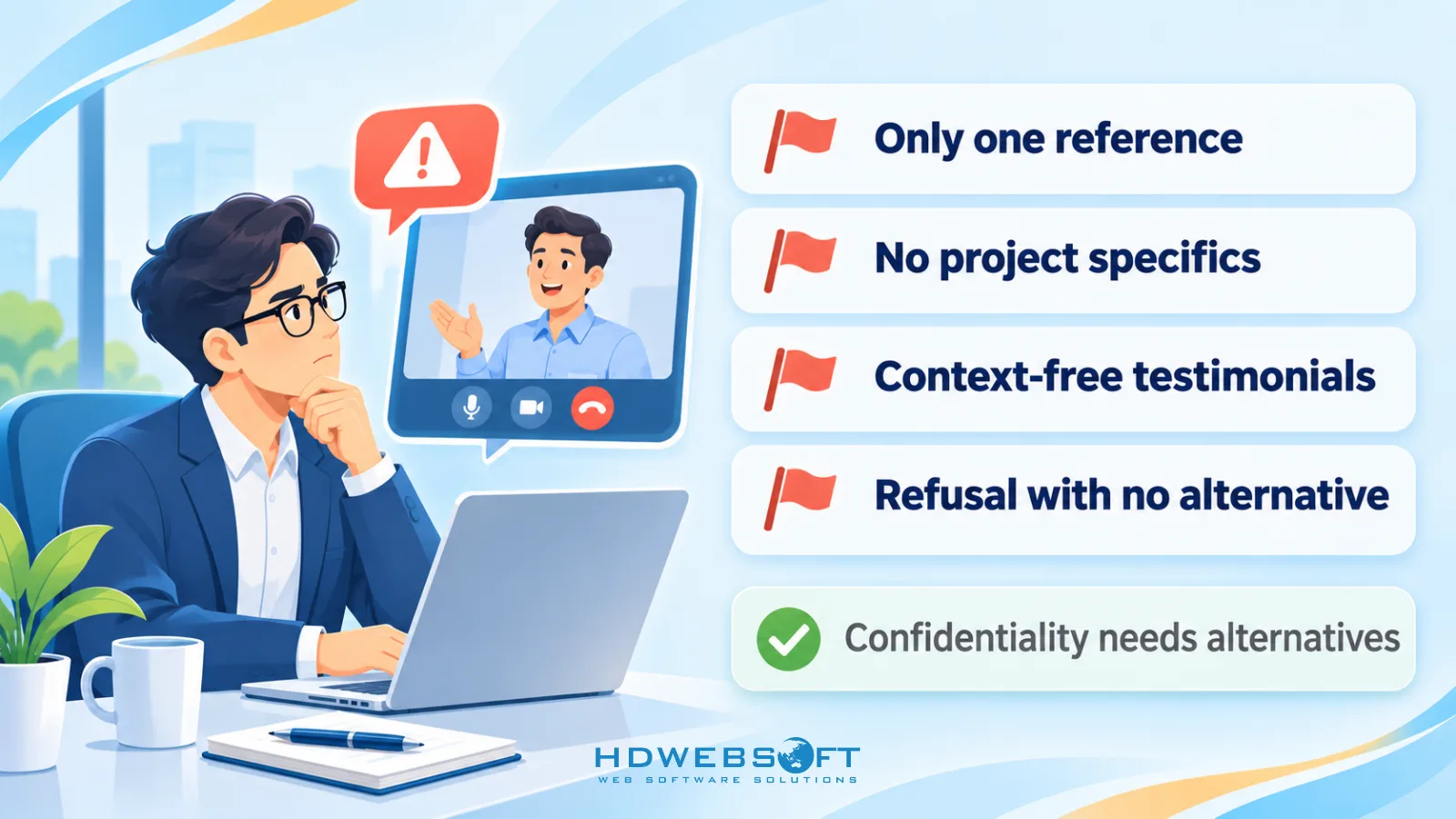
One situation is not automatically a red flag: clients who cannot take calls because of confidentiality or NDA restrictions. This is common in custom development for enterprise and regulated clients. What the vendor owes you instead is verifiable alternative evidence. That means a written reference from a named person and role, LinkedIn-verifiable clients, or an NDA-safe case study. An explanation without evidence is where caution begins; a refusal with no alternative is where it ends.
Software Vendor Reference Check Scorecard
The scorecard records how much confidence each answer earned — not a vendor ranking. Fill it in immediately after each call, while specifics are fresh. Across calls, the pattern matters more than any single row. Converging evidence raises confidence; conflicting evidence marks a criterion for investigation. Empty rows are your probe list for the next call.
Rate confidence per criterion: High — specific, verifiable, consistent with other references; Medium — plausible but single-source or unverified; Low — vague, contradictory, or unverifiable.
| # | Criterion | Evidence to record | Typical follow-up |
|---|---|---|---|
| 1 | On-time delivery | Named milestones, dates, how slippage was communicated | Ask a second reference the same question |
| 2 | Scope-change handling | One walked-through change request, end to end | Probe the impact-analysis process |
| 3 | Estimate accuracy | Variance percentage and stated causes | Ask which phase drifted most |
| 4 | Code quality and handover | Client-dev onboarding time, debt and documentation talk | Route to the client’s engineer |
| 5 | Defect handling | Triage and RCA story, fix timeline | Ask about the worst defect |
| 6 | Engineering collaboration | Who joined reviews and architecture discussions | Ask what the vendor pushed back on |
| 7 | Progress and problem transparency | Bad-news examples, direct tool access | Ask when bad news arrived unasked |
| 8 | Incident ownership | One incident plus the process change it produced | Ask for RCA detail |
| 9 | Team stability | Named engineers who stayed, replacement process | Ask who left and how handover ran |
| 10 | Post-launch support | Response times, handover docs, SLA adherence | Ask about the first post-launch issue |
| 11 | Would rehire | Unhesitating yes plus one thing to manage differently | Ask what they would change |
| 12 | Fit boundaries | Named project types the vendor avoids | Test with your hardest scenario |
Three rules keep it honest. Record evidence, not impressions — “named two release dates” beats “seemed reliable.” Compare across references before concluding. A criterion marked Low by one reference and High by another is an investigation item, not a verdict. And remember the output: a confidence map that supports a judgment, not a score that replaces one. It tells you whether to probe deeper or move to a pilot. This is a tool for weighing reference feedback, not a vendor-selection checklist.
Conclusion: From Reference Checks to Informed Outsourcing Decisions
Reference checks do not remove the risk from an outsourcing decision — they convert unverified claims into evidence you can weigh. Run them before or alongside a paid pilot, and ask every vendor the same structured questions. Distinguish red flags from answers that need clarification, and record confidence rather than impressions. Then let convergence across references — not charisma in a sales call — move a vendor forward.
For a custom software build, pick a partner that treats verification as a normal part of vetting. Explore HDWEBSOFT’s offshore software development services or contact our team to talk through your project. We are comfortable being checked — that is the point.
FAQ
How many references should I check before outsourcing software development?
There is no mandatory number. Multiple independent references are preferable to one, because convergence across clients is what turns anecdotes into evidence. Two or three well-matched references usually beat five loosely related ones. Prioritize recency and project similarity over quantity.
Can I trust written testimonials instead of live reference calls?
No. Testimonials are vendor-selected, edited, and cannot be probed — useful for generating questions, not answering them. A live call lets you ask follow-ups in real time and hear how the client reasons about problems, which is where the real signal is.
What should I do if a vendor cannot provide client references?
Ask why. Confidentiality and NDA restrictions are common in custom development and not an automatic disqualification. But the vendor should offer verifiable alternatives: a written reference from a named person, LinkedIn-verifiable clients, or an NDA-safe case study. A flat refusal with no alternative is a warning sign.
How do I verify that a reference actually worked with the vendor?
Cross-check the person’s role and dates on LinkedIn against the project period, ask for specifics only a participant would know, and compare their account with the vendor’s public case studies. Specifics that hold up under follow-up questions are the strongest verification.
How long should a software vendor reference call take?
Twenty to thirty minutes covers the four question groups if the questions are prepared. Send topic areas in advance, take notes during, and complete your scorecard immediately after while details are fresh.
What is the difference between a reference check and a case study?
A case study is vendor-controlled marketing: a selected project with an edited narrative. A reference check is a live conversation with a client the vendor does not script, where you choose the questions and can probe contradictions.