Is Salesforce a SaaS? This question frequently arises among businesses exploring cloud-based solutions for customer relationship management. As companies navigate the complex landscape of cloud computing, understanding whether Salesforce operates as Software-as-a-Service becomes crucial for making informed technology decisions. The answer is yes, Salesforce is fundamentally a SaaS platform. However, it also offers Platform-as-a-Service (PaaS) capabilities that enhance its versatility.
Throughout this article, we’ll explore what makes Salesforce a leading SaaS provider and examine its Salesforce SaaS or PaaS characteristics. We’ll help you understand how SFDC in Salesforce delivers value to businesses worldwide. By the end, you’ll have a comprehensive understanding of Salesforce’s cloud service model and how it can benefit your organization.
Key Takeaways
- Salesforce is fundamentally SaaS: Its CRM applications are hosted, subscription-based, and accessed through a browser — no installation required.
- The Salesforce Platform adds PaaS: Developers can build custom applications using Apex, Lightning Web Components, and Heroku without managing infrastructure.
- Both models can coexist: Many enterprises run standard SaaS apps while building custom PaaS extensions for unique needs.
- SaaS for speed, PaaS for fit: SaaS deploys faster and costs less upfront; PaaS delivers tailored functionality for specialized processes.
- Salesforce dominates CRM: It holds approximately 20.7% of the global CRM market, ranking #1 for 11 consecutive years according to IDC.
Understanding SaaS (Software as a Service)
To understand how Salesforce fits the SaaS model, let’s first define what SaaS means.
What Defines SaaS?
SaaS is a cloud computing model in which applications are hosted by a service provider and made available to customers over the internet. Instead of purchasing, installing, and maintaining software on individual computers or servers, users simply access applications through a web browser with a subscription-based payment model. This delivery method eliminates the need for complex hardware infrastructure and reduces the IT burden on organizations.
Prime Examples
Popular examples of SaaS applications include:
- Google Workspace for productivity
- Dropbox for file storage
- Slack for team communication
- Salesforce for customer relationship management
These platforms share common characteristics. They’re accessible from anywhere with an internet connection, automatically updated by the provider, and scaled easily based on user needs. SaaS solutions typically operate on a multi-tenant architecture, where multiple customers share the same infrastructure while maintaining data separation and security.
Core Benefits
SaaS offers several compelling benefits for modern businesses. It significantly reduces upfront costs since there’s no need to invest in expensive hardware or software licenses. Automatic updates ensure users always have access to the latest features and security patches without manual intervention. The subscription model provides predictable operational expenses and flexibility to scale up or down based on business requirements.
The global SaaS market reflects this adoption trend. According to Gartner, worldwide end-user spending on SaaS is forecast to reach $299 billion in 2025, up from $250.8 billion in 2024.
Understanding PaaS (Platform as a Service)
What Defines PaaS?
Platform-as-a-Service provides a complete development and deployment environment in the cloud. It includes the infrastructure and tools needed to build, test, and run applications.
Unlike SaaS, which delivers ready-to-use software, PaaS provides developers with a framework to create custom applications without managing the underlying infrastructure. This model handles servers, storage, networking, databases, middleware, and development tools, allowing developers to focus exclusively on coding and innovation.
Prime Examples
Notable PaaS examples include:
- Heroku for application hosting
- Microsoft Azure App Service for building web applications
- Google App Engine for scalable app development
- AWS Elastic Beanstalk for deploying applications
These platforms offer pre-built components, APIs, and development frameworks that accelerate the application development lifecycle while maintaining flexibility and control over the final product.
Core Advantages
PaaS dramatically reduces development time by providing ready-to-use components and eliminating the need for infrastructure setup. PaaS platforms offer built-in scalability, robust integration capabilities, and collaborative tools that enable distributed teams to work efficiently. Cost savings emerge from not having to purchase, configure, or maintain physical servers and development environments.
Is Salesforce a SaaS? The Answer
Salesforce as a Premier SaaS Provider
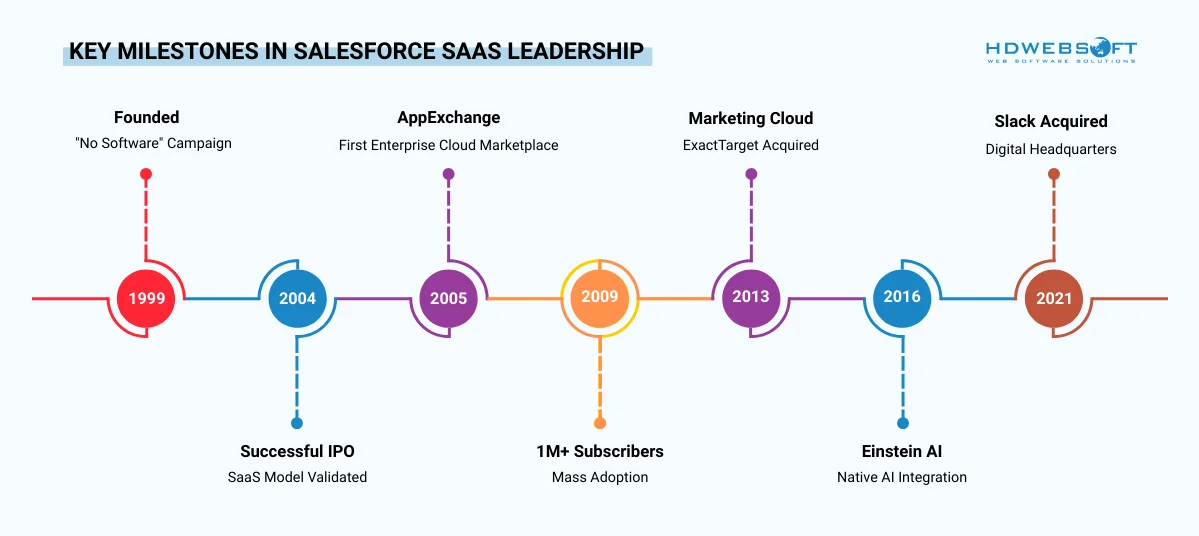
Yes, Salesforce is fundamentally a SaaS platform — and one of the most recognized in the world. Salesforce pioneered the SaaS CRM model when it launched in 1999. Since then, it has fundamentally changed how businesses access and use customer relationship management software.
Rather than requiring companies to install software on their own servers, Salesforce delivers its entire suite of applications through the cloud, accessible via any web browser with an internet connection.
Subscription-Based SaaS Model in Action
The flagship Salesforce CRM exemplifies the SaaS model perfectly. Organizations subscribe to Salesforce on a per-user, per-month basis, gaining immediate access to powerful CRM functionality without any software installation. All data resides securely in Salesforce’s cloud infrastructure, automatically backed up and protected. Updates and new features roll out seamlessly without disrupting operations or requiring manual upgrades from IT teams.
Transforming Business Operations Through Cloud Accessibility
This cloud-based approach has transformed business operations worldwide. Sales teams can access customer information from their smartphones while meeting clients. Service representatives can view complete customer histories from any location. Marketing professionals can launch campaigns and track results in real-time. This accessibility and flexibility represent the core value proposition of Salesforce as a SaaS solution.
The Evolution of Salesforce as a SaaS Pioneer
The Revolutionary “No Software” Campaign
When Salesforce launched in 1999, the enterprise software landscape was dominated by expensive, complex on-premise systems that required significant IT infrastructure and lengthy implementation cycles. Marc Benioff and his co-founders challenged this status quo with a radical idea: delivering CRM software entirely through the internet. Their iconic “No Software” marketing campaign featured a logo with the word “software” crossed out inside a red circle, directly challenging industry giants like Siebel, Oracle, and SAP.
This bold positioning wasn’t just marketing. It represented a fundamental shift in how businesses would consume technology. At industry conferences, Salesforce even staged mock protests against software, complete with picket signs, creating buzz and controversy that forced the market to take notice of this innovative delivery model.
Disrupting the Traditional Enterprise Software Model
Traditional CRM systems required companies to spend hundreds of thousands or even millions of dollars on software licenses, servers, database infrastructure, and specialized IT staff for maintenance. Implementation projects stretched for months or years, often failing to deliver promised value.
Salesforce’s SaaS model demolished these barriers by offering immediate access through a web browser with simple monthly subscription pricing. Small businesses could now afford the same powerful tools previously reserved for enterprises. The pay-as-you-go model aligned costs with actual usage, eliminating the risk of massive upfront investments in systems that might become obsolete or underutilized.
Key Milestones in SaaS Leadership
Market Dominance and Industry Impact
Today, Salesforce commands the largest share of the global CRM market, consistently outpacing competitors like Microsoft Dynamics, SAP, and Adobe. According to IDC’s 2024 Worldwide Semiannual Software Tracker, Salesforce holds 20.7% of the global CRM market, ranking #1 for the 11th consecutive year.
The company’s annual revenue reached $37.9 billion in fiscal year 2025, up 9% year-over-year. Its total remaining performance obligation rose to $63.4 billion by January 31, 2025. This growth demonstrates the scalability and sustainability of the SaaS business model.
Salesforce’s success also inspired an entire generation of SaaS companies across every business function — from human resources (Workday) to collaboration (Zoom) to project management (Asana). The broader SaaS market, now valued at hundreds of billions of dollars annually, owes its existence largely to the path Salesforce pioneered.
Salesforce as a PaaS Provider
The Salesforce Platform Advantage
While Salesforce’s SaaS products define its core identity, the company also delivers powerful PaaS capabilities through the Salesforce Platform (formerly Force.com). This enterprise-grade development platform enables developers and businesses to build custom applications that extend Salesforce’s functionality or create entirely new solutions that integrate with the Salesforce ecosystem.
The Salesforce Platform handles all infrastructure management — servers, databases, security, and networking — allowing developers to concentrate on building innovative applications. This PaaS offering proves invaluable for organizations with unique business processes that can’t be addressed by off-the-shelf software. Applications built on the Salesforce Platform inherit the same enterprise-grade security, scalability, and reliability that power Salesforce’s SaaS products.
Key PaaS Components
Apex
Apex is Salesforce’s proprietary programming language, specifically designed for building business logic and workflows on the platform. Similar to Java in syntax, it enables developers to create complex, database-driven applications with strong typing and object-oriented features. Apex integrates seamlessly with Salesforce’s database and executes on Salesforce’s servers, ensuring optimal performance and security.
Visualforce
Visualforce provides a framework for creating custom user interfaces within Salesforce applications. Developers can design pages that match specific business requirements, incorporating custom logic and styling while maintaining integration with Salesforce data. This component-based framework uses a markup language similar to HTML, making it accessible to web developers.
Lightning Platform
The Lightning Platform represents the modern evolution of Salesforce’s PaaS capabilities, offering component-based development tools that accelerate application creation:
- Lightning Web Components for building responsive user interfaces
- Lightning App Builder for drag-and-drop application assembly
- Lightning Flow for creating automated business processes without code
This framework emphasizes speed, user experience, and mobile-first design.
Heroku
Heroku broadens Salesforce’s PaaS capabilities by supporting applications built in languages like Ruby, Python, Node.js, Java, and PHP. Acquired by Salesforce in 2010, Heroku provides a flexible platform for developers who prefer working outside the Salesforce-specific environment while maintaining seamless integration with Salesforce data and services.
Salesforce SaaS or PaaS? Understanding the Dual Nature
The Hybrid Model Explained
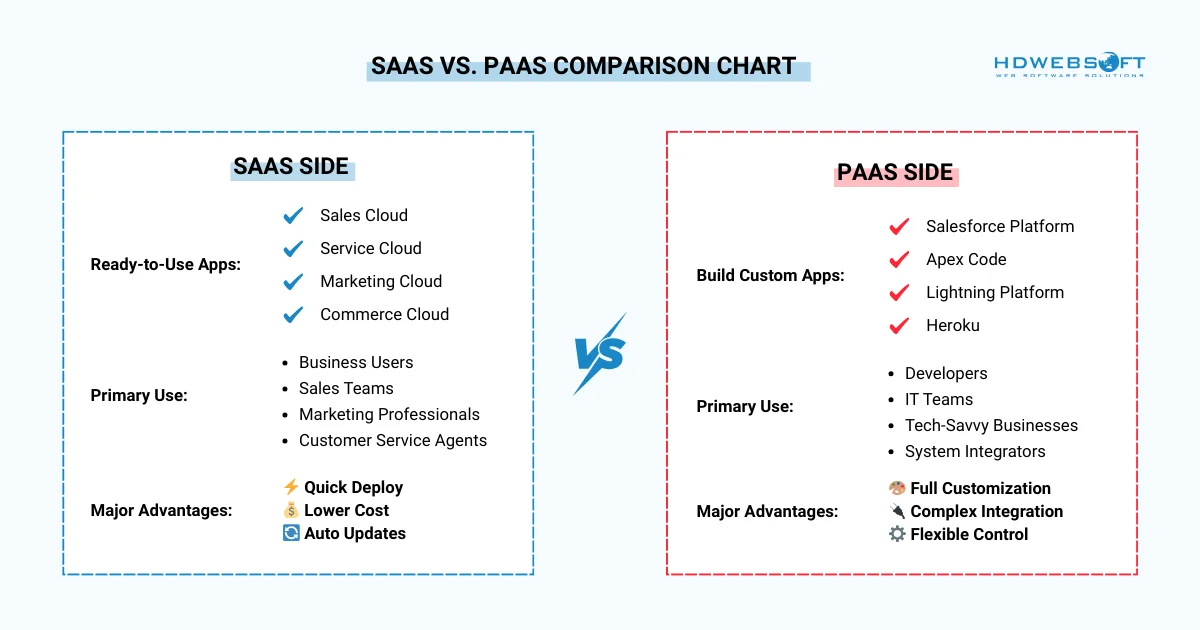
Salesforce uniquely delivers both SaaS and PaaS, creating a hybrid solution that addresses diverse business needs. The SaaS components provide ready-to-use applications like Sales Cloud and Service Cloud. The PaaS components offer development platforms for custom solutions. This dual nature distinguishes Salesforce from competitors who typically focus on one model or the other.
Which Approach Fits Your Business?
The choice between SaaS and PaaS depends entirely on how an organization uses the platform. A small business using Salesforce CRM to manage customer contacts and track sales opportunities is using a purely SaaS use case. A development team building a custom inventory management application on the Salesforce Platform is utilizing PaaS. Many enterprises use both: running standard Salesforce applications while developing custom apps that extend functionality for unique business requirements.
Choose SaaS offerings when standard business processes align with available applications, benefiting from faster deployment and lower costs. Opt for PaaS capabilities when facing unique requirements that can’t be met by off-the-shelf solutions, accepting longer development timelines in exchange for perfect-fit functionality.
Benefits of Salesforce as Both SaaS and PaaS
| Category | SaaS Benefits | PaaS Benefits |
|---|---|---|
| Ease of Use | Immediate access through web browsers with no installation required; intuitive interfaces designed for business users | Development environment ready to use with pre-built components and APIs that accelerate application creation |
| Cost Structure | Predictable subscription fees with no upfront infrastructure investment; pay only for users and features needed | Eliminates infrastructure costs for custom applications; pay for platform usage rather than servers and development environments |
| Maintenance | Automatic updates and patches managed by Salesforce; zero downtime for upgrades | Infrastructure maintenance handled by Salesforce; developers focus solely on application code |
| Scalability | Easily add or remove users and features as business needs change; instant scaling without performance impact | Applications automatically scale with demand; leverage Salesforce’s enterprise infrastructure |
| Security | Enterprise-grade security managed by Salesforce; compliance certifications maintained; regular security updates | Inherits Salesforce’s security model; built-in features for authentication, authorization, and encryption |
| Customization | Configuration options through point-and-click tools; limited to available features and settings | Complete control over application functionality; build exactly what business processes require |
| Development Speed | Immediate deployment; no development time required | Faster than traditional development due to pre-built services; reduced time-to-market for custom solutions |
| Integration | Pre-built integrations with popular business applications; APIs for custom connections | Seamless integration with Salesforce data and all Salesforce clouds; extensive API ecosystem |
| Updates | New features and improvements are delivered automatically three times per year | Platform enhancements benefit custom applications; APIs remain backward compatible |
Real-World Use Case Scenarios
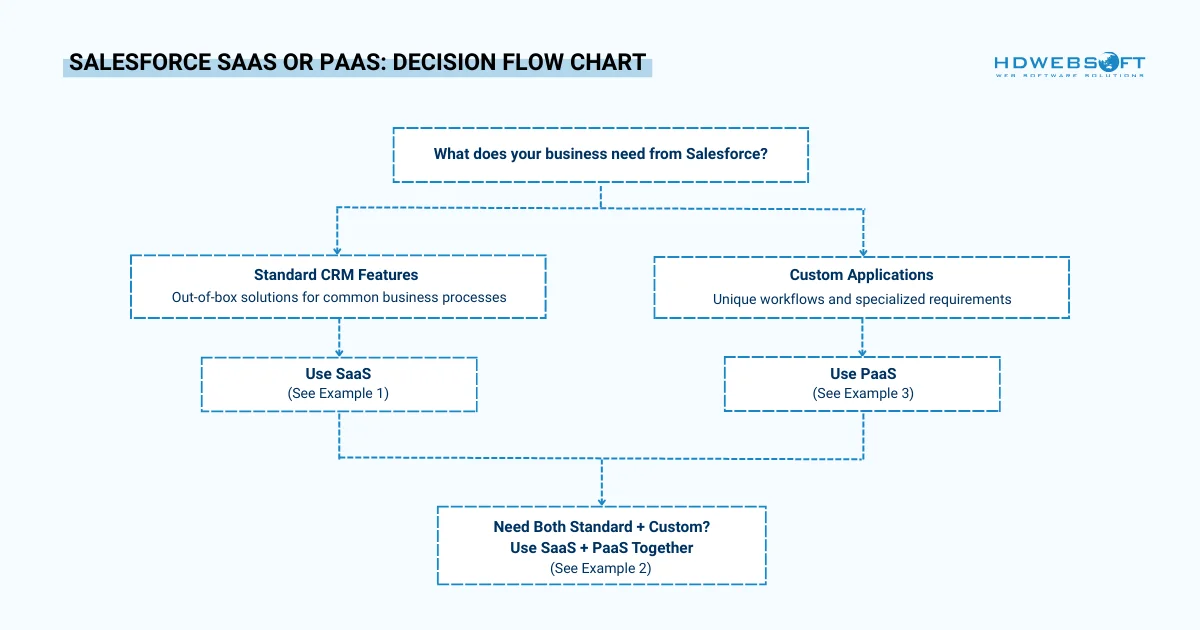
Example 1: Retail Company Leveraging Pure SaaS
A mid-sized retail company with 200 employees implemented Salesforce Sales Cloud and Commerce Cloud to modernize their customer experience. They previously struggled with disconnected systems — their e-commerce platform didn’t communicate with their sales database, creating customer service nightmares and missed sales opportunities.
After implementation, sales representatives gained real-time visibility into customers’ online browsing and purchase history, enabling personalized recommendations during phone calls. The marketing team used integrated data to create targeted email campaigns based on customer preferences and behaviors. Customer service representatives accessed complete order histories, resolving issues faster and improving satisfaction scores.
Example 2: Healthcare Provider Using Both SaaS and PaaS
A healthcare network with multiple hospitals and clinics needed both standard CRM functionality and specialized applications for patient management that complied with HIPAA regulations. They subscribed to Salesforce Health Cloud (SaaS) for basic patient relationship management. Simultaneously, they developed custom applications on the Salesforce Platform (PaaS) for appointment scheduling, lab result tracking, and care coordination.
The Health Cloud SaaS application gave care teams patient timelines, care plans, and communication tools out of the box. Their development team built custom PaaS applications that integrated with their electronic health records system, creating a unified view of patient information across all systems. These custom apps included automated appointment reminders, patient portal integration, and specialized workflows for different medical specialties.
Example 3: Technology Startup Building on PaaS
A fast-growing software startup needed a custom project management and billing system that integrated seamlessly with their customer data in Salesforce. Rather than purchasing separate project management software and attempting complex integrations, they chose to build a custom application entirely on the Salesforce Platform.
Their development team used Apex to create custom business logic for project tracking, resource allocation, and automated billing based on project milestones. Lightning Web Components provided a modern, responsive user interface that matched their brand identity. The custom application accessed all Salesforce CRM data natively, ensuring sales opportunities, customer information, and project details remained synchronized without additional integration work.
How HDWEBSOFT Can Help You
Navigating Salesforce SaaS and PaaS implementation requires expertise, strategic planning, and technical proficiency. HDWEBSOFT offers comprehensive Salesforce development services tailored to your unique requirements. Our team of certified Salesforce professionals brings extensive experience in both SaaS configuration and PaaS custom development.

Our commitment extends beyond initial implementation. We provide continuous support to ensure your Salesforce environment evolves with your business, incorporating new features, optimizing performance, and addressing emerging requirements. For more on managing Salesforce data effectively, see our Salesforce data management best practices.
Conclusion
Salesforce is both SaaS and PaaS. Its CRM products — Sales Cloud, Service Cloud, Commerce Cloud — deliver ready-to-use SaaS applications that revolutionized how businesses manage customer relationships. Its PaaS capabilities through the Salesforce Platform add remarkable versatility, enabling organizations to build custom applications that address unique business requirements.
This hybrid model positions Salesforce as a comprehensive cloud solution that adapts to diverse organizational needs. As cloud computing continues to reshape business technology, Salesforce’s dual nature ensures it remains at the forefront of digital transformation, helping organizations of all sizes compete effectively in an increasingly digital marketplace. Contact us to discuss your Salesforce project.
Frequently Asked Questions
What is the difference between Salesforce SaaS and Salesforce Platform?
Salesforce SaaS refers to ready-to-use applications like Sales Cloud, Service Cloud, and Commerce Cloud that businesses subscribe to on a per-user basis. Salesforce Platform (PaaS) is the development environment where developers build custom applications using Apex, Visualforce, Lightning Web Components, and Heroku. SaaS is for business users; the Platform is for developers.
What is the difference between Salesforce SaaS and PaaS?
SaaS delivers finished software over the internet with no installation or infrastructure management — users just subscribe and access it through a browser. PaaS provides a development framework with tools, servers, and databases so developers can build and deploy custom applications without managing the underlying infrastructure. Salesforce offers both: its CRM products are SaaS, and the Salesforce Platform is PaaS.
Can Salesforce be used as both SaaS and PaaS?
Yes. Many enterprises use both simultaneously. For example, a company might subscribe to Sales Cloud (SaaS) for standard CRM functionality while building a custom inventory management application on the Salesforce Platform (PaaS) that integrates natively with their CRM data. This hybrid approach lets organizations combine ready-to-use tools with tailored solutions.
What are the key PaaS components of Salesforce?
The key PaaS components are Apex (proprietary programming language for business logic), Visualforce (framework for custom user interfaces), Lightning Platform (component-based development tools including Lightning Web Components, App Builder, and Flow), and Heroku (polyglot platform supporting Ruby, Python, Node.js, Java, and PHP). Together they enable custom application development on Salesforce infrastructure.
Should my business choose Salesforce SaaS or PaaS?
Choose SaaS when standard business processes align with available applications like Sales Cloud or Service Cloud — this offers faster deployment and lower costs. Choose PaaS when you have unique requirements that off-the-shelf solutions cannot meet, accepting longer development timelines for custom functionality. Many businesses use both: SaaS for standard processes and PaaS for custom extensions.