
.NET has spent the last few years quietly rebuilding itself into a modern, unified, cross-platform stack — and the trends that define it in 2026 are less about new frameworks and more about a platform that finally ships coherently. If your last impression of .NET is the old .NET Framework of the 2010s, the platform you’d build on today looks very different: one runtime for web, desktop, and mobile, a yearly release train, first-class cloud-native tooling, and AI integration built into the ecosystem.
This is a practical look at the .NET development trends that actually matter now — what changed, why it matters, and what it means if you’re choosing a stack or maintaining a .NET product.
Key Takeaways
- The unified .NET platform is complete — one runtime and base class library across web, desktop, mobile, and cloud, with a predictable yearly STS/LTS release cadence.
- C# is evolving fast — primary constructors, collection expressions, and record types keep the language modern without breaking existing code.
- Cloud-native is now first-class — .NET Aspire, container support, and Native AOT make .NET a serious choice for microservices and serverless workloads.
- Blazor and MAUI extend C# beyond the backend — full-stack web UI and cross-platform mobile/desktop from one language and one skill set.
- AI integration is built in — Semantic Kernel, ML.NET, and Azure OpenAI support make .NET a practical platform for AI-powered products.
The .NET development trends that matter
Unified .NET platform — .NET 8/9/10 and the STS/LTS cadence
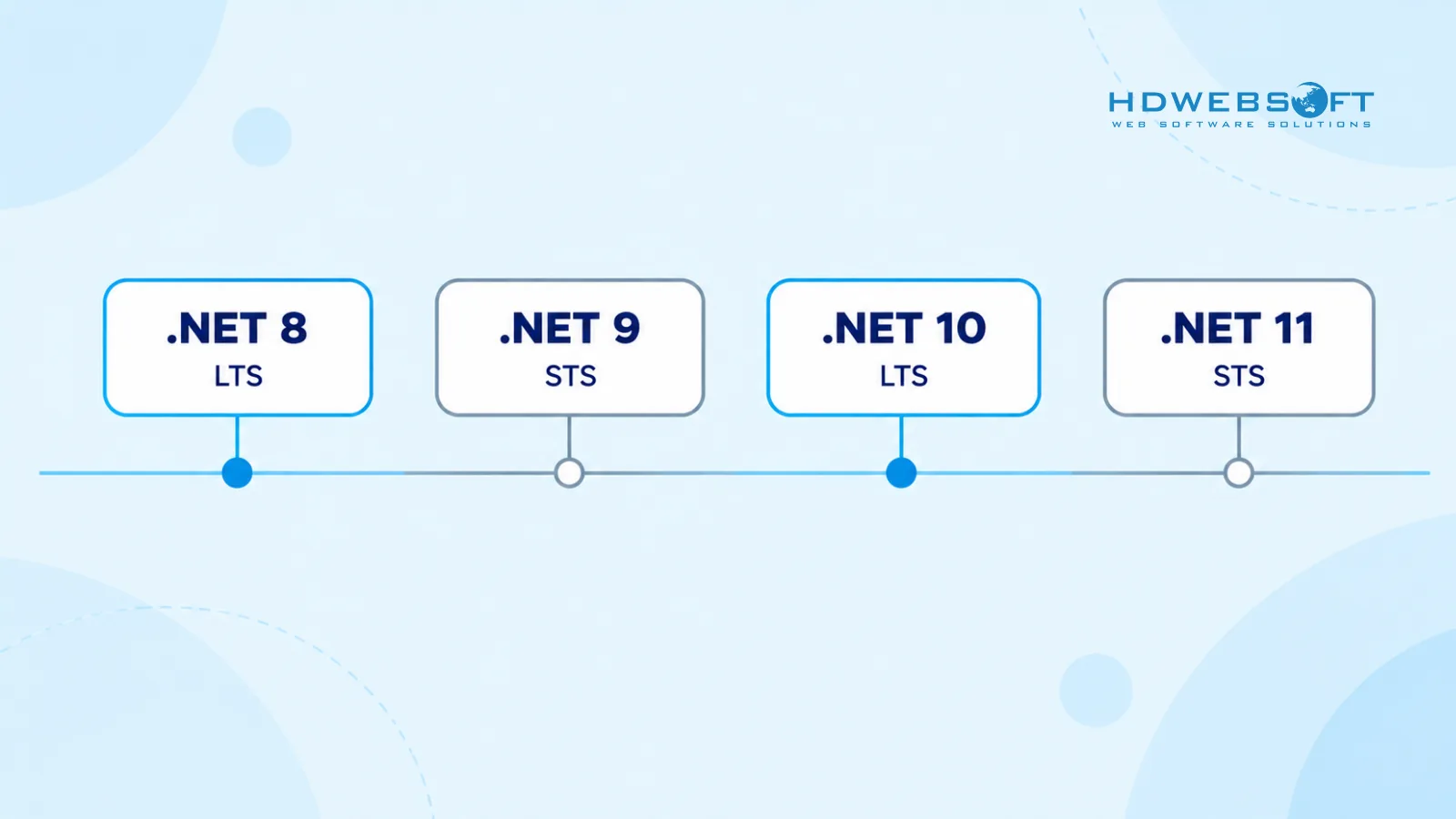
The unification strategy that started with .NET 5 is now finished: one runtime, one base class library, one SDK across web, desktop, mobile, and cloud. What replaced the old framework fragmentation is a predictable yearly release train — even-numbered versions like .NET 8 and .NET 10 are Long-Term Support (LTS) releases backed for three years, while odd-numbered versions like .NET 9 are Standard Term Support (STS) releases backed for 18 months.
For businesses, this cadence changes upgrade planning from a gamble into a routine. You can adopt an STS release to get new features early, or stay on LTS for stability — and the upgrade paths between them are documented and tooling-assisted. The old “which .NET is my app on?” problem that plagued the .NET Framework era is effectively gone.
C# keeps evolving — C# 12/13 and beyond
C# has shipped meaningful language improvements with every .NET release. Primary constructors reduce constructor boilerplate; collection expressions make initializing lists and arrays cleaner; record types give you immutable data models with value semantics in one line. File-scoped namespaces, pattern matching, and nullable reference types have made codebases safer and more readable by default.
The important part for teams: these changes are additive. A C# codebase from five years ago still compiles and runs on the modern runtime, and teams can adopt new language features incrementally rather than through a disruptive migration.
Cloud-native .NET — Aspire, containers, Native AOT
Cloud-native .NET is the trend with the biggest business impact. .NET Aspire is Microsoft’s opinionated stack for building observable, configurable distributed apps — it orchestrates multi-service applications locally, wires up service discovery, telemetry, and health checks by default, and makes cloud deployment predictable. For teams running microservices, Aspire removes a large chunk of the infrastructure plumbing that used to be hand-rolled.
Native AOT compilation publishes self-contained apps with startup times measured in milliseconds and memory footprints a fraction of traditional deployments — a genuine differentiator for serverless, containers, and edge workloads. Combined with first-class Docker support and efficient gRPC and minimal APIs, .NET is now a default-worthy choice for cloud-native backends, not a legacy option.
Blazor as full-stack web UI
Blazor lets developers build interactive web UIs in C# instead of JavaScript. With .NET 8’s unified render modes, a single Blazor app can mix server-side rendering, WebAssembly client-side interactivity, and streaming rendering — choosing per page or per component rather than per app. That flexibility removed Blazor’s biggest historical criticism: being forced to pick one rendering strategy upfront.
For teams already invested in .NET, Blazor means one language, one toolchain, and shared models across the stack. It’s not a JavaScript killer — teams with deep JS expertise and ecosystems will keep their stacks — but for .NET shops it’s the most productive full-stack option Microsoft has shipped.
.NET MAUI — cross-platform after Xamarin
Xamarin reached end of support in May 2024, and .NET MAUI is its successor: one codebase targeting iOS, Android, Windows, and macOS from a single project. MAUI inherits the unified .NET runtime, uses modern C# features, and integrates with Blazor through Blazor Hybrid — letting teams reuse web UI inside native app shells.
For businesses maintaining Xamarin apps, MAUI is the migration path; for new cross-platform products, it’s a credible alternative to Flutter and React Native when the team already writes C#.
AI integration — Semantic Kernel, ML.NET, Azure OpenAI
AI is the newest trend reshaping .NET development. Semantic Kernel is Microsoft’s orchestration SDK for building AI agents and LLM-powered features in C#; ML.NET covers classic machine learning — classification, forecasting, anomaly detection — in-process without a Python service; and Azure OpenAI integration gives .NET apps first-party access to frontier models with enterprise security.
Recent .NET releases added dedicated AI-friendly APIs, tokenizers, and embedding support to the base libraries. For product teams, this means AI features — chat, summarization, recommendations — can be added to a .NET application without leaving the ecosystem or hiring a separate Python team.
Security and performance as defaults
Modern .NET treats security and performance as platform defaults rather than opt-ins. ASP.NET Core ships with HTTPS, HSTS, and secure cookie defaults; built-in data protection, authentication, and authorization middleware cover the OWASP basics without third-party packages. On the performance side, .NET consistently ranks among the fastest mainstream web platforms in independent benchmarks, and each release narrows the gap on raw throughput and memory use.
The practical consequence: a default-configured modern .NET app is both fast and reasonably secure out of the box — teams have to actively work against the platform to ship something slow or insecure.
What these trends mean for your business
These trends translate into concrete business effects:
- Lower infrastructure costs — Native AOT and performance improvements mean smaller containers, faster cold starts, and less compute for the same workload.
- Faster delivery — unified tooling and Aspire’s opinionated defaults remove setup friction; teams spend time on product features instead of plumbing.
- Smaller, cheaper teams — one language (C#) covers backend, web UI, and mobile; you don’t need separate JavaScript, Python, and mobile specialists for a full product.
- Predictable maintenance — the STS/LTS cadence and tooling-assisted upgrades make staying current a scheduled activity, not a risky project.
- AI readiness — the AI stack is integrated, so adding intelligent features doesn’t mean rebuilding your architecture or hiring a parallel team.

.NET vs the alternatives
How does .NET stack up against the other mainstream choices?
- .NET vs Java — both are mature, strongly-typed enterprise platforms. Modern .NET generally wins on raw performance and cloud-native ergonomics; Java wins on ecosystem breadth in some enterprise niches. The detailed trade-offs are in our Java vs .NET comparison.
- .NET vs Node.js — Node wins on JavaScript ubiquity and frontend team reuse; .NET wins on raw CPU-bound performance, strong typing out of the box, and structured enterprise tooling.
- .NET vs Python — Python wins on data science and ML experimentation; .NET wins on production web services, desktop apps, and any workload where type safety and throughput matter.
The honest summary: for Microsoft-adjacent enterprises, Windows-heavy organizations, and teams that value a strongly-typed, batteries-included platform, .NET is the strongest it has ever been.
When .NET is the right choice — and when it isn’t
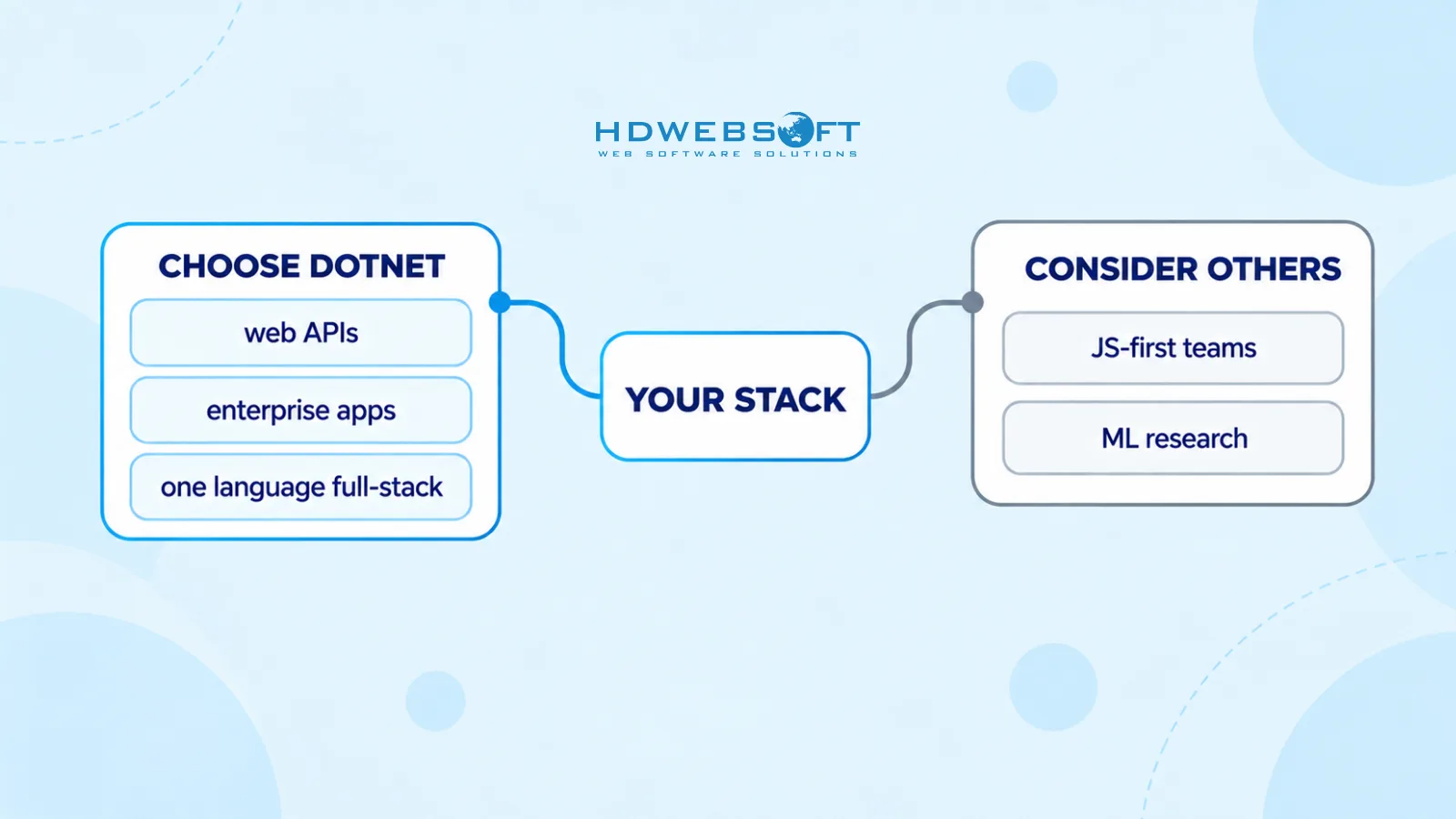
.NET is the right choice when:
- You’re building web APIs, SaaS products, or enterprise line-of-business applications that need performance and type safety
- Your organization already runs Microsoft infrastructure (Azure, Active Directory, Office ecosystem)
- You want one language and one team covering backend, web UI, and mobile
- Long-term support and predictable upgrades matter to your business
.NET might not be the right choice when:
- Your team is deeply invested in JavaScript and your product is a thin frontend over APIs — a full-stack JS framework may fit better
- Your core product is data science or ML research — Python’s ecosystem is still the default there
- You need a very lightweight scripting-level stack for a small site — a framework like Laravel or a static site generator may be simpler
Building a .NET team in 2026
The skills that matter in a modern .NET team have shifted with the platform. Backend engineers need ASP.NET Core, Entity Framework Core, and cloud-native patterns (containers, messaging, observability); frontend work increasingly means Blazor or TypeScript alongside a JS framework; mobile means MAUI; and AI features require Semantic Kernel or ML.NET familiarity on top of solid fundamentals.
The good news: the unified platform makes the talent pool more transferable than before — a strong C# backend engineer can become productive in Blazor or MAUI in weeks, not months. When evaluating candidates or partners, look for evidence of modern .NET (post-.NET 6) work, cloud-native experience, and testing discipline rather than years-with-.NET-Framework tenure.
If you’re staffing a .NET project, our Microsoft .NET developers for hire page covers how we assemble and run .NET teams.
Frequently Asked Questions
What is the current version of .NET?
.NET releases follow a yearly cadence with alternating support models: even-numbered versions like .NET 8 and .NET 10 are Long-Term Support (LTS) releases supported for three years, while odd-numbered versions like .NET 9 are Standard Term Support (STS) releases supported for 18 months. Teams planning production upgrades should target LTS versions.
Is .NET still relevant in 2026?
Yes — .NET is more relevant than it has been in years. The unified .NET platform, yearly release cadence, strong performance gains, Native AOT compilation, and Microsoft’s AI tooling investments have made modern .NET a competitive choice for web APIs, cloud services, desktop, and mobile applications.
What is .NET Aspire?
.NET Aspire is Microsoft’s opinionated, cloud-ready stack for building observable and configurable distributed applications. It simplifies local orchestration of multi-service apps, wires up service discovery, telemetry, and health checks by default, and makes deploying to cloud environments more predictable.
Is Blazor replacing JavaScript?
Blazor lets developers build interactive web UIs in C# instead of JavaScript, and with .NET 8’s unified render modes it can handle server-side, WebAssembly, and streaming rendering in one app. It’s a strong choice for .NET teams, but it complements rather than replaces JavaScript — teams with existing JS expertise or heavy JS ecosystems may still prefer it.
What replaced Xamarin?
.NET MAUI (Multi-platform App UI) replaced Xamarin. It carries the same promise — one codebase for iOS, Android, Windows, and macOS — with a more modern architecture, better performance, and tighter integration with the unified .NET platform. Xamarin support officially ended in May 2024.
How is AI being integrated into .NET?
Microsoft ships AI support through Semantic Kernel for orchestrating LLMs and plugins, ML.NET for classic machine learning in-process, and deep Azure OpenAI integration. .NET 9 and later include dedicated AI-friendly APIs and tokenizers, making it practical to add AI features to .NET apps without leaving the ecosystem.

Conclusion
The .NET development trends that matter in 2026 all point the same direction: a platform that has unified its runtime, modernized its language, embraced cloud-native and AI workloads, and made staying current a routine instead of a project. For teams choosing a stack — or modernizing an older .NET app — the platform is in its strongest position in two decades.
If you’re evaluating .NET for a product or modernization effort, our .NET development services team can help you assess the fit for your roadmap.