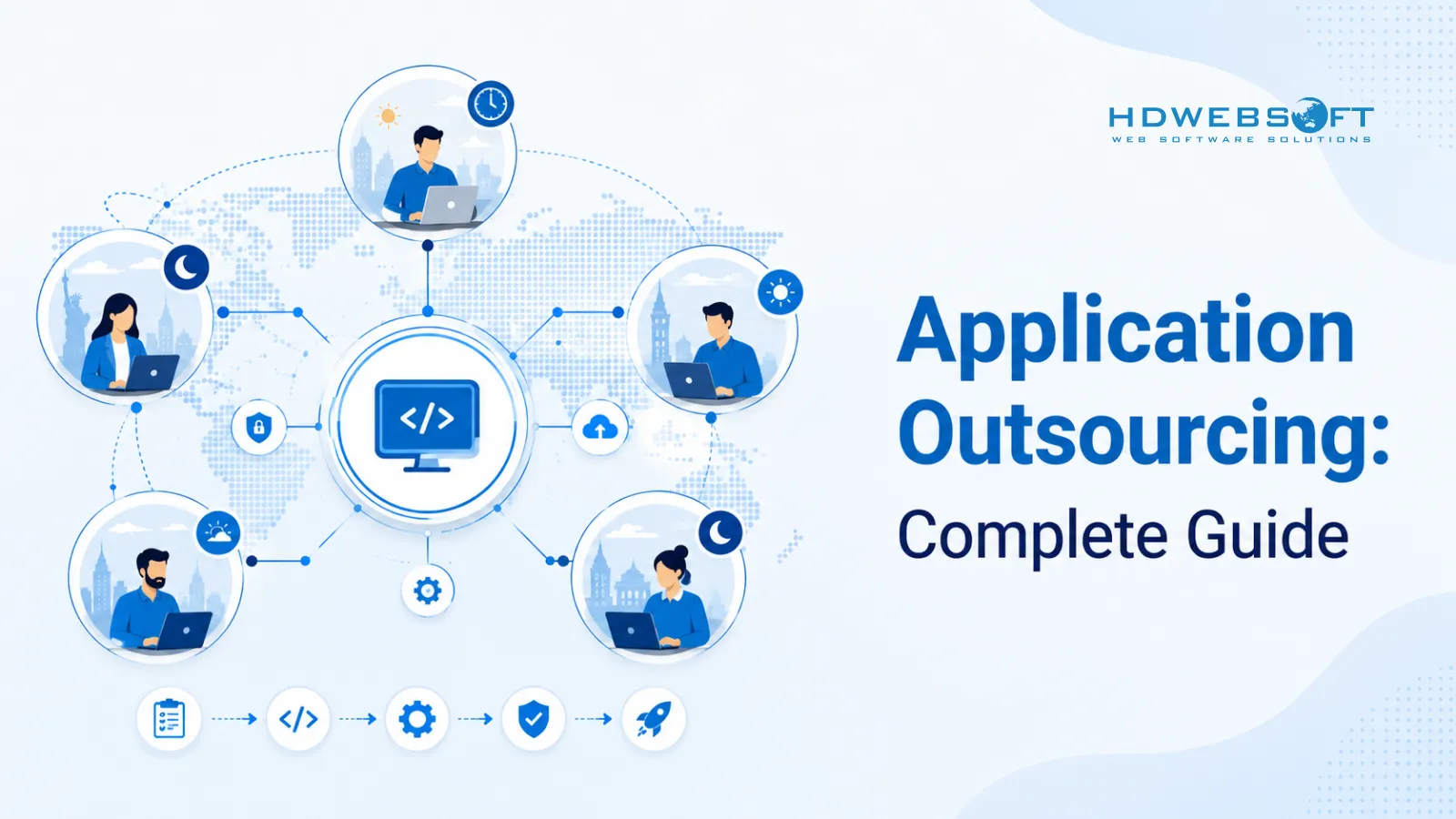
Application outsourcing is the strategic practice of delegating software application development, maintenance, and management to specialized external partners. In today’s competitive business landscape, companies across industries are leveraging this approach to accelerate innovation, reduce costs, and access cutting-edge expertise without the burden of building massive in-house teams.
This comprehensive guide explores why application outsourcing matters for modern businesses, the benefits and challenges you should consider, current trends shaping the industry, and how to choose the right partner for your specific needs.
Key Takeaways
- Application outsourcing delivers strategic value beyond cost reduction, including access to specialized expertise and faster time-to-market
- Success depends on clear communication protocols, proper vendor selection, and well-defined service level agreements
- Current trends emphasize AI-powered development, cloud-native solutions, and sustainable outsourcing practices
- A structured process from discovery through ongoing support reduces risks and ensures quality outcomes
- The right partner should align with your business goals, technical requirements, and cultural values
Why Application Outsourcing Matters Today
The Current Business Landscape
Modern businesses face unprecedented pressure to innovate rapidly while managing operational costs effectively. Technology evolves at an accelerating pace, with new frameworks, tools, and methodologies emerging constantly. Building and maintaining an in-house team capable of staying current across all relevant technologies is increasingly challenging and expensive.
At the same time, customer expectations for digital experiences continue to rise. Users demand seamless, feature-rich applications that work flawlessly across devices and platforms. This creates a significant gap between what businesses need to deliver and the resources they have available internally.
Strategic Benefits Beyond Cost Savings
While cost reduction remains a significant driver, the strategic value of application outsourcing extends far beyond the bottom line. Companies that partner with specialized providers gain access to:
- Specialized expertise in specific technologies and domains
- Scalable resources that can flex with project demands
- Faster time-to-market through established development processes
- Risk mitigation through proven methodologies and compliance frameworks
- Innovation access to emerging technologies and best practices
Key Benefits of Application Outsourcing
Application outsourcing offers numerous advantages that drive business value. Understanding these software outsourcing benefits helps organizations make informed decisions about their development strategies.
Cost Efficiency and ROI
Application outsourcing delivers significant cost advantages through multiple mechanisms. Companies eliminate expenses related to recruitment, training, salaries, benefits, and infrastructure for in-house teams. Instead, they pay for specific deliverables and services, often at competitive rates due to the provider’s economies of scale.
The ROI extends beyond direct cost savings. Faster development cycles mean products reach markets sooner, generating revenue earlier. Access to specialized expertise reduces costly mistakes and rework. Flexible scaling prevents over-provisioning during slow periods while ensuring capacity during peak demands.
Access to Specialized Expertise
Outsourcing partners maintain teams with deep expertise across specific technologies, industries, and methodologies. This includes expertise in:
- Modern frameworks and programming languages
- Cloud platforms and DevOps practices
- Security and compliance requirements
- Industry-specific regulations and standards
- Emerging technologies like AI and machine learning
- Custom software development services that ensure best practices
Rather than building this expertise internally, companies can tap into ready-made knowledge pools, accelerating development and ensuring best practices from day one.
Focus on Core Business Competencies
By outsourcing non-core activities like application development and maintenance, organizations can redirect their internal resources toward strategic initiatives that directly impact their competitive advantage. This focus enables:
- Better allocation of internal talent to high-value activities
- Faster decision-making on core business matters
- Improved product or service quality
- Enhanced customer satisfaction in primary business areas
Scalability and Flexibility
Business needs fluctuate based on market conditions, seasonal demands, and growth stages. Outsourcing provides the flexibility to scale resources up or down quickly without the overhead of hiring, training, or laying off staff.
This scalability is particularly valuable for:
- Startups experiencing rapid growth
- Companies launching new products or entering new markets
- Businesses with seasonal demand patterns
- Organizations undertaking digital transformation initiatives
Risk Mitigation and Compliance
Managing applications internally exposes companies to various risks, including security breaches, compliance violations, and technical failures. Specialized outsourcing partners typically have:
- Established security frameworks and certifications
- Experience with industry-specific compliance requirements
- Disaster recovery and business continuity plans
- Robust quality assurance processes
- Insurance and liability protections
This expertise helps mitigate risks that might otherwise overwhelm internal teams.
Challenges and How to Overcome Them
Communication and Collaboration
Working with external teams, especially across time zones and cultures, can create communication challenges. Language barriers, different working hours, and varying communication styles may lead to misunderstandings or delays.
Solutions:
- Establish clear communication protocols and expectations
- Use collaborative tools that support asynchronous communication
- Schedule regular check-ins at mutually convenient times
- Document requirements and decisions thoroughly
- Foster cultural understanding and relationship building
Quality Control
Ensuring outsourced work meets your quality standards requires active oversight. Without proper monitoring, issues may accumulate until they become costly to address.
Solutions:
- Define clear acceptance criteria and quality metrics
- Implement regular code reviews and testing protocols
- Establish service level agreements (SLAs) with measurable targets
- Create feedback loops for continuous improvement
- Maintain involvement in key decisions and milestones
Vendor Dependency
Relying heavily on external providers can create dependency, making it difficult to switch partners or bring work back in-house if needed.
Solutions:
- Maintain documentation and knowledge transfer processes
- Ensure code and assets remain your intellectual property
- Avoid vendor lock-in through technology choices
- Develop exit strategies as part of initial agreements
- Keep some internal technical capability for oversight
- Choose the right software outsourcing company from the start to minimize dependency risks
Data Security and Privacy
Sharing sensitive data with third parties raises legitimate security concerns, particularly for regulated industries or proprietary information.
Solutions:
- Conduct thorough security assessments before engagement
- Implement robust data protection agreements
- Use secure development environments and access controls
- Regularly audit security practices and compliance
- Limit data sharing to only what’s necessary for the project
The Application Outsourcing Process
Discovery and Planning Phase
Successful outsourcing begins with thorough discovery and planning. This phase involves:
- Needs assessment: Define clear business objectives, technical requirements, and success metrics
- Budget planning: Establish realistic budgets and timeline expectations
- Risk assessment: Identify potential risks and mitigation strategies
- Stakeholder alignment: Ensure all stakeholders understand and support the outsourcing decision
Vendor Selection Criteria
Choosing the right partner is critical to success. Key evaluation criteria include:
- Technical expertise: Relevant technology skills and industry experience
- Cultural fit: Alignment with your values and working style
- Communication capabilities: Language proficiency and responsiveness
- Financial stability: Long-term viability and reliability
- References and reputation: Past client experiences and market standing
- Security and compliance: Certifications and security practices
Onboarding and Integration
Once selected, effective onboarding sets the foundation for success:
- Contract finalization: Clear agreements on scope, timelines, and deliverables
- Team introduction: Establish relationships and communication channels
- Tool setup: Configure development, collaboration, and project management tools
- Knowledge transfer: Share relevant business context and technical information
- Process alignment: Agree on development methodologies and reporting structures
Development and Delivery Model
The ongoing development phase should follow established processes:
- Agile methodologies: Iterative development with regular feedback loops
- Progress tracking: Regular status updates and milestone reviews
- Quality assurance: Continuous testing and quality checks
- Change management: Structured process for handling requirement changes
- Risk monitoring: Ongoing assessment and mitigation of emerging risks
Ongoing Maintenance and Support
Application outsourcing often extends beyond initial development:
- Support agreements: Defined SLAs for maintenance and support
- Performance monitoring: Regular assessment of application performance
- Continuous improvement: Ongoing optimization and enhancement
- Knowledge management: Documentation and knowledge sharing
- Strategic alignment: Regular review of business alignment and value delivery
Current Trends in Application Outsourcing
AI-Powered Development and Automation
Artificial intelligence is transforming application development through:
- Automated code generation: AI tools that accelerate development and reduce manual coding
- Intelligent testing: AI-powered automation testing services that identify issues faster and more accurately
- Predictive analytics: Data-driven insights for better decision-making
- Chatbots and virtual assistants: AI-driven customer support and user assistance
These technologies enable faster development cycles, improved quality, and enhanced user experiences.
Cloud-Native and Serverless Solutions
Cloud adoption continues to accelerate, with emphasis on:
- Cloud-native architectures: Applications designed specifically for cloud environments
- Serverless computing: Eliminating infrastructure management overhead
- Microservices: Modular, scalable application architectures
- Multi-cloud strategies: Avoiding vendor lock-in and optimizing performance
Cloud-based outsourcing offers flexibility, scalability, and cost advantages over traditional on-premises approaches. Providers of software outsourcing services can help businesses leverage these cloud benefits effectively.
According to Deloitte’s Global Outsourcing Survey, companies that strategically outsource software development report significant improvements in project profitability due to optimized resource allocation and reduced overhead.
Nearshoring vs. Offshoring Dynamics
The balance between nearshoring and offshoring continues to evolve:
- Nearshoring growth: Increased preference for geographically closer partners
- Hybrid models: Combining nearshore and offshore resources for optimal balance
- Cultural alignment: Emphasis on cultural fit and communication effectiveness
- Time zone optimization: Strategic selection to support collaboration needs
Companies increasingly prioritize communication and cultural alignment over pure cost considerations.
Sustainability and Ethical Sourcing
Environmental and social responsibility are becoming key factors:
- Green computing: Partners with environmentally sustainable practices
- Ethical labor: Fair treatment of workers and ethical employment practices
- Social responsibility: Community engagement and corporate citizenship
- Transparency: Open reporting on sustainability and ethical practices
These factors influence partner selection and reflect growing stakeholder expectations.
DevOps and CI/CD Integration
Modern development practices emphasize:
- Continuous integration: Automated code integration and testing
- Continuous deployment: Automated release processes
- Infrastructure as code: Version-controlled infrastructure management
- Monitoring and observability: Comprehensive application monitoring
These practices enable faster, more reliable delivery and improved operational efficiency.
How to Choose the Right Application Outsourcing Partner
Evaluation Framework
Use a structured approach to evaluate potential partners:
- Define requirements: Clear technical, business, and cultural requirements
- Research options: Identify potential partners through referrals, research, and industry networks
- Initial screening: Basic fit assessment based on website, portfolio, and initial conversations
- Deep evaluation: Detailed assessment through proposals, references, and technical discussions
- Pilot project: Small initial engagement to validate fit before larger commitment
- Final selection: Comprehensive decision based on all evaluation factors
Key Questions to Ask
During evaluation, ask critical questions:
- Technical capabilities: What specific technologies and methodologies do you specialize in?
- Experience: Can you provide examples of similar projects and client references?
- Team structure: Who will work on our project and what are their qualifications?
- Communication: How will we communicate and how often?
- Quality assurance: What processes do you have to ensure quality?
- Security: What security measures and certifications do you have?
- Pricing: How is pricing structured and what’s included?
- Support: What ongoing support and maintenance do you provide?
Red Flags to Avoid
Be cautious of partners who:
- Lack transparency in pricing or processes
- Have poor communication or responsiveness
- Cannot provide relevant references or case studies
- Resist clear agreements or documentation
- Promise unrealistic timelines or results
- Lack relevant certifications or security measures
- Have high staff turnover or instability
Real-World Applications and Use Cases
Enterprise Application Modernization
Large enterprises leverage outsourcing to modernize legacy systems:
- Migration to cloud: Moving on-premises applications to cloud environments
- Technology updates: Upgrading outdated frameworks and languages
- Architecture improvements: Implementing microservices or modern architectures
- Integration projects: Connecting disparate systems and data sources
These initiatives improve performance, reduce maintenance costs, and enable new capabilities.
Startup MVP Development
Startups use outsourcing to accelerate product development:
- Rapid prototyping: Quick development of minimum viable products
- Technical validation: Proving technical feasibility before major investment
- Market testing: Fast iteration based on market feedback
- Team augmentation: Complementing internal teams with specialized skills
This approach enables startups to validate ideas quickly and efficiently.
Legacy System Migration
Organizations outsource complex migration projects:
- Platform migrations: Moving between technology platforms
- Data migration: Transferring and transforming data between systems
- Business logic preservation: Maintaining critical functionality during migration
- Testing and validation: Ensuring migrated systems work correctly
Specialized expertise reduces migration risks and accelerates timelines.
Industry-Specific Solutions
Different industries have unique outsourcing needs:
- Healthcare: HIPAA compliance, EHR systems, patient portals
- Financial services: Security, regulatory compliance, trading platforms
- Retail: E-commerce platforms, inventory systems, customer experience
- Manufacturing: IoT integration, supply chain systems, operational technology
Industry expertise ensures solutions meet specific requirements and regulations.
FAQ
What is application outsourcing and how does it differ from traditional software development?
Application outsourcing involves delegating software application development, maintenance, and management to external partners. Unlike traditional in-house development, outsourcing provides access to specialized expertise, scalable resources, and potentially lower costs while requiring effective vendor management and communication.
How much can companies save by outsourcing application development?
Savings vary significantly based on project scope, location, and engagement model. Companies typically report 30-60% cost reductions compared to in-house development when considering salaries, benefits, infrastructure, and training costs. However, total ROI includes factors like time-to-market acceleration and access to expertise beyond pure cost savings.
What are the main risks of application outsourcing and how to mitigate them?
Key risks include communication challenges, quality control issues, vendor dependency, and data security concerns. Mitigation strategies include establishing clear communication protocols, implementing rigorous quality assurance processes, maintaining documentation and knowledge transfer, and conducting thorough security assessments and compliance verification.
How long does it typically take to set up an application outsourcing partnership?
Setup timelines vary from a few weeks to several months depending on project complexity and partner selection process. Initial discovery and vendor selection typically takes 4-8 weeks, followed by onboarding and project setup of 2-4 weeks. Complex enterprise projects may require longer periods for thorough evaluation and contract negotiation.
What should I look for when choosing an application outsourcing provider?
Key criteria include relevant technical expertise, industry experience, cultural fit, communication capabilities, financial stability, strong references, security certifications, and clear pricing models. Look for partners who demonstrate understanding of your business goals, ask thoughtful questions, and propose realistic approaches rather than over-promising results.
Is application outsourcing suitable for startups and small businesses?
Yes, application outsourcing can be particularly valuable for startups and small businesses that need specialized expertise but lack resources to build large in-house teams. Outsourcing enables rapid development, flexible scaling, and access to senior talent that might otherwise be unaffordable. Success requires clear requirements, effective communication, and choosing partners experienced with smaller organizations.
Conclusion
Application outsourcing represents a strategic opportunity for businesses to accelerate innovation, access specialized expertise, and optimize costs while focusing on core competencies. Success requires careful partner selection, clear communication, and well-defined processes rather than treating outsourcing as a simple cost-reduction exercise.
The current landscape emphasizes AI-powered development, cloud-native solutions, and sustainable practices. Companies that approach outsourcing strategically—with clear objectives, robust vendor management, and focus on long-term value rather than short-term savings—can gain significant competitive advantages.
If you’re considering application outsourcing for your business, HDWEBSOFT can help you evaluate your options and develop a strategy aligned with your specific needs and goals. Our team combines technical expertise with business understanding to deliver solutions that drive real results.