Software teams are under pressure to release faster, fix issues earlier, and protect applications from increasingly complex security threats. This is why secure DevOps has become a practical priority for modern engineering teams.
In the past, developers focused mainly on building features. Security teams reviewed risks later, often near the end of the software development lifecycle. That approach no longer works well. Today’s applications rely on cloud services, APIs, open-source packages, CI/CD pipelines, AI coding tools, third-party integrations, and distributed teams. A single weak point can move quickly from development into production.
The DevOps skills gap is not only about a lack of cybersecurity specialists. It is also about whether developers, DevOps engineers, QA teams, and product teams understand how to build security into daily software delivery. NIST explains that DevSecOps practices are intended to address security continuously throughout all phases of the software development lifecycle, which means security can no longer sit outside the development process.
Why the Secure DevOps Skills Gap Matters
The secure DevOps skills gap matters because software security is now directly connected to business risk. When developers do not have enough security knowledge, vulnerabilities may be introduced during coding, missed during testing, or deployed through automated pipelines before security teams can respond.
IBM’s 2025 Cost of a Data Breach Report found that the global average cost of a data breach was USD 4.44 million. That number explains why secure software development can no longer be treated as an optional technical concern.
Security Is Now a Shared Responsibility
In a traditional model, security responsibility was often separated from development. Developers wrote code, operations teams deployed it, and security teams reviewed it later.
However, modern software delivery is too fast for that handoff model. CI/CD pipelines, infrastructure as code, automated deployments, and cloud-native architectures allow teams to release changes frequently. If security checks are delayed, risks can move through the pipeline quickly.
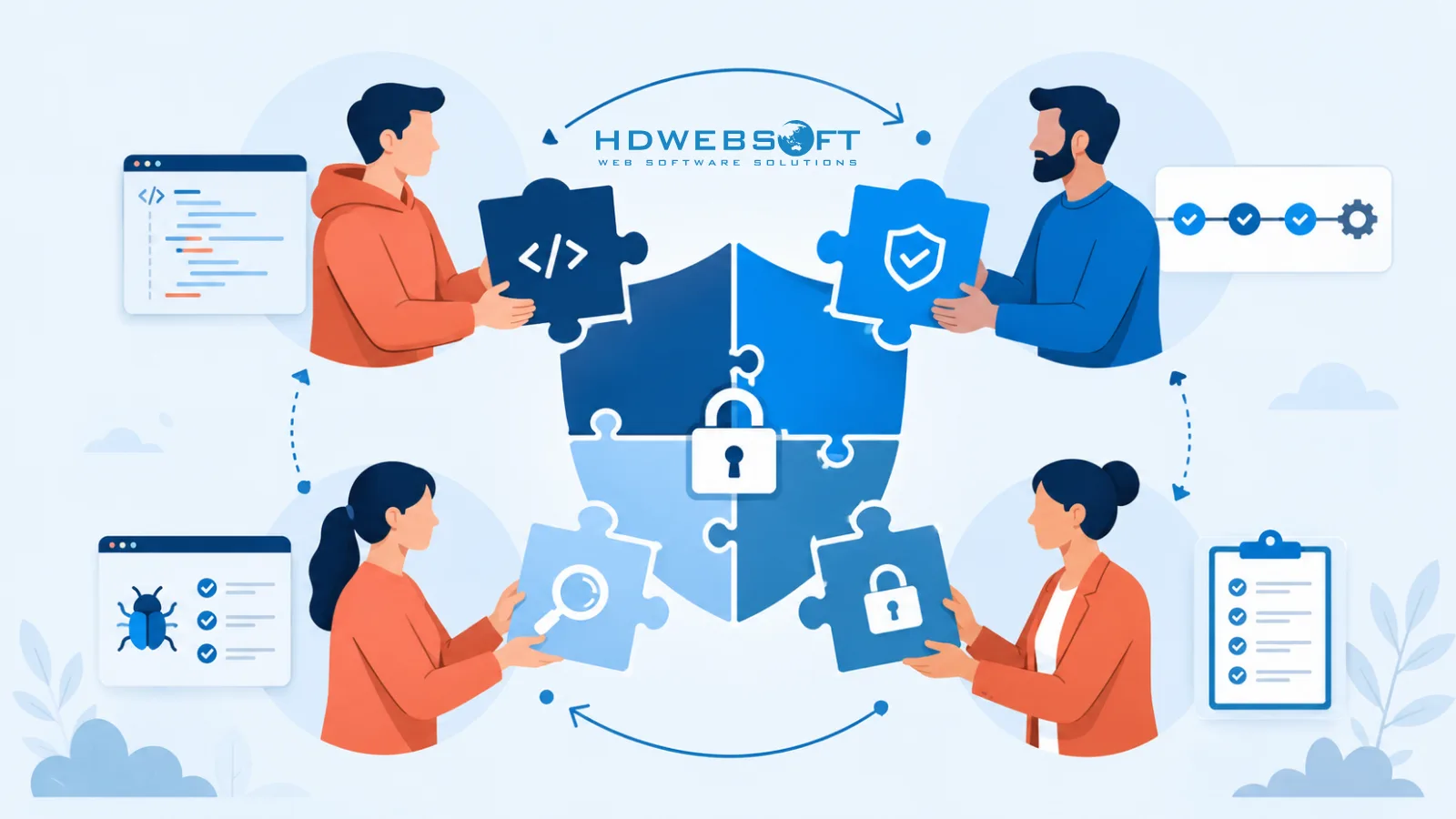
A stronger secure DevOps model gives every role a clear security responsibility. Developers need secure coding skills. DevOps engineers need pipeline and infrastructure security knowledge. QA teams need to understand security testing. Product owners need to define security-related acceptance criteria.
Cybersecurity Teams Cannot Cover Everything Alone
The developer security gap becomes more serious when organizations are already short on cybersecurity talent. ISACA’s 2025 State of Cybersecurity report found that 55% of cybersecurity teams are understaffed and 65% have unfilled cybersecurity positions. The same report also noted that 70% of respondents expect demand for technical cybersecurity contributors to rise.
This means companies cannot rely only on central security teams to catch every issue. Development teams need enough security awareness to prevent common risks earlier.
What Causes the Skills Gap?
The secure DevOps skills gap rarely happens because developers are careless. More often, it happens because security knowledge, delivery speed, business pressure, and tooling do not evolve at the same pace.
Education Often Misses Practical Security Work
Many developers graduate with strong programming knowledge but limited hands-on secure coding experience. They may understand algorithms, databases, and software design, but not enough about threat modeling, access control, dependency risks, secure API design, secrets management, or cloud security.
This creates a gap between what developers learn and what enterprises expect from them. In production environments, developers need to understand not only how to make software work, but also how software can fail, be abused, or expose sensitive data.
The Linux Foundation and OpenSSF addressed this broader issue in 2025 by releasing a Cybersecurity Skills Framework that provides guidance for roles including web and software developers, DevOps engineers, IT project managers, and platform architects. This is a useful direction because security skills should be role-specific, not limited to security specialists.
Security Tools Are Added Without Workflow Design
Many companies buy security tools before redesigning their workflows. As a result, developers may receive long vulnerability reports, noisy alerts, or unclear remediation advice. This can create frustration instead of better security.
In a mature secure DevOps environment, tools should help developers act earlier and faster. Static application security testing, software composition analysis, secret scanning, container scanning, infrastructure-as-code scanning, and dynamic testing should be integrated into the development pipeline with clear ownership.
The goal is not to block developers with more tools. The goal is to give them actionable feedback at the right time.
Ownership Is Often Unclear
Another common problem is unclear ownership. Developers may assume security teams own application security. Security teams may assume developers will fix issues once reported. Product teams may not include security requirements in user stories.
This creates delays and weak accountability.
A better ownership model is simple:
- Developers own secure coding and remediation.
- DevOps engineers own pipeline, deployment, and infrastructure controls.
- Security teams own standards, risk guidance, and complex threat analysis.
- QA teams help validate security-related behavior.
- Product teams define business and user-impact risks.
When responsibility is shared but unclear, security becomes everyone’s concern but no one’s priority. When responsibility is shared and clearly defined, security becomes part of normal delivery.
Building Security Skills Across the Team
Closing the secure DevOps skills gap requires more than one-time training. It needs continuous learning, practical tools, peer support, and a culture where security is treated as part of software quality.
Start With Secure Coding Fundamentals
Developers should first understand the most common security weaknesses that appear in modern applications. These include broken access control, injection, insecure authentication, sensitive data exposure, insecure design, vulnerable dependencies, misconfiguration, and weak logging.
OWASP released ASVS Version 5.0.0 in May 2025, giving teams an updated application security verification standard for web applications and web services.
For developers, secure coding training should cover:
- Input validation
- Authentication and authorization
- Session management
- API security
- Secure error handling
- Data encryption
- Dependency management
- Secrets management
- Logging and monitoring
- Secure design principles
These skills make secure DevOps more realistic because developers can prevent basic issues before they reach testing or production.
Teach Security Through Real Project Scenarios
Generic security training is often too abstract. Developers learn better when training connects to the systems they actually build.
For example, a team building a fintech application should practice secure payment flows, role-based access control, audit logs, and data privacy. A team building a healthcare platform should focus on sensitive health data, consent, compliance, access boundaries, and secure integrations.
Scenario-based learning helps developers understand the impact of security decisions. It also makes training easier to remember because it connects security concepts to familiar code, user flows, and business risks.
Make Security Part of Code Review
Code review should not focus only on style, performance, or logic. It should also check whether the code introduces security risk.
Reviewers can look for issues such as:
- Missing authorization checks
- Unsafe data exposure
- Weak input validation
- Hardcoded secrets
- Insecure API responses
- Overly broad permissions
- Unsafe dependency usage
- Poor error handling
- Missing logging for sensitive actions
This helps make secure DevOps a normal engineering habit instead of a separate activity.
How to Close the Gap
Businesses need a practical plan to build security capability across development teams. The goal is not to turn every developer into a full-time security expert. The goal is to make security knowledge available, repeatable, and easy to apply during daily delivery.
1. Create Role-Based Security Training
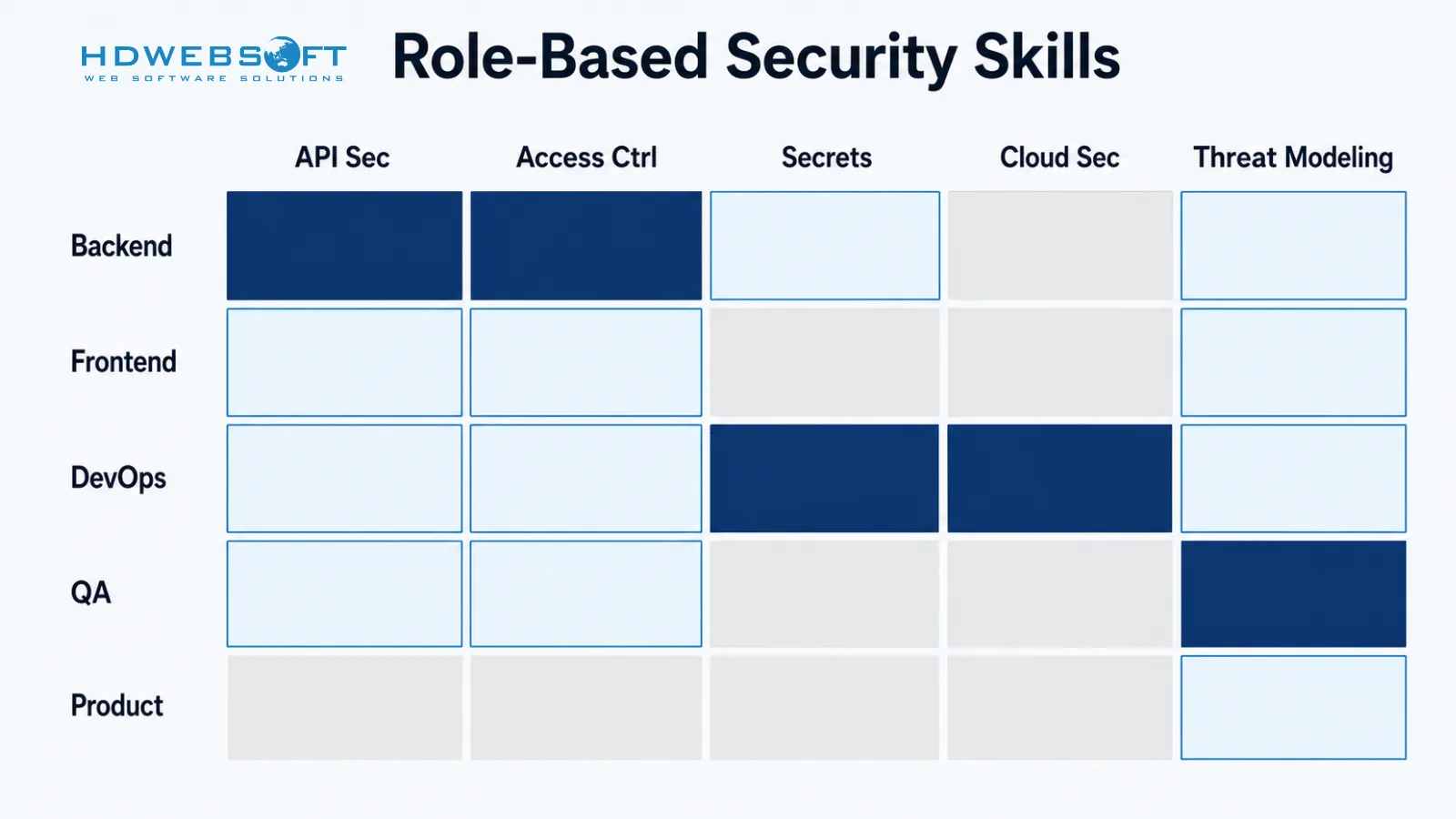
A backend developer, frontend developer, DevOps engineer, QA engineer, and product owner do not need the exact same security training. Each role needs the security knowledge that matches its responsibilities.
For example:
- Backend developers need API security, access control, data validation, and dependency security.
- Frontend developers need XSS prevention, secure session handling, and safe data exposure practices.
- DevOps engineers need secrets management, CI/CD security, infrastructure security, and cloud permissions.
- QA engineers need security test cases, abuse cases, and regression validation.
- Product owners need risk awareness and security acceptance criteria.
Role-based training makes secure DevOps easier to adopt because it avoids overwhelming every team member with irrelevant material.
2. Integrate Security Scanning Into CI/CD Pipelines
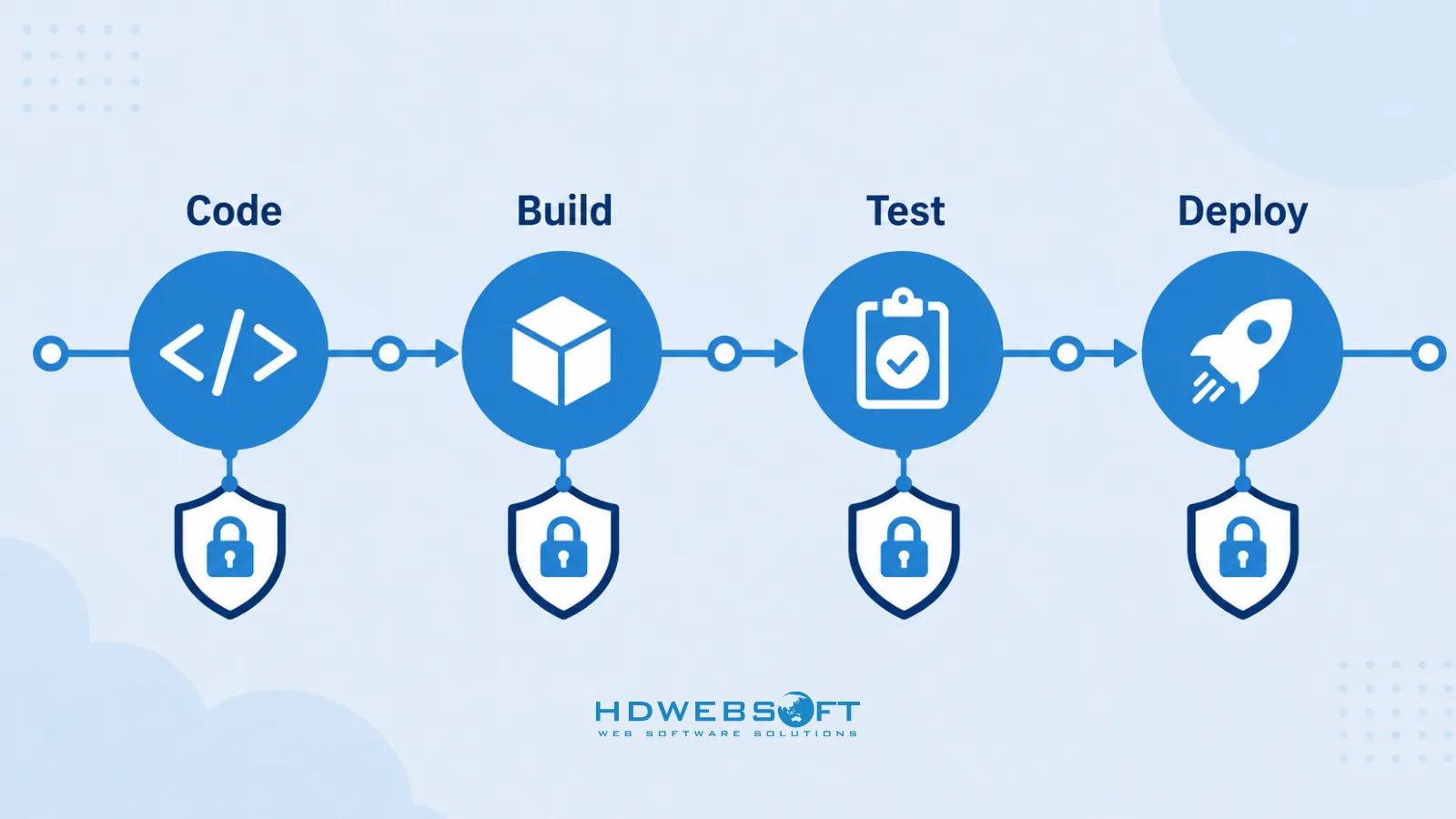
Security checks should be built into the development workflow. If security tools only run at the end of the project, teams may discover issues too late and face expensive rework. A well-structured DevOps implementation roadmap should treat security scanning as a core milestone, not an afterthought.
In a modern pipeline, security scanning can include:
- Static application security testing
- Dependency vulnerability scanning
- Secret detection
- Container image scanning
- Infrastructure-as-code scanning
- API security testing
- Dynamic application security testing
- License compliance checks
When automated delivery flows push changes to production without early security checks, even small issues can spread quickly. This is why security automation must be part of the delivery pipeline, not a separate final step.
However, pipeline security should be designed carefully. Not every finding should block every release. Teams should define severity levels, exception rules, remediation timelines, and escalation paths.
3. Build a Security Champions Program
A security champions program gives each development team one or more people who act as the bridge between engineering and security.
Security champions do not replace the security team. Instead, they help bring practical security knowledge into sprint planning, code review, threat discussions, and release preparation.
A strong security champion may help with:
- Reviewing security-sensitive stories
- Explaining secure coding standards
- Helping developers understand scanner results
- Supporting threat modeling sessions
- Sharing lessons from incidents
- Coordinating with security specialists
- Encouraging better security habits within the team
This model works well for secure DevOps because it brings security closer to the team without slowing delivery through a centralized bottleneck.
4. Add Threat Modeling Earlier in the SDLC
Threat modeling helps teams think about how a system could be attacked before it is built. It is especially useful for new features, APIs, authentication flows, payment systems, AI features, and integrations with third-party services.
Threat modeling does not need to be heavy. Even a short discussion can help teams identify risks such as:
- Who can access this feature?
- What data is exposed?
- What could an attacker abuse?
- What happens if an API is called too many times?
- What secrets or credentials are involved?
- What logs are needed for investigation?
- What controls should be added before release?
This makes DevOps more proactive. Instead of finding every issue after coding, teams can reduce risk during design.
5. Use AI Carefully in Development and Security
AI coding tools are changing software development, but they also create new security concerns. Developers can use AI to generate code, write tests, explain vulnerabilities, review pull requests, or summarize security findings. However, AI-generated output still needs human review.
The Stack Overflow 2025 Developer Survey found that 84% of respondents are using or planning to use AI tools in their development process, and 51% of professional developers use AI tools daily.
This matters because AI can improve speed, but it can also increase the risk of insecure generated code, data exposure, and weak governance. Developers need guidance on what code can be shared with AI tools, how generated code should be reviewed, and how AI features should be secured before release. For a deeper look at AI-related security risks, see our guide on LLM security for agentic AI.
For secure DevOps, AI should be treated as an assistant, not an authority.
What Secure DevOps Looks Like in Practice
A mature DevOps process is not defined by one tool or one training course. It is defined by how consistently security is integrated into daily delivery.
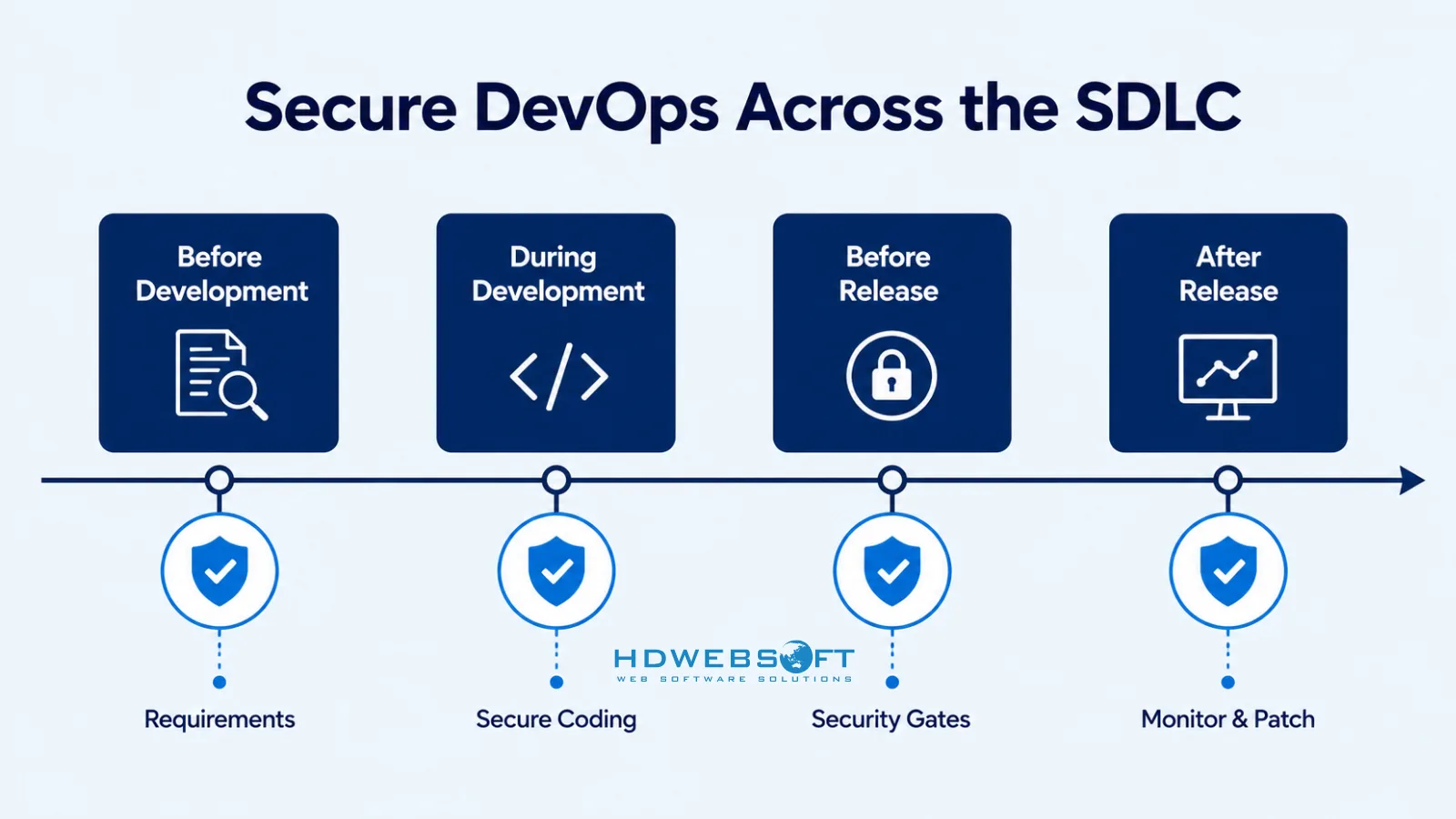
Before Development
Before coding begins, teams should clarify security requirements, user permissions, data sensitivity, regulatory needs, and possible abuse cases. Security should appear in user stories and acceptance criteria when relevant.
This early discussion helps teams avoid vague requirements such as “make it secure.” Instead, they can define specific behaviors, such as who can access a feature, what data should be masked, and what actions should be logged.
During Development
During development, teams should follow secure coding standards, use dependency checks, protect secrets, review code carefully, and run automated tests. Developers should receive feedback while they are still working on the feature, not weeks later.
This is where the secure DevOps skills gap often becomes visible. If developers do not understand the scanner output, ignore alerts, or lack time to fix issues, tools alone will not improve security.
Before Release
Before release, teams should review high-risk changes, verify critical security controls, check pipeline results, validate access control, and confirm that monitoring is ready. High-severity issues should have clear remediation rules.
Security gates should be strict enough to reduce risk but practical enough to support delivery. A useful release process should distinguish between critical vulnerabilities, medium-risk issues, accepted risks, and items that can be fixed after release.
After Release
After release, teams should monitor logs, respond to incidents, patch dependencies, review vulnerabilities, and learn from production issues. Security is not complete when the application goes live.
Post-release learning helps teams improve training, update secure coding standards, tune security tools, and prevent similar issues in future development cycles.
How Businesses Should Measure Progress
To improve the secure DevOps skills gap, organizations should measure both technical and cultural progress. Metrics help teams understand whether security is becoming part of the workflow or staying as a separate compliance activity.
Technical Metrics
Useful technical metrics include:
- Number of high-severity vulnerabilities found before production
- Mean time to remediate vulnerabilities
- Percentage of repositories with secret scanning enabled
- Percentage of critical dependencies patched on time
- Percentage of releases with required security checks
- Number of production incidents linked to coding or configuration issues
- False positive rate from security scanners
- Percentage of applications covered by security testing
These metrics show whether teams are reducing security risk earlier in the development lifecycle.
Team and Process Metrics
The secure DevOps skills gap is also a people and process issue, so businesses should measure team readiness as well.
Useful process metrics include:
- Number of teams with trained security champions
- Security training completion by role
- Developer satisfaction with security tools
- Number of threat modeling sessions completed
- Percentage of security issues fixed within SLA
- Percentage of user stories with security acceptance criteria when needed
- Time needed to clarify security ownership
- Frequency of security knowledge-sharing sessions
These metrics help leaders see whether security knowledge is spreading across the organization.
Common Mistakes That Keep the Skills Gap Open
Many companies try to improve application security but still struggle because their actions do not address the real causes of the secure DevOps skills gap.
Treating Security as a Final Review
If security checks happen only before release, teams will discover issues too late. This creates pressure, conflict, and rework. Security needs to move earlier into planning, coding, testing, and deployment.
Overloading Developers With Tool Alerts
Too many alerts can make developers ignore security tools. Teams should tune scanners, prioritize high-risk findings, and provide clear remediation guidance.
Giving Everyone the Same Training
Generic training is easy to organize but often less effective. Developers, QA engineers, DevOps engineers, and product owners need training that matches their actual responsibilities.
Ignoring Cloud and Pipeline Security
Modern application risk is not only inside application code. It can also come from misconfigured infrastructure, exposed secrets, weak pipeline permissions, vulnerable containers, and poor access control.
Using AI Without Governance
AI tools can help development teams, but they should not be used without rules. Teams need policies for data sharing, generated code review, security validation, and AI-assisted development workflows.
Final Thoughts
The secure DevOps skills gap is no longer a narrow training issue. It is a business, engineering, and security challenge. Modern software teams need to move fast, but they also need to build systems that are secure, reliable, and resilient.
Closing this gap requires practical training, better workflow design, automated security checks, security champions, threat modeling, and responsible AI usage. Most importantly, it requires a culture where security is treated as part of software quality.
HDWEBSOFT provides DevOps services and cybersecurity services for businesses that want to build secure, scalable, and reliable software delivery processes. As an ISO 27001 certified company, we apply the same security standards to our own delivery that we recommend to our clients. With the right strategy, DevOps security can help teams reduce risk without slowing innovation.
FAQs About Secure DevOps
What is secure DevOps?
Secure DevOps is an approach that integrates security into DevOps practices. It helps teams build, test, deploy, and operate software with security controls included throughout the software development lifecycle.
What is the secure DevOps skills gap?
The secure DevOps skills gap refers to the difference between the security knowledge development teams need and the security knowledge they currently have. It often includes gaps in secure coding, CI/CD security, cloud security, dependency management, and threat modeling.
Why do developers need DevOps security skills?
Developers need security skills because many vulnerabilities are introduced during coding, configuration, dependency management, or API design. Security teams cannot catch every issue after development is finished.
What causes the secure DevOps skills gap?
The skills gap in securing DevOps is usually caused by limited secure coding education, unclear ownership, fast delivery pressure, poor workflow design, noisy security tools, and a lack of role-based training.
How can companies train developers in secure DevOps?
Companies can train developers through secure coding courses, project-based workshops, threat modeling sessions, code review guidance, security champions programs, and hands-on remediation practice.
What tools support DevOps security?
Common tools include static application security testing, software composition analysis, secret scanning, container scanning, infrastructure-as-code scanning, dynamic testing, API security testing, and CI/CD quality gates.
Is secure DevOps the same as DevSecOps?
They are closely related. DevSecOps is the common industry term for integrating security into development and operations. Secure DevOps is often used to describe the same goal in a more readable way: making DevOps practices secure by design.
How does AI affect secure DevOps?
AI can help developers write code, generate tests, review issues, and summarize security findings. However, AI also introduces risks such as insecure generated code, data exposure, and weak governance. Human review remains essential.
What is the best first step for improving DevOps security?
The best first step is to identify where security issues currently enter the software lifecycle. After that, teams can prioritize role-based training, CI/CD security checks, and security ownership for the highest-risk areas.