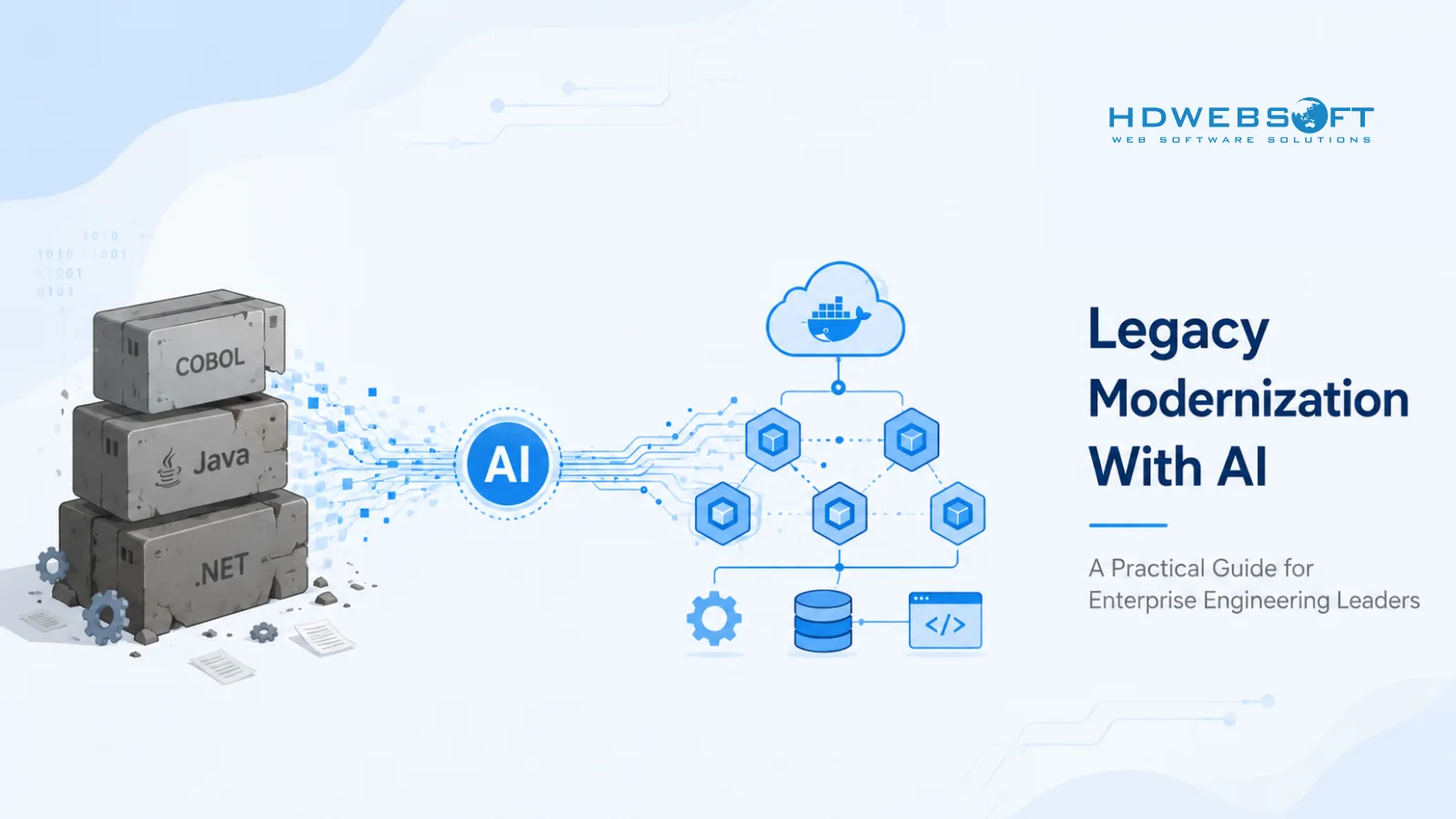
Legacy modernization with AI uses large language models and code agents to accelerate code understanding, refactoring, migration, and test generation for aging codebases, while senior engineers retain ownership of architecture, security, and release decisions. For enterprises sitting on decades of COBOL, Java, .NET, or PHP, that distinction matters. AI does not modernize a system on its own. It changes how fast a skilled team can do it, and how much of the painful manual work can be offloaded.
The pressure is real. HFS Research estimates the Global 2000 are carrying $1.5–2 trillion in accumulated tech debt, and despite nearly 30% of IT budgets going to modernization, only three in ten organizations have modernized their core applications. Cognizant’s 2025 analysis adds that 85% of senior leaders have serious concerns about their current tech estate’s ability to support AI, yet 79% will retire less than half of their tech debt by 2030. The gap between intent and execution is where most enterprises are stuck.
This guide is built on the same foundation as our deeper AI augmented software development primer. Here we focus specifically on legacy codebases: what AI actually does well, where humans must lead, a pragmatic six-step process, the risks enterprise leaders must govern, and when it makes sense to bring in an AI-augmented modernization partner.
What Is Legacy Modernization With AI?
Legacy modernization with AI is the practice of combining large language models and AI code agents with senior engineers to understand, refactor, migrate, and test aging codebases faster than manual methods allow. The AI handles pattern-heavy, repetitive, or documentation-sparse work. Engineers own architecture, business logic, security, and what ships to production.
The key word is augmented, not automated. An AI can read 50,000 lines of undocumented PHP and produce a module map, suggest a refactor, or generate characterization tests for a function nobody has touched since 2011. A senior engineer still decides whether that refactor is safe, whether the tests capture the right intent, and whether the change can ship without breaking a downstream integration that exists only in someone’s retirement notes. This is what separates disciplined AI-assisted legacy code modernization from reckless automation.
This is the same distinction that defines AI-augmented software engineering more broadly. The AI accelerates the work. The engineer owns the outcome. Teams that forget this distinction are the ones that end up with AI-generated bugs in production that nobody can explain.
Why AI Changes the Economics of Legacy Modernization
For decades, modernizing a legacy system meant a painful trade-off. You either kept maintaining old code with a shrinking pool of developers who understood it, or you committed to a multi-year rewrite that drained budget and carried a high risk of failure. The cost of standing still is no longer hypothetical. Pega’s 2025 research, conducted by Savanta, estimates that the average global enterprise wastes more than $370 million annually due to technical debt. A significant portion of this cost is associated with legacy transformation efforts, including the time required to complete traditional modernization projects and the losses from unsuccessful transformation initiatives.
AI shifts this economics in three concrete ways. First, it compresses the understanding phase. Instead of a new engineer spending months reading undocumented code to build a mental model, an AI agent can ingest the codebase, produce a module map, and answer questions like “what does this service do” or “which functions touch the customer table” in hours. Second, it accelerates the safety-net phase. Generating characterization tests for code that has no tests is one of the highest-leverage uses of AI in modernization, because it lets engineers refactor with confidence instead of fear. Third, it speeds up the mechanical refactoring phase. Renaming, extracting functions, removing dead code, and modernizing syntax are pattern-heavy work that AI handles well, freeing senior engineers to focus on the architecture and business logic decisions that actually require human judgment.
The business case is straightforward. Every month a legacy system stays in place is a month your team cannot ship the features the business actually wants. HFS Research reports that 80% of enterprise leaders believe AI will improve modernization outcomes, but only one in five are scaling AI across multiple functions. The opportunity right now is not in waiting for AI to mature further. It is in putting disciplined AI-augmented engineering to work on the parts of your codebase where the risk is controllable.
Where AI Actually Helps in Legacy Modernization (and Where It Doesn’t)
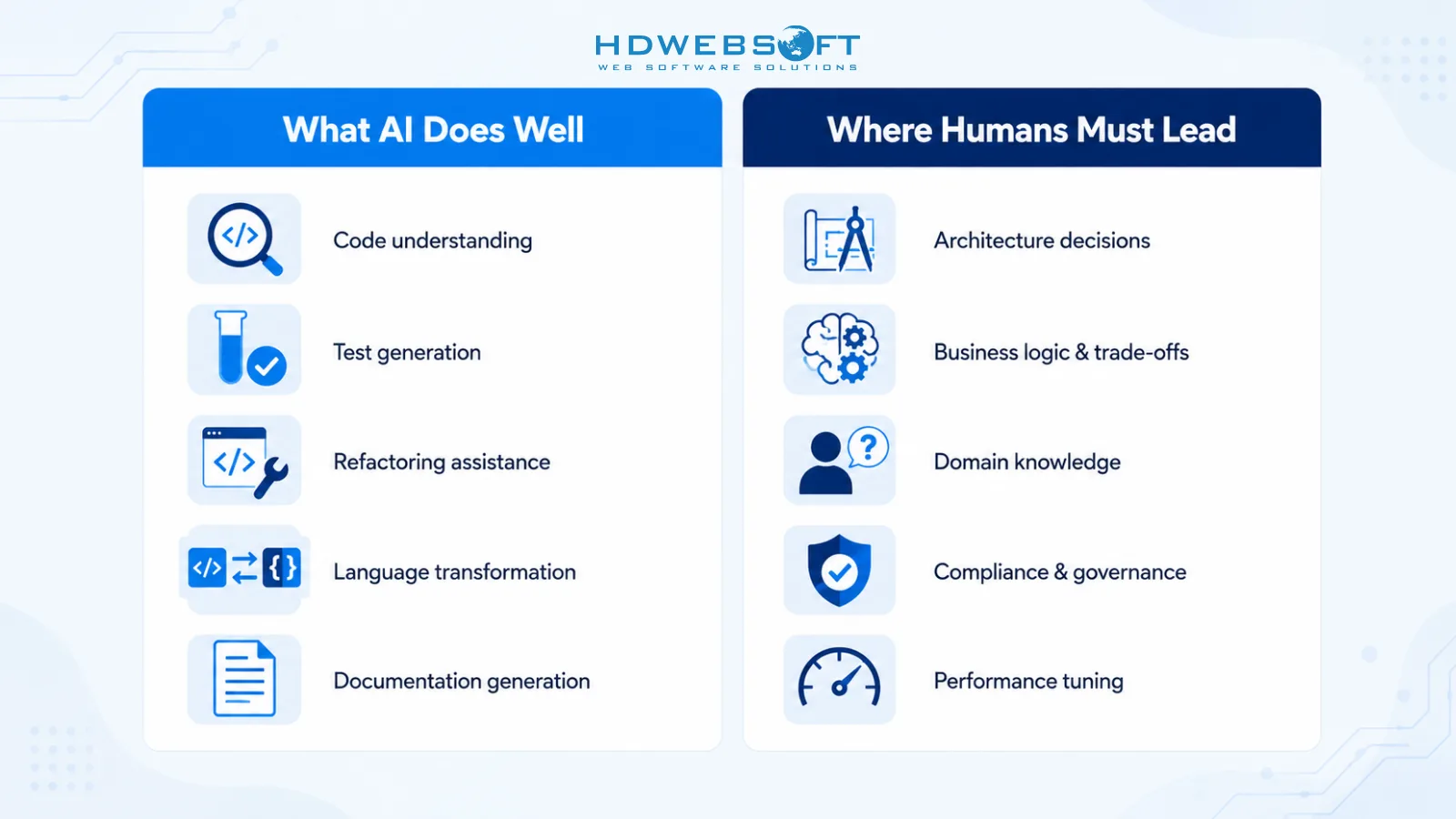
Not every part of a legacy modernization effort benefits equally from AI. Knowing the boundary is what separates a program that ships from one that stalls.
What AI Does Well
- Code understanding and explanation. AI can read undocumented or sparsely documented code and produce plain-language summaries of what a module, function, or service does. This is especially valuable when the original authors have left.
- Test generation. AI can generate unit and characterization tests for code that has none, giving engineers a safety net before any refactor begins.
- Mechanical refactoring. Renaming, extracting functions, removing duplicate logic, modernizing deprecated syntax, and gleaning dead code are pattern-heavy tasks where AI is reliable and fast.
- AI-assisted language and framework transformation. AI can translate code from one language or framework to another, for example COBOL to Java, PHP to Node.js, or .NET Framework to .NET 8. This is AI-assisted transformation, not automatic translation. Engineers must still validate architecture, business logic, integrations, and runtime behavior. The AI produces a candidate; the team reviews, adjusts, and owns the result.
- Documentation generation. AI can produce API docs, architecture notes, and inline comments from existing code, which is critical when the only living documentation has been a retiring developer’s memory.
Where AI Struggles and Humans Must Lead
- Architecture decisions. Where to draw microservices boundaries, how to split a monolith, what data model to adopt, and whether to rewrite versus rehost are judgment calls that require business context AI does not have.
- Implicit business logic. Logic that is spread across decades of patches, workarounds, and “we did it this way because of the 2008 compliance change” decisions is hard for AI to reconstruct without someone who knows the history.
- Domain knowledge that lives in people. If the only person who understands why a certain batch job runs in a specific order retired two years ago, AI cannot call them.
- Compliance, security, and data migration review. AI can flag issues and explain findings, but the final accountability for regulated industries, PII handling, and schema migrations with production data belongs to engineers and reviewers.
- Performance tuning on real production traffic. AI can suggest optimizations, but validating them against real load, real data shapes, and real failure modes is a human-led activity.
The practical takeaway: use AI to compress the work that is pattern-heavy and well-bounded. Use senior engineers for the decisions that are context-heavy and consequential. Modernization programs that try to push AI past its actual boundary are the ones that produce confident-looking but wrong code. AI code refactoring for legacy applications works best when the scope of each change is bounded, the safety net is in place, and a senior engineer can confidently explain why the change is safe.
A Pragmatic Process: How to Modernize Legacy Code With AI
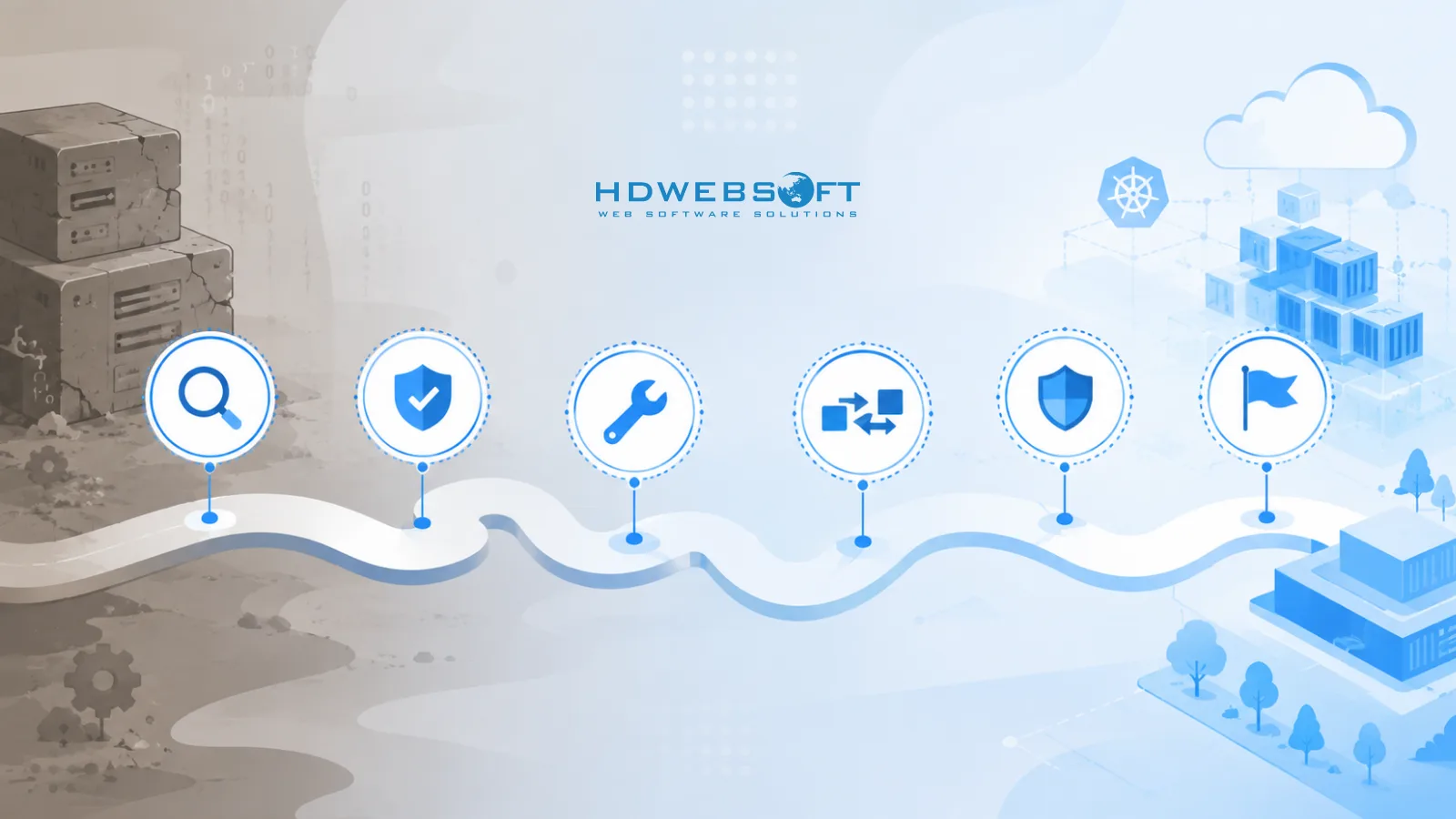
A disciplined process is what turns AI from a novelty into a reliable modernization accelerator. The six steps below are the sequence we recommend for enterprise codebases. They are not rigid; adapt the order and depth to your risk profile.
1. Codebase Assessment and Knowledge Extraction
Start by giving an AI agent or code-aware tool access to the codebase so it can ingest, index, and produce a structural map. The output you want is a module-level inventory: what each major component does, what it depends on, where the hotspots are, and where documentation is missing. This becomes your modernization backlog, prioritized by business value and risk. The AI software development lifecycle is a useful reference for how this fits into a broader AI-augmented delivery model.
2. Test Generation Before Refactoring
Before changing any production code, generate characterization tests for the behavior you intend to preserve. The goal is to capture what the system actually does today, not what it was supposed to do. Human review is essential here, because a test that locks in the wrong behavior is worse than no test. Engineers who know the system should confirm that each generated test reflects real intent.
3. AI-Assisted Refactoring in Small, Reviewable Batches
Refactor one module or one concern at a time. Keep changes small, independently testable, and easy to review. AI proposes the refactor, a senior engineer reviews and approves, and the change ships only after the safety-net tests pass. The discipline here is not about a fixed line-of-code threshold. It is about making sure every change is small enough that a reviewer can confidently say “this is safe” without having to trust the AI on faith.
4. AI-Assisted Language and Framework Transformation
When the modernization involves moving from one language or framework to another, treat AI output as a first draft, not a finished migration. The AI can translate syntax and common patterns quickly, but engineers must validate that the translated code preserves business logic, integrates correctly with upstream and downstream systems, and behaves the same way at runtime. Depending on the migration risk, teams can choose staged cutover, parallel validation, feature flags, or gradual rollout as a transition strategy. None of these is mandatory in every case; the right approach depends on how much blast radius a failure would have.
5. Security, Compliance, and Performance Review
This step is human-led, with AI as an assistant. AI can scan for known vulnerability patterns, explain findings, and suggest fixes. Engineers and security reviewers own the final call, especially in regulated industries where every change needs an audit trail. For data migrations, validate schema changes against real data shapes before running them against production.
6. Cutover and Rollback Plan
Every module cutover needs a rollback plan that has been tested, not just written down. Feature flags, staged rollout, and parallel validation are all valid options. The right combination depends on the migration risk and how much downtime the business can tolerate. The point is to never ship a modernization change where the only recovery path is “restore from backup and hope.”
Risks and Governance: What Enterprise Leaders Must Watch
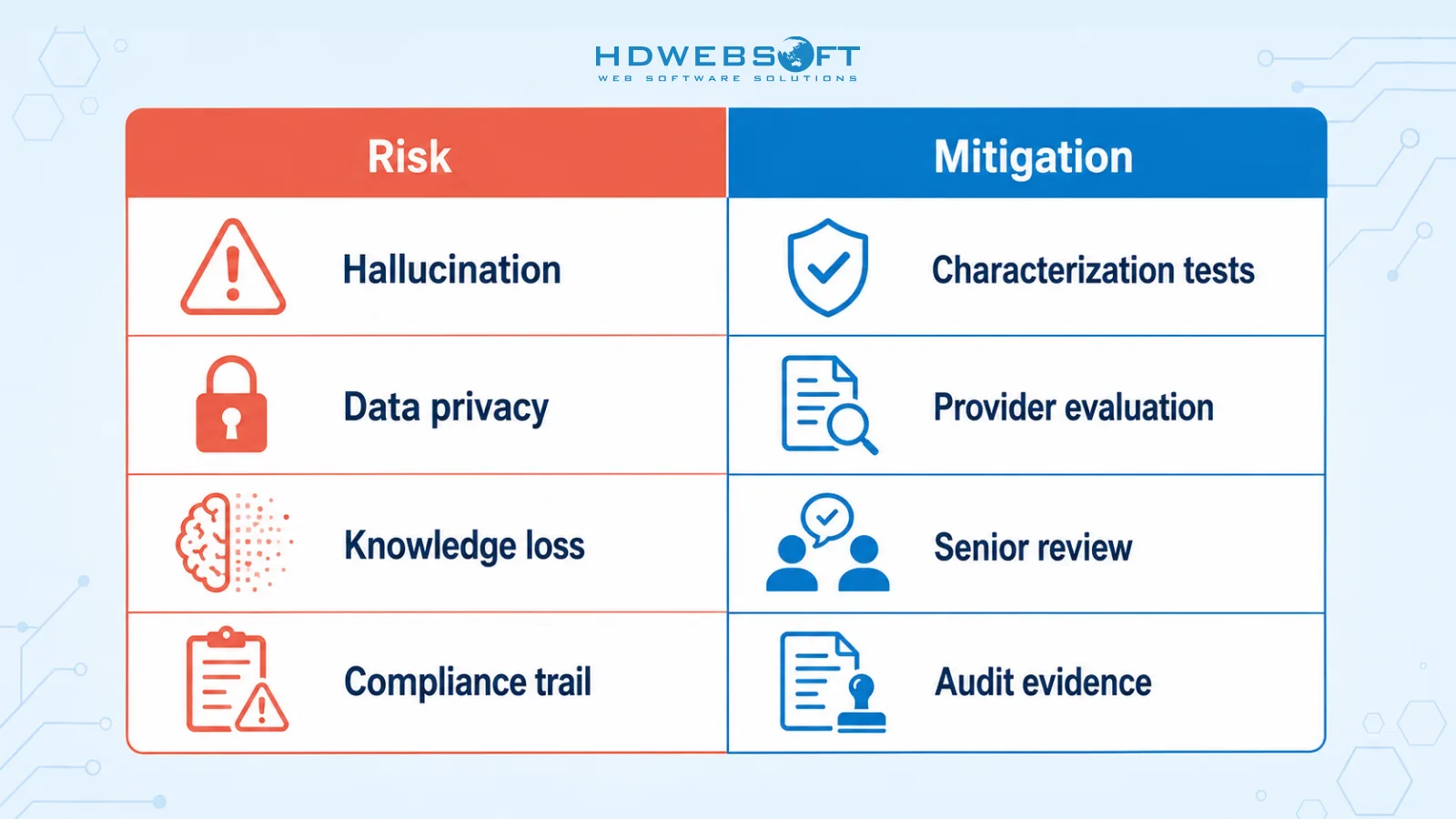
AI-augmented modernization introduces a specific set of risks that enterprise leaders need to govern actively. None of these are reasons to avoid AI. They are reasons to put guardrails in place before the first refactor ships.
Hallucination. AI can produce code that is syntactically correct but semantically wrong. A function that compiles and passes a shallow test can still break business logic in a way that only surfaces in production. The mitigation is the safety-net test step above, plus mandatory human review of every AI-proposed change.
Data privacy and IP exposure. Sending legacy source code to an LLM provider can raise NDA, IP, and compliance concerns, especially for regulated industries. The right response is not to assume self-hosted or enterprise-tier AI is always required. It is to evaluate the specific provider’s data retention policy, model-training policy, access controls, data residency options, logging practices, and contractual terms against your regulatory and contractual obligations. Some codebases can use mainstream cloud LLMs safely under the right terms. Others cannot. The decision should be documented, not defaulted.
Over-reliance and knowledge loss. When junior engineers lean on AI to understand legacy code without building their own mental model, the team loses the institutional knowledge that makes future modernization safer. Pair AI use with deliberate knowledge transfer: senior engineers review AI explanations, correct them, and add context. The AI is a starting point, not a substitute for understanding.
Compliance trail. In regulated industries, AI-generated code changes may need to be tracked, reviewed, and approved in ways that differ from standard development. Define upfront how AI-assisted changes are labeled in your review system, who is accountable, and what audit evidence is retained.
| Risk | Mitigation |
|---|---|
| Hallucination | Characterization tests + mandatory human review |
| Data privacy / IP | Evaluate provider terms, retention, residency, logging per codebase |
| Knowledge loss | Pair AI use with senior review and documented context |
| Compliance trail | Label AI-assisted changes, define accountability, retain audit evidence |
How to Refactor Legacy Applications With AI: A Checklist
Use this checklist before starting any AI-assisted modernization effort, and revisit it before each major milestone.
- The full codebase has been indexed or made accessible to the AI tool you are using.
- Characterization tests have been generated and human-reviewed for the modules you plan to change.
- Every refactor is small, independently testable, and easy for a senior engineer to review.
- A data privacy and IP review has been completed for the chosen LLM provider, covering retention, training policy, residency, and logging.
- A rollback plan exists for each module cutover and has been tested, not just documented.
- AI-assisted language or framework transformations are validated by engineers for architecture, business logic, integrations, and runtime behavior before shipping.
- Security and compliance review is human-led, with AI as an assistant, and audit evidence is retained for regulated changes.
- Senior engineers are explicitly accountable for every AI-proposed change that ships.
When to Bring in an AI-Augmented Modernization Partner
Most enterprises do not lack the intent to modernize. They lack the bandwidth, the AI tooling expertise, or the combined legacy-plus-modern skill set to do it without slowing down the rest of the roadmap. The gap between belief and execution is often a talent and focus gap, not a technology gap.
The signals that it makes sense to bring in an external partner are usually clear. Your in-house team does not have the bandwidth to take on a modernization track alongside roadmap work. Your codebase spans multiple languages or frameworks and no single internal team has fluency across all of them. You need to move faster than hiring a full modernization team would allow. Or you have strong legacy knowledge in-house but limited experience with AI-augmented workflows and want to avoid a long learning curve on a high-stakes project. In these cases, specialized AI code refactoring services can bridge the gap without disrupting your existing delivery cadence.
HDWEBSOFT works with enterprises on exactly this kind of work. Our engineering teams in Vietnam combine AI tooling with senior engineers who have modernized COBOL, Java, .NET, and PHP systems for regulated and high-scale environments. We operate under ISO 27001 controls, overlap with US and EU timezones for daily collaboration, and structure engagements around risk-managed cutover rather than big-bang rewrites. If you want a second set of eyes on your codebase before committing to a modernization path, talk to HDWEBSOFT.
Conclusion
AI does not modernize legacy systems on its own. What it does is change the economics of modernization for teams that pair it with disciplined engineering. The understanding phase gets faster. The safety-net phase gets cheaper. The mechanical refactoring phase gets less painful. The decisions that actually matter, architecture, business logic, security, compliance, and what ships to production, stay exactly where they belong: with senior engineers who own the outcome.
The enterprises that will close the gap between modernization intent and execution are not the ones waiting for AI to mature further. They are the ones putting disciplined AI-augmented engineering to work on the parts of their codebase where the risk is controllable, building safety nets before refactoring, and scaling from there. If that is the gap you are trying to close, start with one module, build the safety net, and let the results inform the next one.
If you are further along and already know you want a structured assessment, you can request a legacy codebase assessment directly. The assessment maps your system, identifies the highest-leverage modernization targets, and gives you a risk-ranked backlog you can execute with your own team or with ours.
Key Takeaways
- Legacy modernization with AI uses LLMs and code agents to accelerate code understanding, refactoring, migration, and test generation, while senior engineers retain ownership of architecture, security, and release decisions.
- AI is strong at code understanding, test generation, mechanical refactoring, and AI-assisted language or framework transformation. Engineers must still validate architecture, business logic, integrations, and runtime behavior.
- AI is weak at architecture decisions, implicit business logic, domain knowledge that lives in people, compliance review, and performance tuning on real traffic.
- Characterization tests before refactoring are the safety net that makes AI-assisted modernization safe enough to ship.
- Data privacy and IP decisions should be made per codebase by evaluating provider retention, training, residency, access controls, and logging, not by assuming one deployment model fits all.
- Start small, keep changes reviewable, test rollback plans, and scale modernization from proven results.
FAQ
Can AI fully modernize a legacy codebase on its own?
No. AI can accelerate code understanding, test generation, mechanical refactoring, and language transformation, but it cannot own architecture decisions, business logic validation, security review, or release accountability. Legacy modernization with AI is augmented, not automated. Senior engineers remain responsible for what ships.
What AI tools can help with legacy code modernization?
Code-aware AI agents and IDE integrations such as GitHub Copilot, Cursor, Claude Code, and Gemini Code Assist can assist with code explanation, test generation, refactoring, and language transformation. The right tool depends on your codebase size, language stack, data privacy requirements, and whether you need codebase-wide indexing or inline assistance. Evaluate each tool against your security and compliance constraints before adopting it.
Is it safe to send legacy source code to AI tools?
It depends on the provider and your regulatory context. Before sending legacy source to any LLM provider, evaluate the provider’s data retention policy, model-training policy, access controls, data residency options, logging practices, and contractual terms. Some codebases can use mainstream cloud LLMs safely under the right terms. Others require enterprise-tier isolation, self-hosted models, or scoped access. The decision should be documented per codebase, not defaulted.
How much time does AI save in legacy modernization?
There is no reliable modernization-specific benchmark that applies across codebases. The savings depend on codebase size, language, test coverage, team experience with AI tooling, and how much of the work is pattern-heavy versus context-heavy. The most consistent savings come from the understanding and test generation phases, where AI compresses work that would otherwise take weeks of manual reading into days.
When should we hire an external AI-augmented modernization partner?
Consider an external partner when your in-house team lacks the bandwidth, the AI tooling expertise, or the combined legacy-plus-modern skill set to run a modernization track alongside roadmap work. Other signals: your codebase spans multiple languages, you need to move faster than hiring allows, or you have legacy knowledge in-house but limited AI-augmented workflow experience and want to avoid a long learning curve on a high-stakes project.
What languages and frameworks can AI help migrate?
AI-assisted transformation is feasible for many common migrations, including COBOL to Java, PHP to Node.js, .NET Framework to .NET 8, Java 8 to Java 17+, and monolith to modular architectures. The AI produces a candidate translation. Engineers must still validate architecture, business logic, integrations, and runtime behavior before shipping. AI-assisted transformation is not automatic translation.