Java has been powering enterprise software for three decades — and the reasons teams still choose it have evolved from “safe and boring” into genuinely modern advantages. If your last impression of Java is verbose boilerplate and slow applets, the platform you’d build on today looks very different: virtual threads, records, pattern matching, native-image compilation, and a Spring ecosystem that has kept pace with every architectural shift.
This is a practical look at the Java development advantages that actually matter — what the platform gives you, where it excels, and when something else might serve better.
Key Takeaways
- JVM portability is still the core advantage — one codebase runs across operating systems and architectures, with backward compatibility measured in decades.
- Modern Java is genuinely modern — Java 17 and 21 LTS brought virtual threads, records, sealed classes, and pattern matching; the language is no longer the bottleneck.
- The ecosystem is the deepest in enterprise — Spring Boot, Jakarta EE, Maven/Gradle, and a library for nearly everything, matured over decades of production use.
- Performance has changed — GraalVM native images and Project Loom make Java competitive in startup time, memory footprint, and massive concurrency.
- The talent pool is enormous — Java remains one of the most-taught and most-used languages, which matters for hiring and long-term maintenance.
What makes Java different
Write once, run anywhere — the JVM
Java’s founding promise still holds: compiled bytecode runs on any platform with a JVM, from laptops to mainframes. For enterprises with mixed infrastructure — Linux servers, Windows desktops, cloud instances — that portability removes an entire class of deployment problems. Just as important is backward compatibility: code written for Java 8 a decade ago still runs on today’s JVMs, which is why enterprises trust Java for systems that must live for twenty years.
Modern Java — 17/21 LTS, virtual threads, records
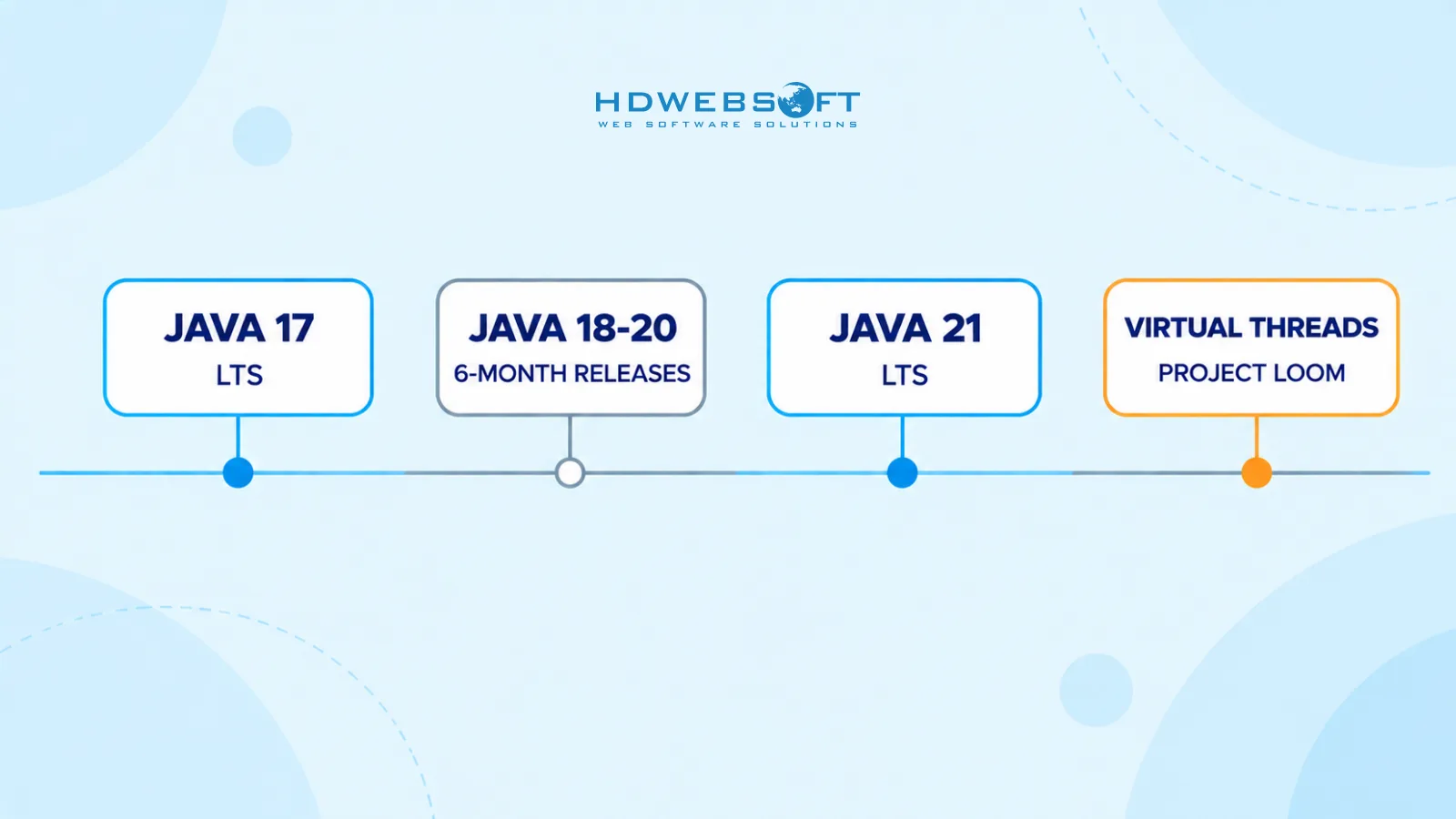
The Java of 2026 is not the Java of 2010. The language now ships a major release every six months with Long-Term Support versions every two years — Java 17 and Java 21 are the LTS anchors. Virtual threads, delivered in Java 21 through Project Loom, let servers handle millions of concurrent tasks with simple blocking-style code — eliminating the complexity of reactive programming for most workloads. Records remove data-class boilerplate; sealed classes and pattern matching make domain modeling precise; and text blocks, switch expressions, and var have quietly cleaned up everyday syntax.
The practical effect: Java codebases are now shorter, safer, and easier to review than their reputation suggests — and upgrades follow a predictable, tooling-assisted path.
The ecosystem — Spring Boot, Jakarta EE, and tooling
Java’s deepest advantage is its ecosystem. Spring Boot is the de facto standard for Java backends — auto-configuration, embedded servers, production metrics, and an integration for nearly every infrastructure product exist as first-class modules. Jakarta EE carries the enterprise standards lineage, while newer frameworks like Quarkus and Micronaut target cloud-native and serverless deployments specifically. Build tooling (Maven, Gradle), testing (JUnit 5, Testcontainers), and observability integrations are all mature — a Java team rarely has to build infrastructure plumbing from scratch. The dev.java portal documents the modern language and runtime for teams upgrading from older Java versions.
Tooling and the developer experience
Java’s tooling is a quiet advantage that teams who’ve worked in other ecosystems appreciate immediately. IntelliJ IDEA is widely regarded as the best IDE in the industry — refactoring, code analysis, and framework support that understand Java deeply. Profilers like async-profiler and JFR (Java Flight Recorder) make performance work diagnostic rather than guesswork, and JFR runs continuously in production with negligible overhead. Testcontainers spins up real databases and message brokers for integration tests in Docker, which means tests exercise real infrastructure instead of mocks. Very few ecosystems offer this level of production-grade tooling as a default part of the workflow — and it compounds: better tooling means faster debugging, safer refactoring, and more confidence in releases.
Where Java excels
Enterprise backends and microservices
Java’s home turf. Banks, insurers, telecoms, and governments run their core systems on Java — and Spring Boot remains the most widely used microservices framework in any language. The combination of strong typing, mature transaction management, battle-tested libraries, and predictable long-term support makes Java the default for systems where failure is expensive and lifetimes are measured in decades.
Big data and streaming
The big data world is built on the JVM: Apache Kafka, Spark, Flink, Cassandra, and Elasticsearch are all Java or JVM-native. If your product involves event streaming, batch analytics, or search at scale, the JVM is where the tooling is deepest — and Java gives you first-class access to all of it.
Android and the mobile legacy
Kotlin is now Google’s preferred Android language, but Java remains fully supported on Android and dominates the installed base of existing apps. Teams maintaining large Android codebases, or hiring across a mixed Kotlin/Java mobile stack, still live in the Java ecosystem daily.
Desktop and embedded
JavaFX and Swing still power internal enterprise desktop tools, and Java runs in ATMs, point-of-sale terminals, industrial controllers, and smartcards. It’s not the glamorous end of the platform, but it’s a real one — and it’s why “Java is everywhere” remains literally true in enterprise environments.
Cloud and serverless
Java’s cloud story has transformed in the last few years. GraalVM native images compile Java applications ahead-of-time into standalone executables that start in tens of milliseconds and use a fraction of the memory — directly addressing the cold-start problem that kept Java out of serverless. Spring Boot 3 integrates native compilation as a build option, and AWS Lambda’s SnapStart feature restores JVM snapshots for near-instant cold starts. Combined with JVM support for every major managed cloud service, Java is now a practical choice for event-driven and serverless architectures — not just long-running servers.

Java vs the alternatives
- Java vs .NET — the classic enterprise matchup. Both are strongly-typed, GC-based platforms with deep ecosystems. Java wins on cross-platform heritage, big data tooling, and talent pool depth; .NET wins on Windows integration and modern cloud-native ergonomics. The detailed trade-offs are in our Java vs .NET comparison.
- Java vs Python — Python wins on data science, ML, and prototyping speed; Java wins on production performance, type safety, and maintainability at scale. Many shops use both deliberately.
- Java vs Node.js — Node wins on JavaScript ubiquity and I/O-heavy frontend-adjacent services; Java wins on CPU-bound throughput, strong typing, and structured enterprise tooling.
- Java vs Go — Go wins on simplicity, startup time, and cloud-native tooling; Java wins on ecosystem breadth, mature enterprise libraries, and the ability to express complex domain models.
The honest summary: for large, long-lived, high-throughput systems — especially in regulated industries — Java remains the strongest default.
The advantages at a glance
| Advantage | What it means in practice |
|---|---|
| JVM portability | One codebase across OS and architectures; no platform-specific rewrites |
| Backward compatibility | Decade-old code still runs; upgrades are planned, not forced |
| Modern language | Virtual threads, records, pattern matching — concise, safe code |
| Spring Boot ecosystem | The deepest backend framework: integrations for nearly everything |
| Performance | GraalVM native images, Loom concurrency — competitive at every scale |
| Talent pool | One of the largest developer communities; easy hiring and staffing |
| Tooling | Mature IDEs, profilers, testing, and observability out of the box |
| Long-term support | LTS releases every two years; predictable upgrade cadence |
When Java is the right choice — and when it isn’t
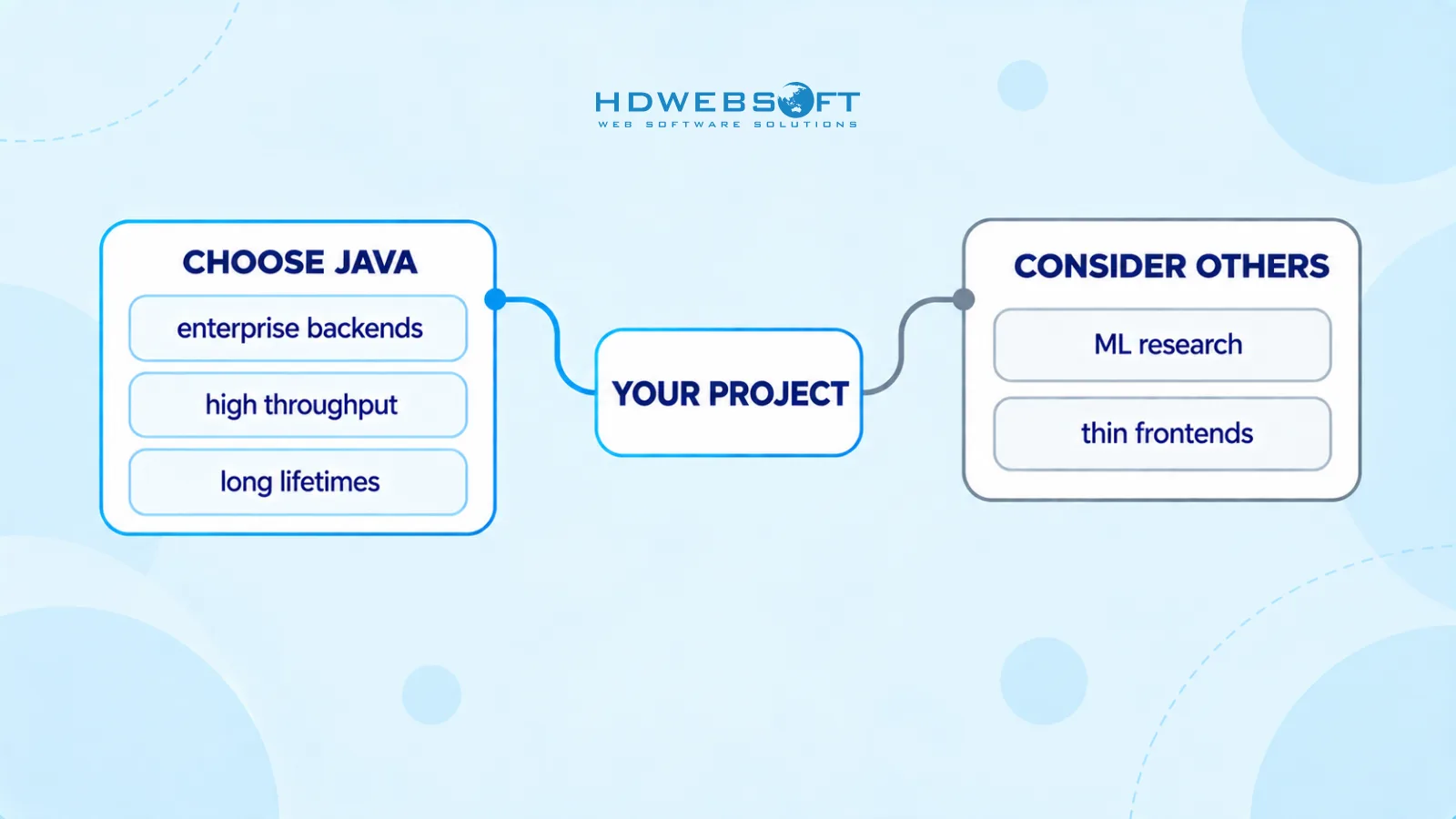
Java is the right choice when:
- You’re building large backend systems, microservices, or APIs that must scale and live for years
- Your industry is regulated or risk-averse — banking, insurance, healthcare, telecom, government
- You need deep integration with big data or streaming infrastructure (Kafka, Spark, Flink)
- Long-term maintainability and a deep hiring pool matter more than bleeding-edge DX
- Your team already knows the JVM ecosystem — productivity compounds immediately
Java might not be the right choice when:
- You’re building a thin frontend or a small marketing site — a lighter stack is simpler
- Your core product is data science or ML research — Python’s ecosystem is the default there
- You need extreme startup speed and tiny footprints for serverless functions — GraalVM narrows this, but Go or Node may still fit better
- Your team is JavaScript-first and the backend is a thin layer over APIs — full-stack JS may reduce context-switching
Building a Java team
Java’s scale cuts both ways: the talent pool is enormous, but depth varies. For modern Java work, look for Spring Boot experience, familiarity with Java 17+ features, cloud-native patterns (containers, messaging, observability), and testing discipline — not just years on legacy Java 8 codebases. The good news for staffing: a strong Java engineer transfers across domains easily, and the language’s stability means knowledge compounds rather than churns.
Outsourcing is a proven model for Java teams — the language’s maturity makes specifications, code reviews, and handovers straightforward across distributed teams. A sensible team shape for most projects pairs a tech lead who owns architecture and code review with mid-level engineers who own features end-to-end, adding QA automation and DevOps capacity as the system grows. Because Java’s conventions are so standardized, distributed teams converge on the same patterns quickly — which is why Java has been a mainstay of offshore delivery for two decades.
If you’re staffing a Java project, our Java developers for hire page covers how we assemble and run Java teams.
Frequently Asked Questions
What are the main advantages of Java?
Java’s main advantages are JVM portability (write once, run anywhere), strong backward compatibility, a mature ecosystem led by Spring Boot, strong typing with modern language features, excellent tooling, and one of the largest developer talent pools in the world. It remains the default choice for large enterprise backends.
Is Java still relevant in 2026?
Yes — Java is more relevant than its reputation suggests. Modern Java (17 and 21 LTS) added virtual threads, records, and pattern matching; Spring Boot 3 modernized the dominant framework; and GraalVM native images cut startup times dramatically. Java consistently ranks among the top languages in developer surveys and powers most large enterprise backends.
What are virtual threads in Java?
Virtual threads, delivered as a final feature in Java 21 through Project Loom, are lightweight threads managed by the JVM rather than the operating system. They allow servers to handle massive concurrency with simple, blocking-style code — removing the need for complex reactive programming in most high-throughput applications.
Is Java good for microservices?
Yes. Spring Boot is the most widely used microservices framework in the Java world, and the ecosystem covers everything from service discovery to observability. With GraalVM native images and modern frameworks like Quarkus and Micronaut, Java microservices now start in milliseconds and use a fraction of the memory of traditional deployments.
Is Java better than Python for backend development?
For large, long-lived backend systems, Java usually wins — it offers stronger typing, better performance, and more predictable behavior at scale. Python wins for data science, ML experimentation, and rapid prototyping. Many organizations use both: Python for data work, Java for the production backend.
Is Java dying because of Kotlin?
No — Kotlin and Java coexist. Kotlin is now Google’s preferred language for Android, but server-side Java remains dominant in enterprise. Kotlin compiles to the same JVM bytecode and can call Java libraries directly, so most teams adopt Kotlin selectively rather than replacing Java wholesale.
Conclusion
The Java development advantages that matter in 2026 are no longer just “safe and mature” — they’re genuinely modern: virtual threads that remove concurrency complexity, records and pattern matching that clean up the language, native-image compilation that fixes startup times, and a Spring ecosystem that has absorbed every architectural shift from monoliths to microservices to serverless.
If you’re evaluating Java for a product or modernization effort, our Java development services team can help you assess the fit for your roadmap.