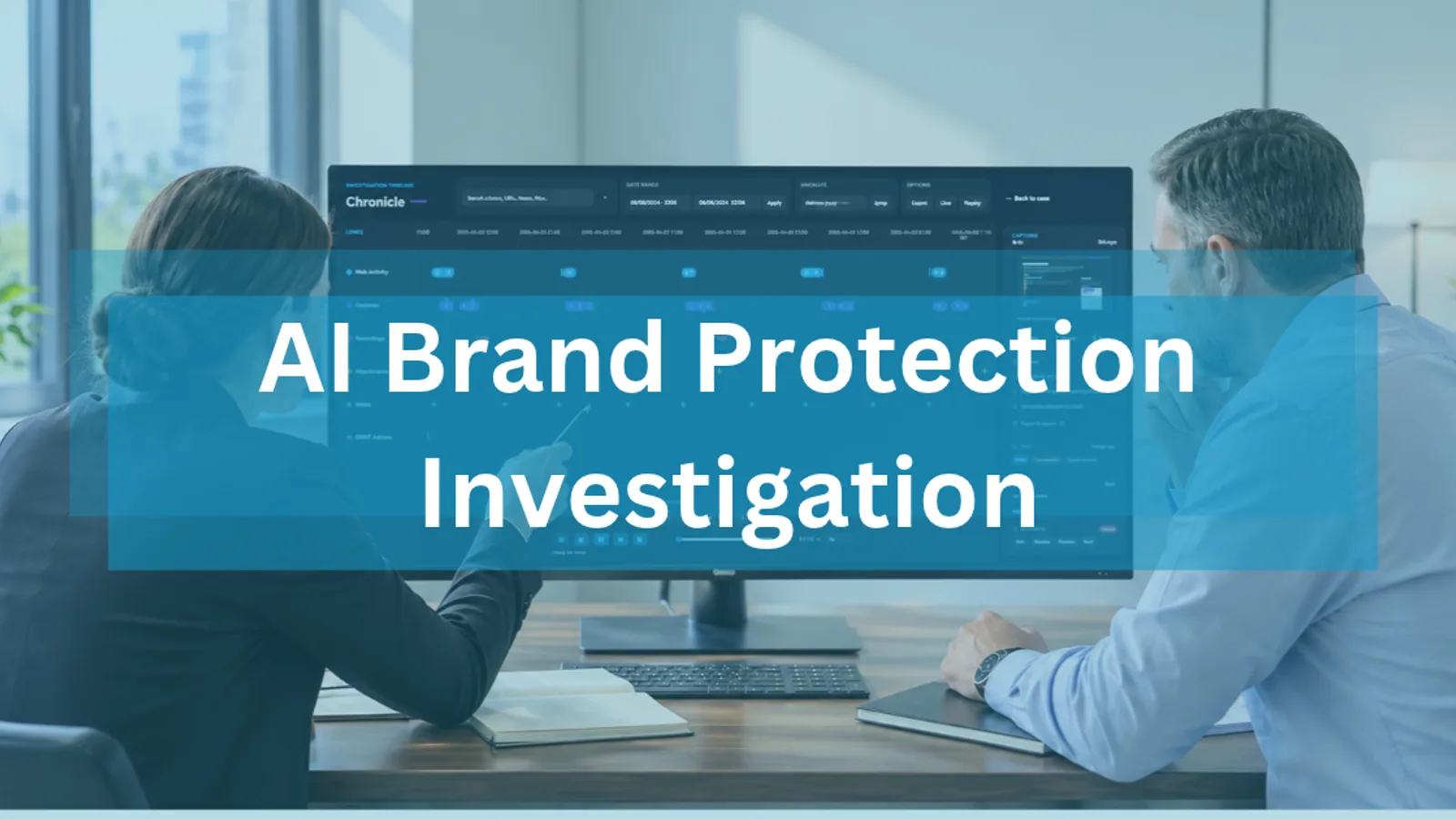
Counterfeit websites, stolen product images, phishing emails, and fake marketplace sellers all drain revenue and erode trust — yet investigators chasing them typically stitch together dozens of disconnected tools for WHOIS lookups, reverse image search, header analysis, and marketplace checks. A Swedish SaaS company engaged HDWEBSOFT to consolidate that fragmented workflow into a single subscription platform where investigators collect evidence, run forensic checks, let an AI agent execute full investigations, and finish with a report that holds up when shared with legal teams.
Project Context
Brand abuse is a volume problem. Every fake storefront, copied image, or spoofed email needs evidence collected across multiple sources — domain records, image forensics, email headers, marketplace listings — before a takedown or legal escalation can proceed. The client’s customers were doing that work manually: open a WHOIS lookup here, a reverse image search there, a header analyzer somewhere else, then copy everything into a document by hand.
The product vision was an investigator’s workbench in one login: track emails and files to see when and where they are opened, probe any website or seller through dedicated investigation labs, and let an AI agent run the whole evidence chain autonomously before writing up findings. HDWEBSOFT designed and built the full platform — a Blazor Server web application backed by PostgreSQL, with Stripe billing for the subscription model and an AI investigation agent orchestrated through the Microsoft Agent Framework.
Stakeholder Interview
“Every outside source spoke a different dialect — WHOIS returns text, VirusTotal returns scores, Google Vision returns labels. The turning point was refusing to let the AI read any of them raw. We forced everything through a normalization layer that emits one small, standard evidence signal, then told the agent: you cannot write a finding until a real signal backs it, and every step goes into a replayable timeline. That is when investigators stopped double-checking the AI and started attaching its reports to takedown notices.”
— Quynh Le, Project Manager at HDWEBSOFT
That discipline shaped the platform’s architecture. Rather than letting each integration surface raw payloads, every data source was adapted to emit standardized “signals” — small, typed evidence objects that feed a single report builder. The AI agent operates under fixed tool ordering and must cite a signal for every conclusion, with each step persisted to an auditable timeline. Trust became a property of the pipeline, not a hope about the model.
Key Features
- Email & document tracking — tracked emails, images, and files report when and where they are opened, capturing location, device, and referral source.
- Investigation labs — purpose-built checks for websites, domains, images, files, email headers, companies, technologies, and online marketplaces, including eBay seller profiling.
- Image forensics — extract image metadata, find copies circulating online, and surface indicators that an image has been edited.
- AI investigation agent — an autonomous agent runs the evidence checks step by step and produces a complete, cited investigation report.
- Intelligence dossiers — all findings compiled into a readable report with citable evidence entries.
- Subscriptions & billing — plan tiers, free trial, and payment processing through Stripe.
Technical Challenges
Many external sources, no common language
OpenAI, Google Vision, Apify, WHOIS, VirusTotal, and other providers each return different formats, enforce different rate limits, and fail in different ways. Integrating them naively would have produced a fragile tangle of per-provider logic that the AI agent could not reason over consistently.
Long-running jobs that must survive restarts
Scraping, screenshot capture, and AI investigation runs take far longer than an HTTP request. These jobs could not freeze the application’s UI thread, and a server restart mid-investigation could not silently lose hours of collected evidence.
AI output that must be defensible
An investigation report is only useful if its conclusions can be traced back to real evidence. A generative AI free-writing a report risks fabricating findings — unacceptable when reports reach legal teams. The agent needed constraints that made every claim cite a concrete check.
Sources that fight back
Target websites frequently block automated access. Downloads and scraping attempts were routinely refused, so collection workflows needed resilient fallback paths instead of hard failures.
Solutions
One shared pipeline of standardized signals
Every data source was wrapped in an adapter that converts raw provider output into small, standardized evidence “signals.” A single report builder consumes signals from all sources uniformly — adding a new provider means writing one adapter, not retouching the investigation and reporting layers. The AI agent works exclusively over signals, which is also what makes its citations verifiable.
Durable background job orchestration
Heavy work — scraping, screenshots, image analysis, AI runs — was moved to background jobs persisted in PostgreSQL. Jobs survive process restarts and resume rather than restart, keeping the Blazor UI responsive throughout long investigations.
An AI agent with evidentiary guardrails
The agent was built on the Microsoft Agent Framework with hard constraints: a fixed tool execution order, a requirement that every finding reference a stored signal, and a persisted timeline of each step taken. The output reads like an investigator’s work product because it is produced under the same evidentiary rules.
Resilient collection under blocking
Proxy fallback and retry strategies were layered into the collection workflows so blocked downloads and scraping attempts recover automatically instead of failing the investigation.
Business Outcomes
- Investigations drop from hours to minutes — autonomous agent runs plus unified evidence collection replaced tool-hopping manual work.
- One platform replaces many tools — consolidated subscriptions and a single workflow cut software cost and training time for investigation teams.
- Reports ready for legal escalation — evidence-cited dossiers can be shared with legal teams or end clients without re-verification.
- A recurring-revenue SaaS model — Stripe subscriptions with free trials let the client monetize the platform as a product, not a service engagement.
Technical Snapshot
- Backend & app: .NET 10, ASP.NET Core Blazor Server, MudBlazor component library, PostgreSQL with Entity Framework Core, database-persisted background jobs.
- AI & analysis: OpenAI through the Microsoft Agent Framework, Google Vision image analysis, Apify scraping, WHOIS and VirusTotal enrichment.
- Billing: Stripe subscriptions, trials, and plan management.
- Infrastructure: AWS (S3 storage, SES email, ECS hosting), Docker containers, Azure DevOps CI/CD.
Conclusion
The platform replaced a fragmented, manual investigative workflow with a single subscription product where evidence flows through one standardized pipeline and an evidence-guardrailed AI agent produces citable reports. The hardest part — making AI output trustworthy enough for legal contexts — was solved architecturally: normalize every source into signals, persist every step, and let the model write only what the evidence supports.
If your team is building an AI agent that must produce defensible output, a data-collection platform facing hostile sources, or a subscription SaaS product, our AI development services and data scraping & web crawling development services cover exactly this delivery model. Contact our team to scope a similar build.
Explore related work
Continue with related case studies, services, industries, and regional delivery experience.