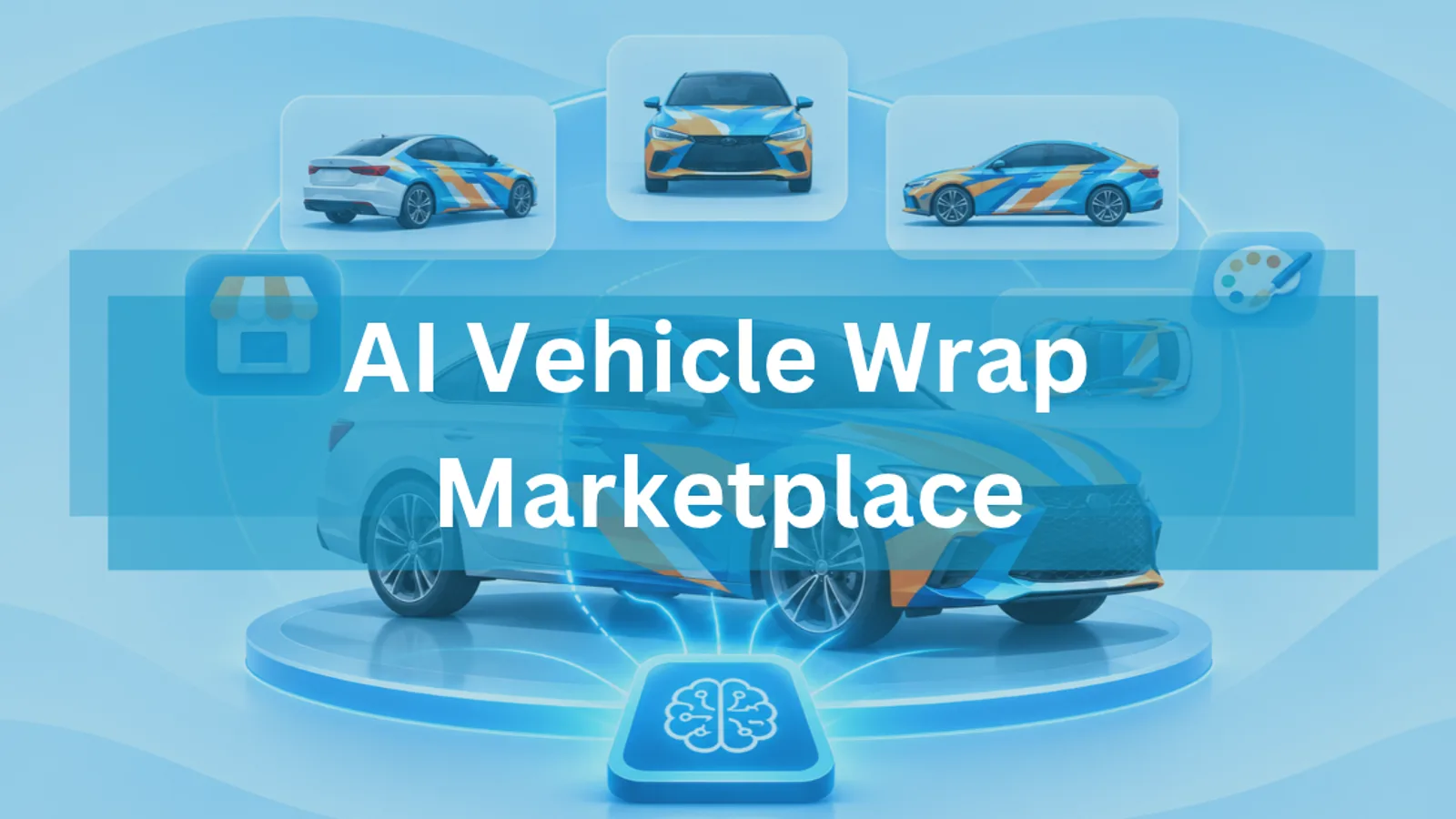
A Canada-based marketplace startup set out to remove the guesswork from custom vehicle wraps. The traditional buying process is slow and risky: customers cannot visualize the final look, must visit multiple shops for quotes, and shops struggle to reach new customers. HDWEBSOFT delivered a multi-role marketplace where vehicle owners design wraps on 3D vehicle models, preview photorealistic AI renders from seven camera angles, and order directly from vetted installers, while affiliate shops receive pre-qualified paid leads and independent artists earn automatic commissions on approved designs.
Project Context
Custom vinyl wrapping has a fundamental confidence problem. A wrap is a significant purchase, yet buyers traditionally commit without seeing the result — browsing flat samples in a shop and hoping the final look matches their imagination. Meanwhile, wrap shops depend on walk-ins and word of mouth, and talented wrap designers have no channel to monetize their work beyond one-off commissions.
The client envisioned a single platform that solves all three problems at once: an AI design studio that shows customers exactly what their vehicle will look like before they pay, a marketplace that routes qualified orders to professional installers, and a design marketplace where artists publish and earn from community-approved wrap designs. A small HDWEBSOFT team took on the full build — five user roles, real-time order workflows, marketplace payments, and an AI generation pipeline — on an aggressive timeline, in a domain none of them had touched before: vehicle wrap geometry, car parts, surfaces, and unfolded drawings.
Stakeholder Interview
“Early renders kept mangling the details that make a vehicle believable — mirror shapes, badges, panel gaps, wheel designs. The turning point was treating the prompt itself as an engineered artifact: versioned, parameterized per vehicle family and camera angle, and regression-tested like code. Once prompts lived in a config layer admins could tune without redeploys, every tuning cycle got dramatically cheaper.”
— Chinh Tran, Team Leader at HDWEBSOFT
That engineering discipline came out of necessity. The team ran structured iteration loops — generate, inspect each angle against the real vehicle, log failure modes like wrong mirror shapes or missing emblems, then feed the findings back into the prompt as explicit constraints — repeating until the full seven-angle set held up. Chained generation (front three-quarter first, remaining angles after, with retries for failures) caught errors early instead of producing complete sets of bad renders, and regression tests per prompt version ensured a fix for one angle could not silently break another.
Key Features
- AI Design Studio — customers design wraps on 3D vehicle models; AI (Google Gemini + fal.ai) renders photorealistic previews from 7 camera angles plus short promo videos, with automatic AI-labeling on shared assets.
- Design Discovery Marketplace — artists publish designs, admins approve them, and customers browse, favorite, and order community designs.
- Multi-Role Platform — dedicated portals for Customers, Artists, Affiliate shops (staff and admins), and Platform Admins, with company-based multi-tenancy.
- Lead & Order Management — automatic lead distribution to shops, accept/reject/assign workflow, and a full order lifecycle (Pending → Paid → Confirmed → Processing → Ready → Fulfilled) with real-time status updates.
- Payments & Payouts — Stripe payment processing, coupon and discount system, commission and tax configuration, and automatic Stripe Connect payouts to shops and artists 7 days after fulfillment.
- Real-Time Chat & Notifications — in-order conversations between customers and installers via Socket.IO, plus Expo push notifications and SendGrid email.
- Comprehensive Admin Dashboard — catalog management (vehicle types, car parts, wrap options, brands), AI model and prompt configuration, pricing and commission settings, reports and analytics, coupon and document management.
- Pricing Engine — automatic price estimation based on selected surfaces, materials, and vehicle parts.
Technical Challenges
Photorealistic Consistency Across Seven Angles
Vehicles have extremely small details — door handles, mirrors, badges, panel gaps, wheel designs — and early AI renders distorted or omitted them. Because each vehicle model needed a consistent set across 7 camera angles, a render that looked right from the front could be visibly wrong from the side, and regenerating full sets was expensive. There was no generic prompt template that could cover every vehicle family.
Orchestrating Long-Running AI Jobs Reliably
Image sets, promo videos, and AI-labeling are long-running jobs that cannot block API requests. Failures mid-pipeline — a single angle failing, a video job timing out — needed retry and recovery logic without abandoning the order or losing the work already completed.
Five-Role Multi-Tenant Permission Model
Customers, Artists, shop staff, shop admins, and Platform Admins each see different data and trigger different workflows — and a user can belong to multiple companies. Business rules for leads, payouts, and refunds all depend on which role acts, and mistakes here leak data between shops or misroute money.
Handling Money Correctly
Commission and tax rates are stored in basis points, payment amounts are snapshotted at order time, refunds follow defined flows, and automated Stripe Connect payouts run on a schedule with dispute handling. Any rounding or state error shows up as real money in the wrong account.
An Unfamiliar Domain on an Aggressive Timeline
Vehicle wrap geometry — car parts, surfaces, unfolded drawings — was new to every developer on the team. With a small team and an aggressive deadline, the domain had to be learned fast enough to make correct modeling decisions the first time.
Solutions
Prompts Treated as Engineered, Testable Artifacts
Instead of one generic prompt string, the team built a structured prompt builder that assembles instructions from per-vehicle-family profiles, per-angle camera specifications (focal length, framing, visibility rules for each of the 7 angles), and wrap finish/material rules — so each vehicle model gets tailored instructions. Iteration ran as test cycles: generate, inspect each angle against the real vehicle, log failure modes (wrong mirror shape, missing emblems, warped panels), and feed the findings back as explicit prompt constraints until output was consistently accurate. Prompt values live in a database-driven config layer (AiPromptConfig), so admins can tune prompts and switch image or video models at runtime from the admin panel — no redeploys per tuning round. Regression unit tests per prompt version protect tuning progress: a change that fixes one angle cannot silently break another.
Chained Generation Pipeline
The front three-quarter angle generates first, followed by the remaining angles, with targeted retries for failures. Errors surface and get corrected early instead of producing a full set of bad renders — which matters when each full set carries real generation cost.
A Stable Platform Around the AI Core
The rest of the platform was kept deliberately boring so the team could focus on prompt quality: BullMQ/Redis job queues isolate AI workloads from the request path, role guards plus a company-membership state machine enforce multi-tenancy, validated order state machines carry payment-rate snapshots through the lifecycle, and automated Stripe Connect payouts close the loop without manual reconciliation.
Business Outcomes
- Customers buy with confidence — they visualize the exact wrap on their vehicle before purchase, reducing hesitation, back-and-forth revisions, and abandoned orders for affiliate shops.
- Shops receive pre-qualified, paid leads with zero acquisition effort, streamlining their sales pipeline and increasing installation volume.
- Artists gain a passive income channel through approved public designs with automatic commission payouts.
- Admins run the platform from settings alone — commissions, tax rates, pricing, AI models, and email templates all configurable without redeployments, reducing operational cost.
- Automation replaced manual coordination — lead assignment, status workflows, and payouts run themselves, letting the platform scale to more shops and orders without growing the ops team.
Technical Snapshot
- Backend: NestJS 11 + TypeScript, PostgreSQL (Prisma ORM), Redis + BullMQ job queues, Socket.IO, Swagger/OpenAPI, JWT authentication, Helmet, rate limiting.
- Frontend: React 19 + Vite + TypeScript, Tailwind CSS, shadcn/ui (Radix UI), TanStack Query & Table, React Hook Form + Zod, Recharts, dnd-kit, React Router v7, Socket.IO client.
- AI pipeline: Google Gemini API + fal.ai for image and video generation, Sharp for image processing, database-driven AiPromptConfig with runtime model and prompt switching, per-version regression tests.
- Integrations: Stripe payments + Stripe Connect payouts, Supabase Auth, Cloudflare R2 (S3-compatible storage), SendGrid/Nodemailer email, Expo push notifications.
- Testing & DevOps: Jest, Playwright, Docker, AWS, ESLint/Prettier/Husky.
Conclusion
The platform turned a slow, shop-by-shop guessing process into a self-serve marketplace where AI previews de-risk the purchase and automation handles leads, orders, and payouts end to end. The hardest part — photorealistic fidelity across seven angles for every vehicle family — was solved not with more generation budget but with engineering discipline: structured prompts, measured iteration, and regression-tested configuration.
If your team is building a marketplace, an AI-powered product visualizer, or a multi-role platform with complex payment flows, our AI development services and e-commerce software development services cover exactly this delivery model. Contact our team to scope a similar build.
Explore related work
Continue with related case studies, services, industries, and regional delivery experience.