Behavior-driven development (BDD) keeps evolving as software teams adopt AI, microservices, and stricter non-functional requirements. The top 10 BDD testing trends for 2026 are AI-assisted scenario authoring and test maintenance, the SpecFlow to Reqnroll migration in .NET, contract-driven BDD for microservices, accessibility as an executable acceptance criterion, governed living specifications, scenario governance and test-suite debt management, CI/CD-native BDD with selective execution and release gates, BDD expansion to security performance and observability, one behavior model across web mobile and API, and behavior-driven evaluation for AI agents and probabilistic systems.
These trends share one shift: BDD is no longer only a test automation technique. It is becoming a governed, AI-augmented, cross-cutting practice that touches discovery, collaboration, deployment safety, and even how teams evaluate AI agents.
What Is BDD in 2026?
BDD is a collaborative practice where teams discover and describe software behavior through concrete examples, then turn those examples into executable specifications. The term “BDD testing” is common in search, but BDD itself is broader than test automation. As Cucumber defines it, BDD revolves around three activities: discovery, collaboration, and examples — not only writing automated tests.
In practice, a BDD workflow starts with a conversation among developers, testers, and business stakeholders. They explore a feature using examples written in a structured language such as Gherkin (Given / When / Then). Those examples later become automated scenarios that double as living documentation. If you want a deeper comparison with test-driven development, see our guide on TDD vs BDD, and for the business case, see our overview of 10 key benefits of BDD testing.
What changed in 2026 is the scope. BDD now extends beyond functional acceptance into accessibility, security, performance, observability, and even AI agent evaluation. The collaboration layer still matters, but the executable specification layer is now expected to cover more of the quality surface.
Why BDD Trends Matter in 2026
Three forces are reshaping BDD in 2026, and each one shows up across the trends below.
First, AI has moved from experiment to mainstream in quality engineering. According to the World Quality Report 2025 from Capgemini, 89 percent of organizations are piloting or deploying generative AI in quality engineering, but only 15 percent have scaled it enterprise-wide. That gap between experimentation and disciplined adoption is exactly where BDD scenario governance and AI-assisted authoring become decisive.
Second, the BDD tooling ecosystem went through a real disruption. Tricentis ended SpecFlow support on December 31, 2024, and the community regrouped around Reqnroll, which already had more than 5,000 projects by early 2025. .NET BDD teams can no longer treat their framework choice as settled.
Third, BDD adoption itself keeps climbing. The State of Testing 2024 report from PractiTest shows BDD usage rising from 19 percent in 2022 to 23 percent in 2023 and 26 percent in 2024. As more teams adopt BDD, the cost of poor scenario hygiene, brittle automation, and isolated test suites grows — which is why governance, contract testing, and cross-platform behavior models now matter more than chasing another framework.
Top 10 Trends in BDD Testing for 2026
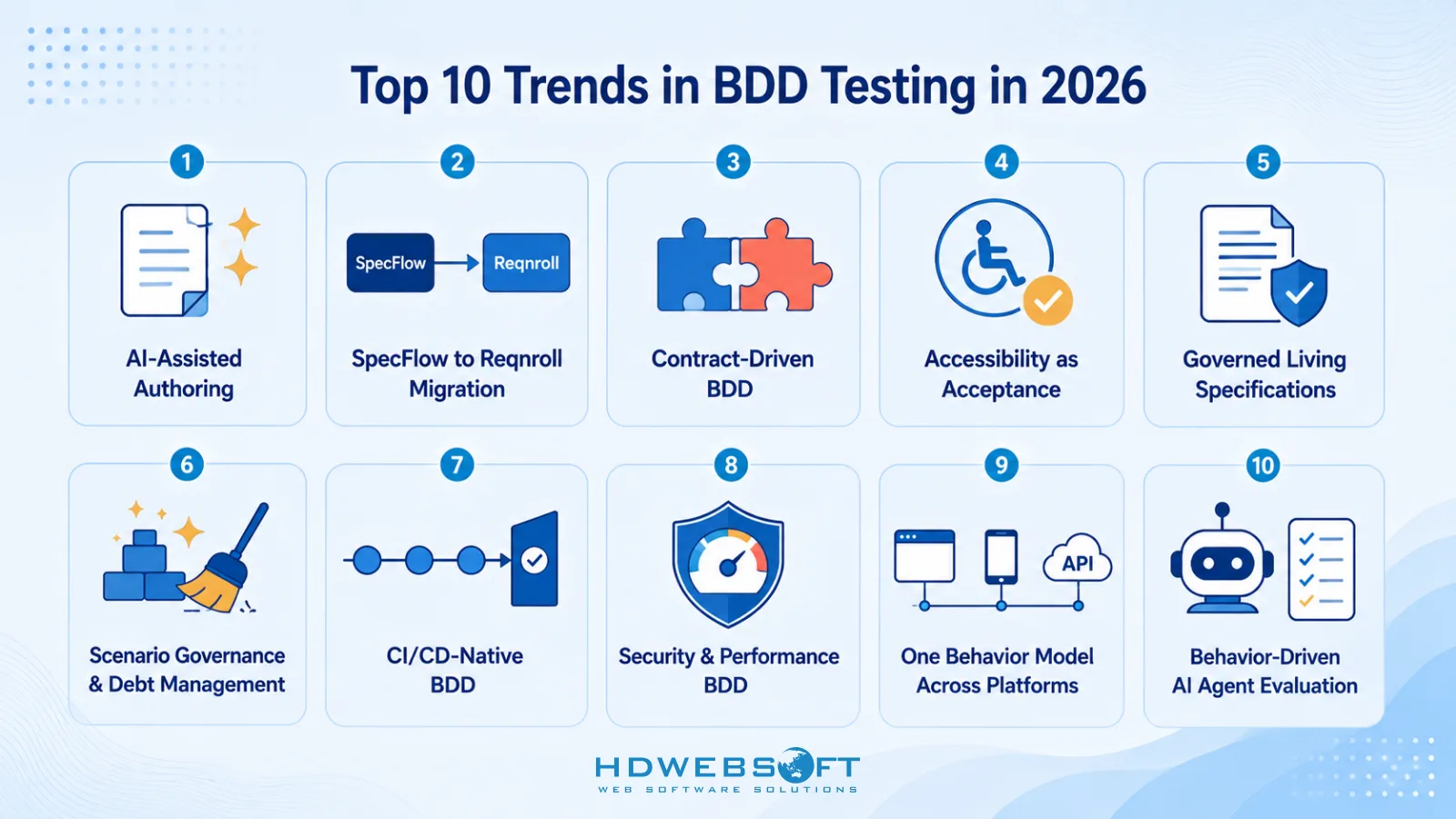
1. AI-Assisted BDD Scenario Authoring and Test Maintenance
AI is the most visible 2026 shift in BDD workflows. Teams now use large language models to draft Gherkin scenarios from user stories, suggest step definitions, refactor duplicated steps, and self-heal tests when UI selectors or API contracts change.
The 2026 trigger is maturity. According to BrowserStack’s State of AI in Software Testing 2026, 61 percent of organizations already use AI across most of their testing workflows. The practical application for BDD is concrete: AI generates a first draft of scenarios from a feature brief, a reviewer refines the language with the business side, and the automation layer wires those scenarios to step definitions. Self-healing is the bigger maintenance win — when a button label or endpoint changes, AI proposes an updated selector or payload instead of leaving the suite red.
The trade-off is trust. AI-generated scenarios can hallucinate business rules, miss edge cases, and produce steps that pass without proving the behavior. Treat AI as a co-author that needs a human reviewer, not as a replacement for the discovery conversation.
2. SpecFlow EOL Accelerates Reqnroll Migration for .NET BDD
The .NET BDD ecosystem had a hard reset in 2024-2025. Tricentis announced SpecFlow end-of-life on December 31, 2024, deleted the SpecFlow GitHub repository, and disabled the support site. The community fork, Reqnroll, launched in January 2024 and reached more than 5,000 projects by early 2025, including suites with over 1,000 feature files.
The 2026 trigger is urgency. SpecFlow will not be updated for newer .NET platforms beyond .NET 7, and the knowledge base is gone. Teams staying on SpecFlow are accumulating migration debt and security risk. Reqnroll supports .NET 8.0 and 9.0, scenario-level parallelization, and a SpecFlow Compatibility Package that allows near-drop-in migration with minimal namespace changes.
The trade-off is migration cost. Large SpecFlow suites with custom plugins, bindings, and tooling integrations need a real migration plan. The compatibility package reduces the first step, but teams should still budget time to move namespaces, update CI, and retrain contributors.
3. Contract-Driven BDD for Microservices and Deployment Safety
As microservices and distributed systems became the default architecture, end-to-end BDD suites across every service turned slow, flaky, and expensive. The 2026 answer is to combine BDD behavior scenarios with consumer-driven contract testing using Pact.
The 2026 trigger is deployment safety. Pact’s can-i-deploy gate checks whether a consumer and provider are contract-compatible before either ships, so breaking API changes fail in CI instead of in production. BDD scenarios describe the user-facing behavior; contracts describe the service-to-service agreement. Together they catch breakage earlier than a full end-to-end suite ever can.
The trade-off is scope. Contract testing does not replace end-to-end tests for journeys that genuinely span many services. Use contracts for the stable integration boundaries and reserve end-to-end BDD for a small set of critical user journeys.
4. Accessibility Becomes an Executable Acceptance Criterion
Accessibility is no longer a separate audit that happens before release. In 2026, teams integrate axe-core with Playwright-BDD to run WCAG 2.1 and 2.2 AA accessibility scans as reusable BDD steps inside the same suite as functional scenarios.
The 2026 trigger is regulation and reach. The European Accessibility Act takes effect in 2025, and WCAG 2.2 is now the baseline for many procurement contracts. A scenario such as Then the checkout page has no critical WCAG 2.2 AA violations runs on every build, attaches a machine-readable report, and fails the pipeline on a serious or critical violation. Accessibility becomes a first-class acceptance criterion instead of a manual checklist.
The trade-off is coverage. Automated axe scans catch structural violations such as missing labels, contrast, and ARIA misuse, but they do not catch every real-world accessibility problem. Pair automated BDD accessibility steps with manual assessment and inclusive user testing.
5. Living Specifications Become Governed Product Artifacts
Living documentation — feature files that stay in sync with the product because they are executable — has been a BDD promise for years. In 2026, mature teams treat these specifications as governed product artifacts, versioned, reviewed, and owned like production code.
The 2026 trigger is traceability pressure. Regulated industries and enterprise procurement now expect requirement-to-test-to-result traceability. Tools such as CucumberStudio, Xray BDD, and Zephyr with Gherkin support turn feature files into a single source of truth that connects Jira requirements, executable scenarios, and run results. The feature file is no longer a QA artifact owned by automation engineers; it is a product artifact owned by the trio of product, engineering, and QA.
The trade-off is process overhead. Governance adds review steps, naming conventions, and ownership rules. Without them, living documentation rots into stale feature files that no one trusts.

6. BDD Scenario Governance and Test-Suite Debt Management
As BDD suites grow, scenario debt accumulates: duplicated steps, ambiguous Given blocks, brittle background setups, and scenarios that pass without proving anything. The 2026 trend is explicit scenario governance — rules for authoring, reviewing, and pruning scenarios before the suite becomes a liability.
The 2026 trigger is suite size. Teams with hundreds or thousands of scenarios now hit maintenance costs that rival the cost of writing them. Governance practices include scenario linting (for example, enforcing a single When per scenario), step reuse policies, naming conventions, and periodic suite pruning. AI-assisted duplicate detection helps, but the discipline is human.
The trade-off is enforcement. Governance only works if reviewers actually apply the rules in pull requests. Codify the rules in linting and CI checks where possible, and treat the rest as a team agreement that needs regular reinforcement.
7. CI/CD-Native BDD with Selective Execution and Release Gates
BDD suites used to run as a single nightly job. In 2026, they are CI/CD-native: scenarios are tagged, executed selectively based on changed code paths, and used as release gates that block deployment when critical behaviors break.
The 2026 trigger is pipeline speed. As release cadence compresses, full-suite runs become a bottleneck. Selective execution uses tags such as @smoke, @critical, or @service:checkout to run only the scenarios affected by a change, while contract and can-i-deploy gates verify integration safety. Parallel scenario execution, now supported in frameworks such as Reqnroll, cuts wall-clock time further.
The trade-off is configuration complexity. Selective execution requires disciplined tagging and a clear mapping between code changes and affected scenarios. Misconfigured selection can skip critical tests and give false confidence. Invest in tagging conventions before investing in selection logic.
8. BDD Expands to Security, Performance, Resilience, and Observability
BDD started with functional acceptance. In 2026, teams write behavior scenarios for non-functional requirements too: security attack vectors, performance budgets, resilience under failure, and observability assertions.
The 2026 trigger is breadth of risk. Security BDD scenarios describe expected system behavior under attack, such as Given an unauthenticated request to /admin, Then the response status is 403. Performance BDD scenarios assert response time budgets for critical journeys. Resilience scenarios verify graceful degradation when a dependency fails. Observability scenarios check that a failure emits the expected metric, log, and trace. The same Gherkin structure now covers a wider quality surface.
The trade-off is tooling maturity. Non-functional BDD often needs additional libraries — security scanners, load generators, chaos tooling, observability clients — wired into the step definitions. Start with one non-functional dimension, usually security or accessibility, before expanding.
9. One Behavior Model Across Web, Mobile, and API Testing
Cross-platform used to mean maintaining separate test suites for web, mobile, and API. The 2026 trend is one behavior model that drives all three, with shared scenarios and platform-specific step definitions underneath.
The 2026 trigger is convergence. Frameworks such as Playwright-BDD, Appium with Gherkin bindings, and Karate for API-first BDD now share scenario vocabulary. A scenario such as Given a logged-in user, When they view their order history, Then the five most recent orders are shown can drive a web step, a mobile step, and an API step from the same feature file. Device farm cloud providers handle the mobile execution scale.
The trade-off is abstraction discipline. Shared scenarios only stay readable if platform-specific details stay in the step definitions and not in the Gherkin. Leak platform details into the scenario and the model fragments again. For tool selection guidance, see our article on how to choose a suitable BDD testing tool.
10. Behavior-Driven Evaluation for AI Agents and Probabilistic Systems
The newest 2026 trend is using BDD to evaluate AI agents and other probabilistic systems that do not have deterministic outputs. Teams write behavior scenarios that describe acceptable behavior ranges, then run evaluation harnesses that check whether agent outputs fall within those ranges.
The 2026 trigger is AI agent adoption. As agents take on real workflows, deterministic assertions such as Then the response equals X no longer fit. Behavior-driven evaluation instead checks properties: the agent cites a source, stays within allowed tools, refuses unsafe actions, and completes the task within a latency budget. The scenario becomes an evaluation case, and the suite becomes an evaluation harness. This is BDD applied to AI quality, not only to software behavior.
The trade-off is evaluation design. Probabilistic systems need representative test sets, scoring rubrics, and tolerance thresholds. Poorly designed evaluation scenarios either pass everything or fail on noise. Treat behavior-driven evaluation as an emerging practice: start with a small set of critical agent behaviors and expand as the evaluation discipline matures.
How These Trends Impact the STLC
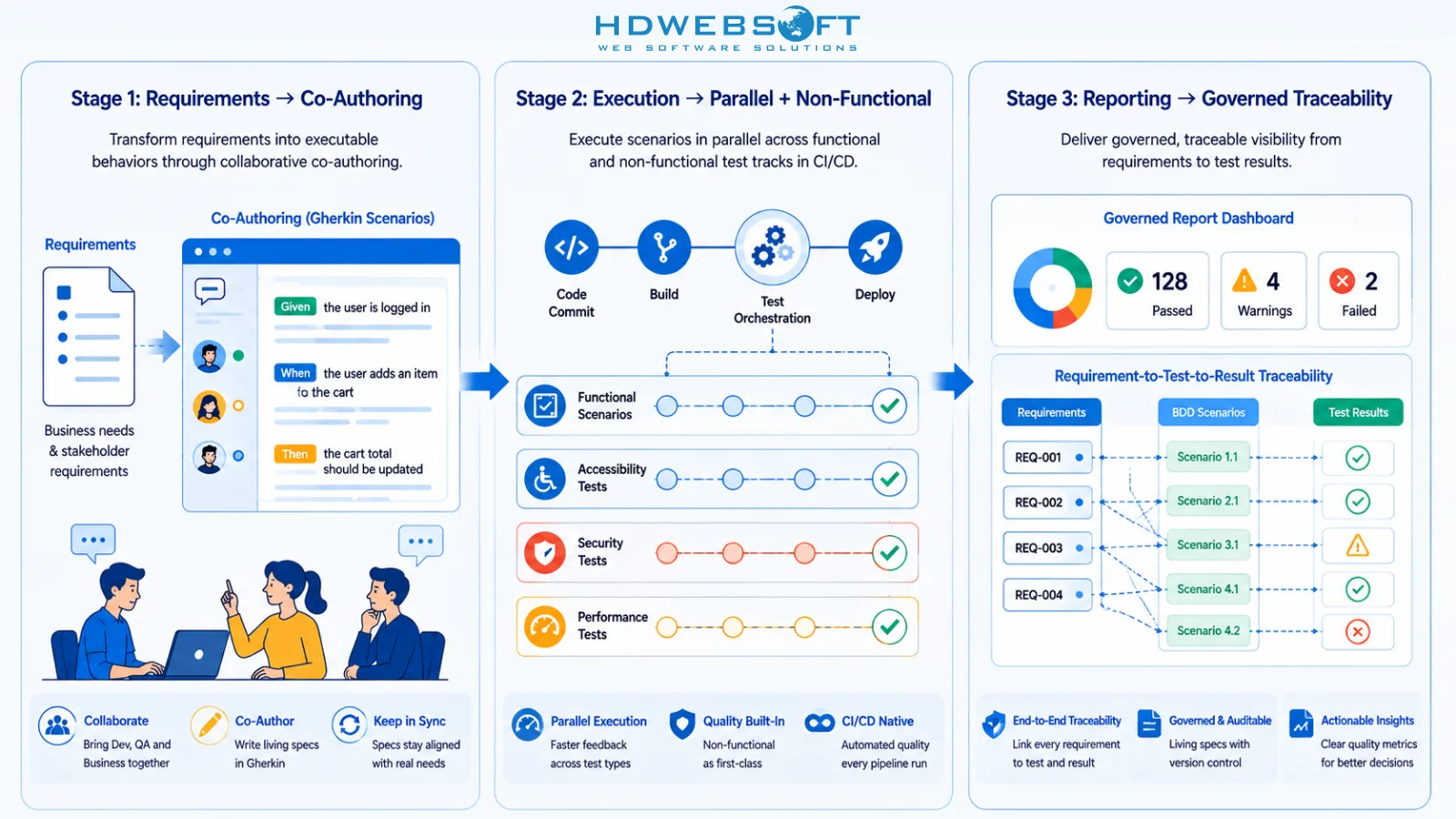
The Software Testing Life Cycle (STLC) is not just receiving more automation in 2026. The BDD trends above reshape three stages in particular.
-
Requirements and test design. Living specifications and governed feature files move test design upstream into discovery. Instead of testers receiving a finished requirement and writing tests afterward, the trio collaborates on examples that become the requirement and the test at the same time. AI-assisted authoring accelerates the first draft, while governance keeps the result trustworthy. The STLC stage that used to be “analyze requirements” becomes “co-author executable specifications.”
-
Execution and integration. CI/CD-native BDD, contract testing, and selective execution change how tests run. Scenarios execute in parallel, only the affected ones run on a given change, and
can-i-deploygates verify integration safety before release. Accessibility and non-functional scenarios run alongside functional ones, so the STLC execution stage covers a wider quality surface in the same pipeline instead of in separate manual phases. -
Reporting and closure. Living documentation, traceability, and observability scenarios change what a test result means. A run no longer produces only a pass/fail count; it produces a governed artifact that links requirements to scenarios to outcomes, plus accessibility, security, and performance evidence. For regulated industries, that traceability is now a deliverable, not a nice-to-have.
How to Start Applying These BDD Trends
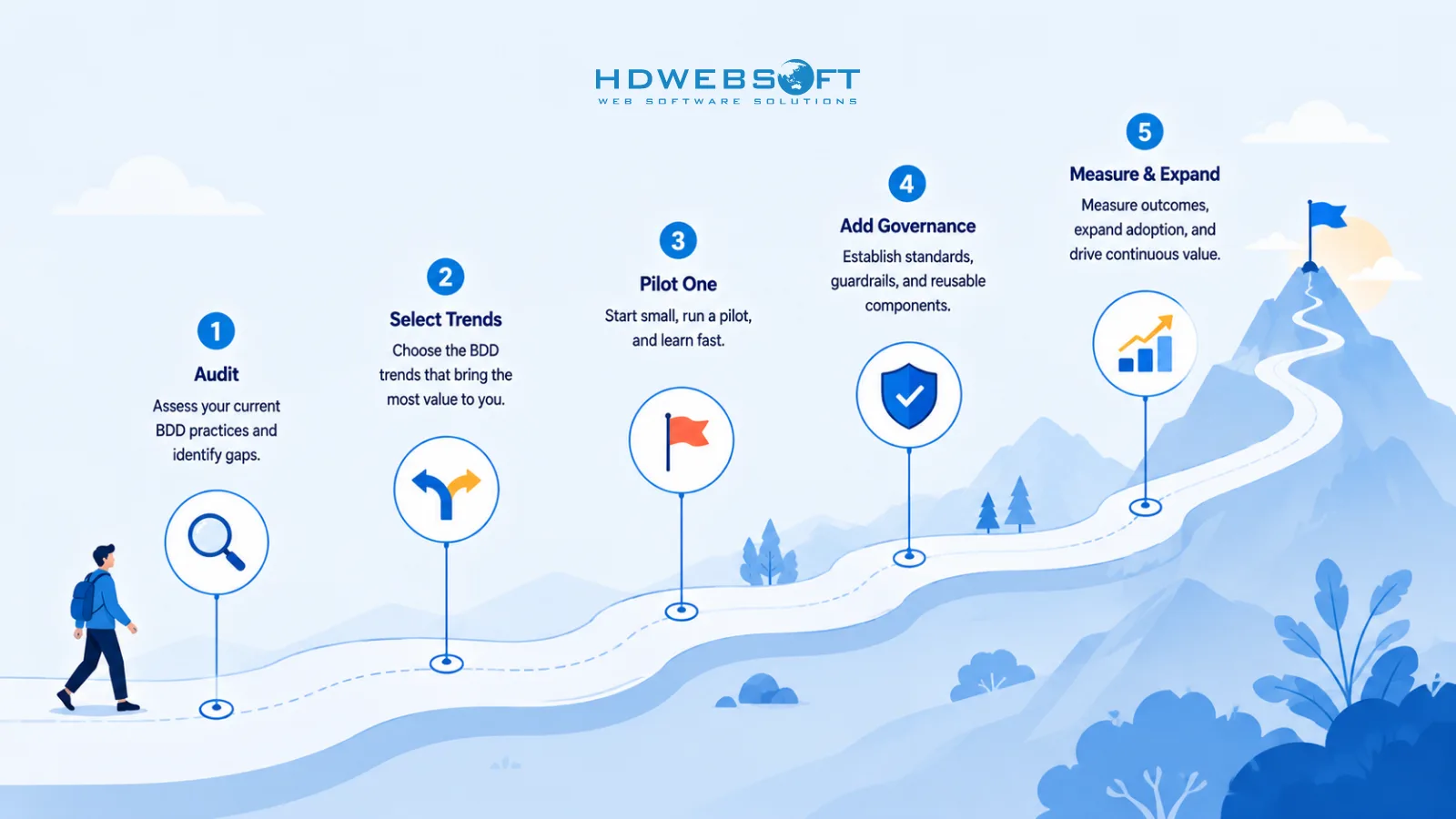
Most teams cannot adopt all ten trends at once. A pragmatic 2026 adoption path looks like this.
- Audit your current BDD maturity. List which trends you already touch and which are gaps. Be honest about scenario hygiene, CI integration, and non-functional coverage.
- Pick two or three trends that fit your context. A .NET team should prioritize the Reqnroll migration. A microservices-heavy team should prioritize contract-driven BDD. A regulated or consumer-facing team should prioritize accessibility as an acceptance criterion.
- Pilot one trend with a real feature. Run AI-assisted authoring on one feature, or wire one accessibility BDD step into one journey, and measure the impact on speed, coverage, and maintenance.
- Add governance before scale. Scenario linting, naming conventions, and review rules are cheaper to introduce with 50 scenarios than with 500.
- Measure and expand. Track maintenance time, flakiness, coverage breadth, and deployment confidence. Expand to the next trend only when the pilot shows real improvement.
FAQ
What are the top BDD testing trends for 2026?
The top BDD testing trends for 2026 are AI-assisted scenario authoring and maintenance, the SpecFlow to Reqnroll migration in .NET, contract-driven BDD for microservices, accessibility as an executable acceptance criterion, governed living specifications, scenario governance and test-suite debt management, CI/CD-native BDD with selective execution and release gates, BDD expansion to security performance and observability, one behavior model across web mobile and API, and behavior-driven evaluation for AI agents and probabilistic systems.
Is SpecFlow still supported in 2026?
No. Tricentis ended support for SpecFlow on December 31, 2024, and the SpecFlow GitHub repository was removed. Reqnroll is the maintained open-source successor, forked from SpecFlow in January 2024 and used by more than 5,000 projects by early 2025. .NET teams still on SpecFlow should plan a migration to Reqnroll.
How is AI changing BDD testing?
AI is changing BDD testing by generating and refining Gherkin scenarios from user stories, suggesting step definitions, self-healing tests when UI or API surfaces change, and summarizing test results. According to the World Quality Report 2025, 89 percent of organizations are piloting or deploying generative AI in quality engineering, although only 15 percent have scaled it enterprise-wide.
What is contract-driven BDD for microservices?
Contract-driven BDD for microservices combines behavior scenarios with consumer-driven contract testing using tools like Pact. Each service pair agrees on an executable contract, verified in CI with a can-i-deploy gate, so breaking API changes are caught before deployment instead of during a slow end-to-end suite.
Can BDD be used for accessibility and security testing?
Yes. In 2026, teams integrate axe-core with Playwright-BDD to run WCAG 2.1 and 2.2 AA accessibility scans as reusable BDD steps, and write security BDD scenarios that describe attack vectors and expected system behavior. BDD is expanding from functional verification to non-functional requirements including performance, resilience, and observability.
Which BDD tools are most relevant in 2026?
The most relevant BDD tools in 2026 are Cucumber and CucumberStudio for Ruby, JavaScript, and Java ecosystems, Reqnroll for .NET as the SpecFlow successor, Behave for Python, Karate for API-first BDD, and Playwright-BDD for end-to-end web and mobile testing with built-in accessibility support.
Conclusion
BDD in 2026 is no longer just a test automation technique. It is a governed, AI-augmented practice that spans discovery, deployment safety, accessibility, security, and even AI agent evaluation. The teams that benefit most are the ones that pair the new tooling with the older discipline: real collaboration, governed scenarios, and selective execution that protects release speed without sacrificing coverage.
If you want a partner to help assess your BDD setup and pilot one of these trends, HDWEBSOFT provides software testing services and automation testing services grounded in ISO 9001 and ISO/IEC 27001 certified delivery.