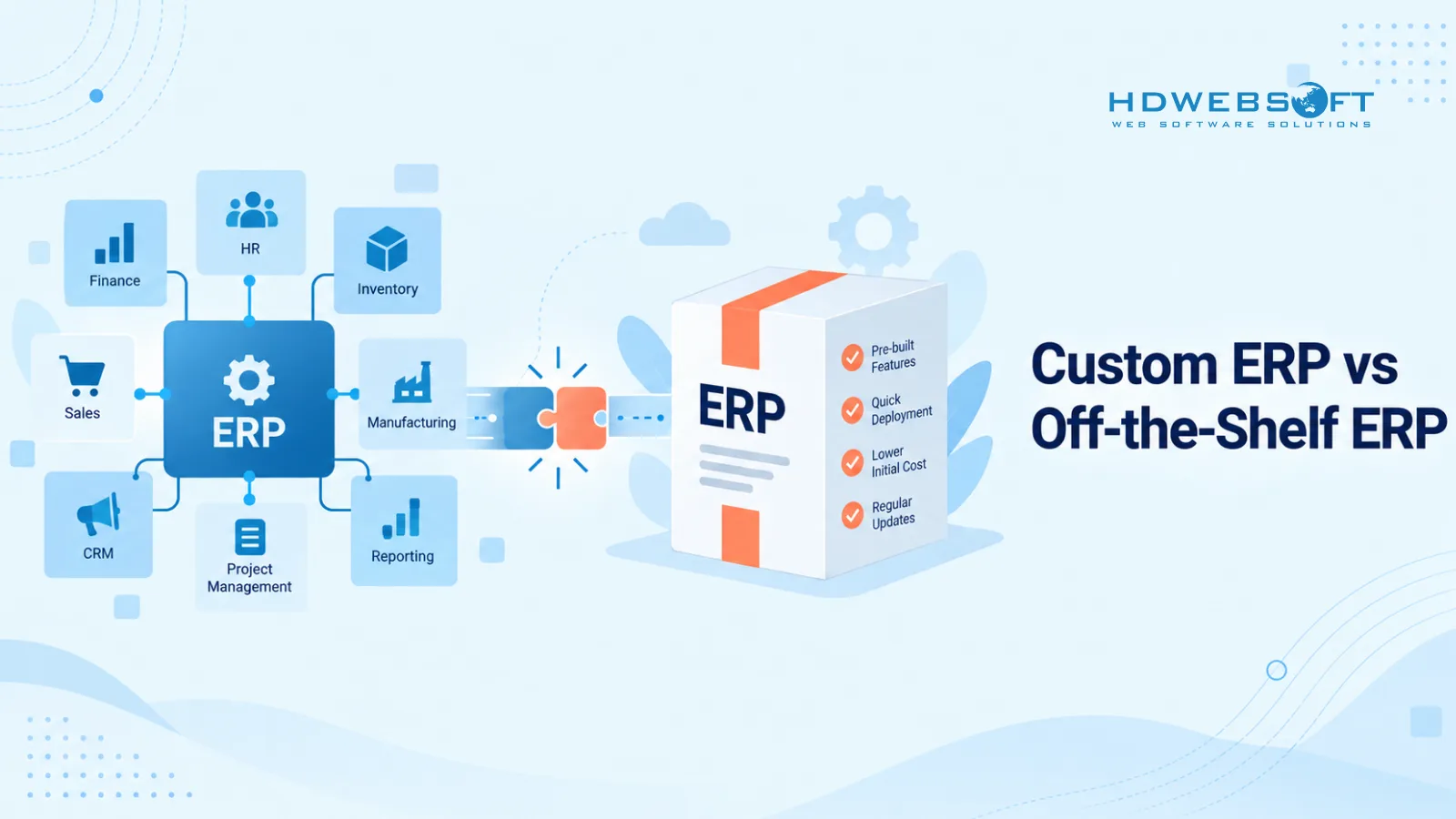
ERP software is crucial for streamlining operations, improving productivity, and driving growth in a 2026 business environment where AI and cloud-native architecture are reshaping how enterprises manage data. Whether a business opts for off-the-shelf or custom ERP software can significantly impact its operations, scalability, and overall success. A growing number of enterprises are also exploring composable ERP — assembling best-of-breed modules rather than committing to a single monolithic system — as a third path between these two extremes. This blog will explore the need for ERP systems, compare off-the-shelf and custom ERP solutions, and discuss factors to consider when choosing the right ERP system for your business. For businesses considering custom software vs off-the-shelf solutions, understanding the broader context helps in making informed decisions.
The short answer: Off-the-shelf ERP is a pre-built, vendor-supported solution that deploys fast and costs less upfront but offers limited customization. Custom ERP is built from scratch to fit your exact processes, workflows, and industry requirements, offering full customization, AI integration, and scalability — at a higher initial cost and longer development time. Choose off-the-shelf for standard processes and speed; choose custom when your business has unique needs that packaged solutions cannot meet.
Key Takeaways
- Off-the-shelf ERP deploys in weeks to months with lower upfront costs, but limited customization and recurring vendor license fees.
- Custom ERP takes 6–18 months to build and costs more upfront, but delivers full process alignment, AI tailored to your data, and no vendor lock-in.
- Composable ERP is a third option — assembling best-of-breed modules via APIs for flexibility without full custom development.
- Total cost of ownership (TCO) matters more than initial price: off-the-shelf costs climb with per-user licensing and add-ons, while custom ERP TCO stabilizes after build.
- AI is the biggest 2026 differentiator: custom ERP can embed AI trained on your proprietary data; off-the-shelf AI is trained on generic data.
- Choose custom when you have unique processes, deep integration needs, compliance/data sovereignty requirements, or AI-driven automation as a strategic priority.
Why is the ERP System Important?
If your business has outgrown its current financial software, it’s time to consider an ERP system. Whether you’ve hit the limits of basic accounting software or your existing ERP can’t keep up with your growth, enterprise software development can provide the solution you need.
ERP software is primarily valuable because it brings together crucial data from different parts of a business into one place. This means less time spent manually inputting data and ensures everyone in the company can easily access the information they need.
According to Gartner’s April 2026 forecast, worldwide software spending is projected to reach $1.44 trillion in 2026, a 15.1% increase from the previous year. Generative AI is a major driver of this growth, with enterprises more than doubling their investment in GenAI model development year over year. The enterprise software market remains the fastest-growing segment in the entire IT industry, with annual growth consistently exceeding 10%.
Custom ERP software development offers significant advantages across various industries. Sectors such as manufacturing, distribution, construction, business services, healthcare, automotive, transportation, logistics, and telecommunications often reap the most benefits. To understand modern ERP trends, including cloud-based ERP solutions, we’ll explore various implementation approaches. We’ll delve deeper into this later in the article.
Off-the-shelf ERP software
Off-the-shelf ERP software is a pre-built solution designed to address the common needs of businesses across various industries. It comes with standard features and functionalities that can be deployed relatively quickly.
Advantages of out-of-the-box ERP solutions
These pre-built systems provide a solid foundation for operations and can be a cost-effective choice for many organizations.
Quick Implementation
One of the primary advantages of an off-the-shelf ERP system is its speed of implementation. Since the software is pre-built and pre-configured, businesses can deploy it much faster than custom ERP systems. This rapid deployment allows companies to start benefiting from the ERP solution sooner, which is particularly important for businesses looking to address immediate operational challenges.
Lower Initial Costs
Off-the-shelf ERP solutions generally have a lower initial cost compared to custom ones. The development costs are spread across multiple customers, making it more affordable for small and medium-sized enterprises (SMEs). Additionally, these solutions often come with predefined processes requiring minimal customization, reducing the upfront investment.
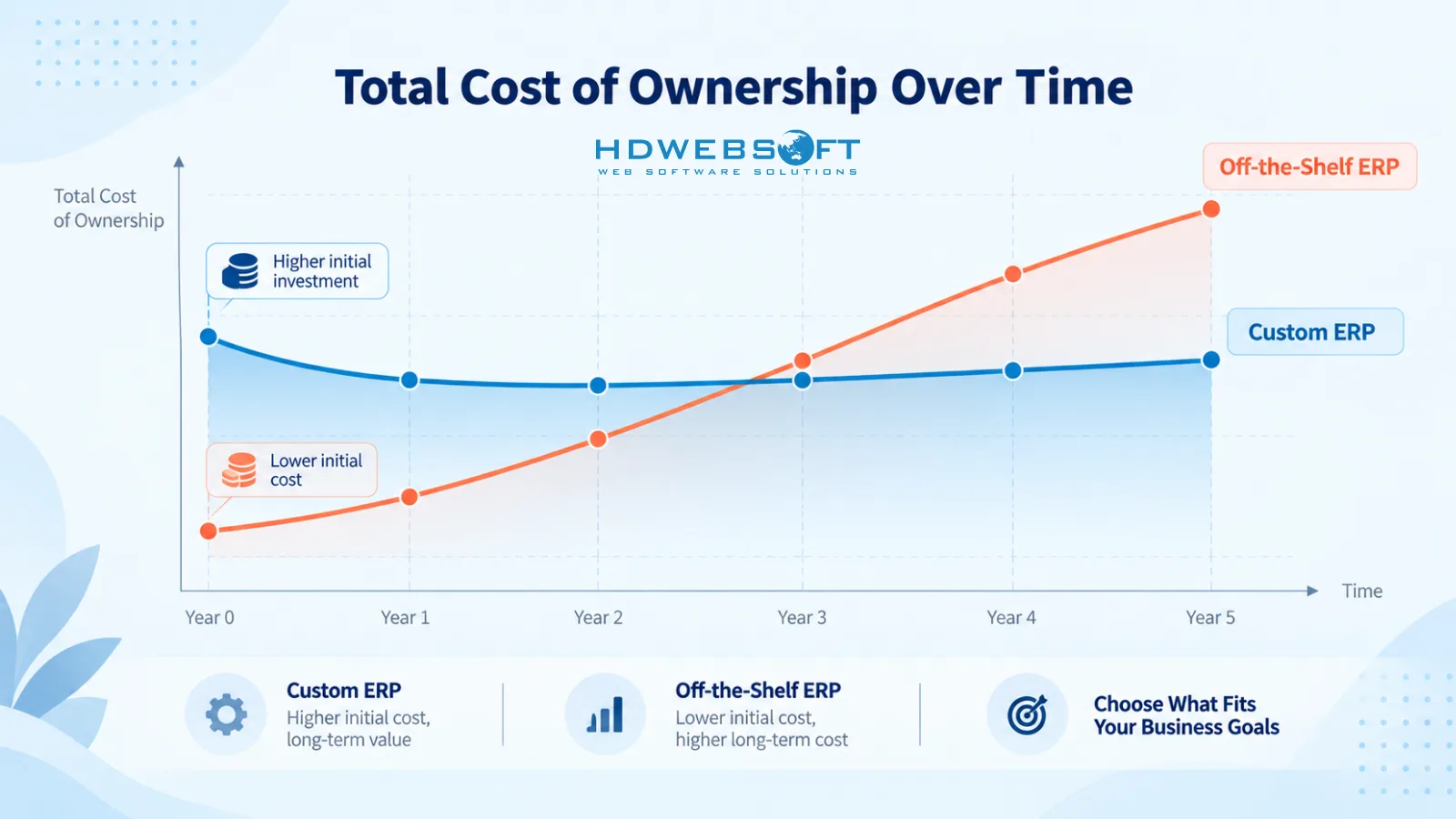
Total cost of ownership comparison: custom ERP vs off-the-shelf ERP over time.
Proven and Reliable Functionality
Ready-made ERP software is typically well-tested and widely used across different businesses. This means that the software has been refined and optimized based on real-world feedback, leading to a reliable and stable product. Businesses can trust that the core functionalities will work as expected without the need for extensive testing and debugging.
Regular Updates and Vendor Support
Out-of-the-box ERP software vendors regularly release updates to ensure the system remains compliant with industry standards and adapts to new technologies. These updates often include security patches, new features, and performance improvements.
Furthermore, businesses can rely on vendor support for troubleshooting, training, and system maintenance, reducing the burden on internal IT teams.
Disadvantages of ready-made enterprise system
While off-the-shelf ERP software offers many advantages, it also comes with certain limitations. Let’s explore some of the drawbacks associated with these pre-built solutions:
Limited Customization
The most significant drawback of off-the-shelf software is its limited customization options. Because it is designed to meet the needs of a broad range of businesses, it may not perfectly align with a particular company’s specific processes or workflows.
As a result, businesses may need to adapt their processes to fit the software, which can lead to inefficiencies or require workarounds.
Feature Overload
Off-the-shelf ERP software often includes a wide range of features designed to cater to various industries and business sizes. However, not all of these features may be relevant to your business. Unnecessary functionalities can clutter the user interface and complicate the system, making it harder for employees to navigate and use it effectively.
Vendor Dependency
With ready-made solutions, businesses are dependent on the vendor for updates, support, and future developments. If the vendor discontinues the product or significantly changes its pricing model, it can leave businesses in a difficult position.
Moreover, integrating the ERP system with other software or customizing it to fit unique requirements may require vendor assistance, leading to potential delays and additional costs.
Applicability across industries
Off-the-shelf ERP software is designed to be versatile and applicable across a wide range of industries. However, its effectiveness depends on the complexity of the business processes and the degree of customization required.
Automotive
In the automotive industry, ready-made enterprise systems can help manage complex supply chains, manufacturing processes, and regulatory compliance. These systems’ standard features can meet the needs of many automotive businesses.
However, the industry’s unique requirements for parts traceability, warranty management, and compliance may require additional customization or specialized modules.
Manufacturing and Retail
Out-of-the-box systems offer manufacturing and retail businesses strong inventory management, production planning, and sales tracking capabilities. These systems can streamline operations and improve efficiency, making them suitable for many companies. Despite that, businesses with unique production processes or specialized retail needs might encounter limitations with standard features.
Distribution and Wholesale
Off-the-shelf ERP software is particularly well-suited for distribution and wholesale industries, where it can effectively manage logistics, inventory, and order fulfillment. These systems provide real-time visibility into stock levels, shipments, and customer orders, helping businesses optimize their supply chains. However, businesses with highly specialized distribution models may require additional customization.
FoodTech
In the FoodTech industry, ready-made software can assist with supply chain management, compliance with food safety regulations, and traceability. While these systems can handle many standard operations, businesses with specific needs related to food production, quality control, or specialized distribution channels may need to seek additional customization or industry-specific solutions.
Which is the Right Solution for Your Business? ERP or CRM.
Custom ERP software
Custom ERP software refers to Enterprise Resource Planning systems specifically designed and developed to meet the unique requirements of a particular business. It’s built from the ground up, providing a tailored fit for the company’s processes, workflows, and objectives.
Advantages of tailored ERP system
A custom ERP system offers several distinct advantages:
Full Customization and Flexibility
One of the most significant advantages of bespoke ERP is its ability to be fully customized to meet a business’s specific needs. Whether it’s integrating unique workflows, automating specialized processes, or accommodating industry-specific regulations, custom ERP systems can meet these needs. They are built to fit the exact requirements of the organization.
Additionally, as most software is shifting to cloud solutions, cloud-based ERP will offer the flexibility of remote access and scalability, further enhancing the customization and adaptability of the system. They are built to fit the exact requirements of the organization.
This level of customization ensures that the software aligns perfectly with the company’s operations, leading to greater efficiency and effectiveness.
Scalability and Future-Proofing
Custom ERP software is designed with the future in mind. As a business grows and evolves, its processes and requirements will likely change. It can be scaled and modified to accommodate these changes, ensuring that the system remains relevant and effective over time. Modern custom ERP systems are increasingly built as cloud-native, microservices-based, and API-first architectures, which means individual modules can be scaled independently and new capabilities can be added without rebuilding the entire system. This scalability is crucial for businesses that anticipate growth, expansion, or changes in their operational structure.
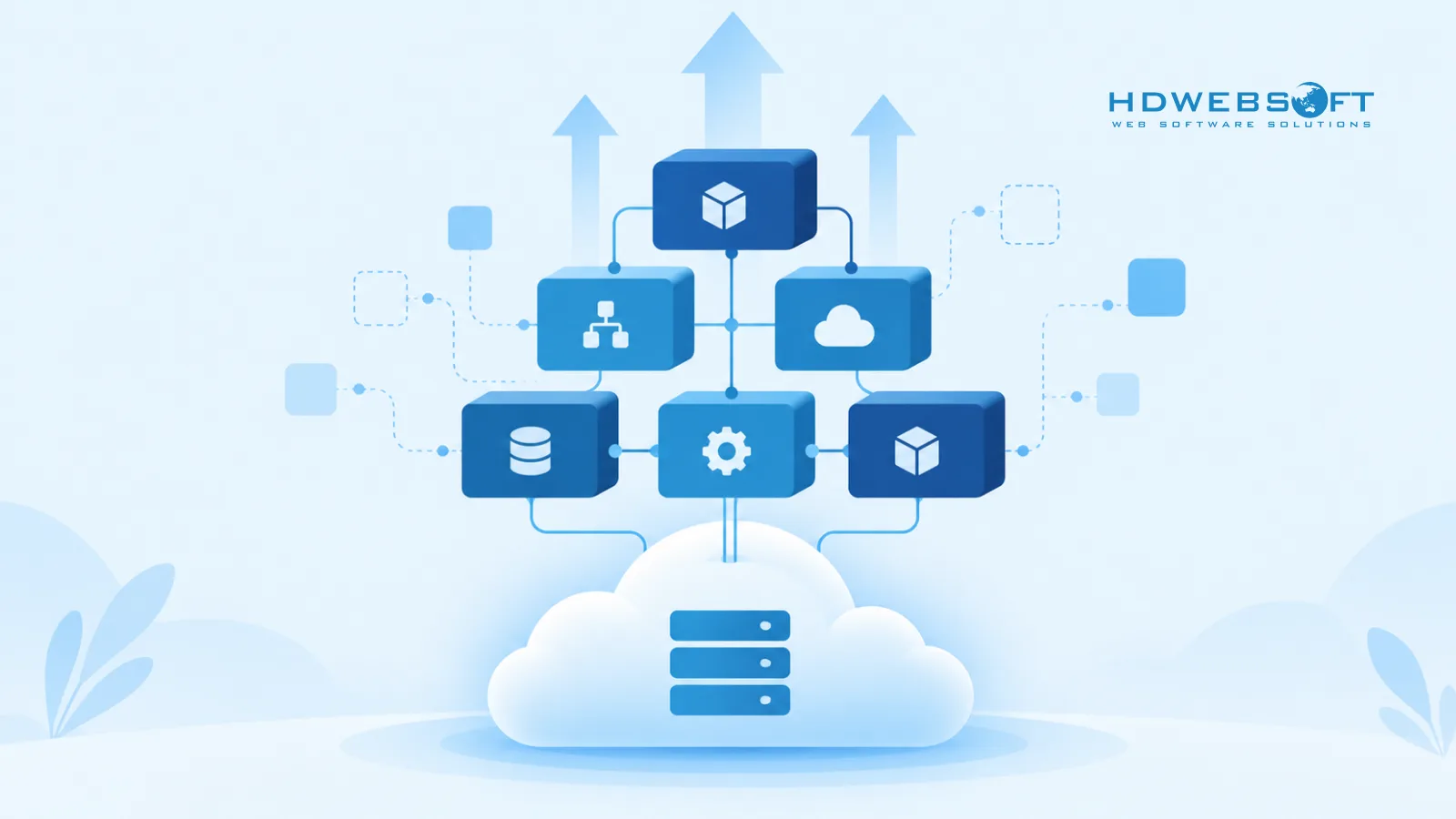
Cloud-native modular ERP architecture enables independent module scaling.
Competitive Advantage
Businesses can gain a competitive edge by investing in a custom ERP system. Tailor-made solutions can be designed to implement unique business strategies, optimize specific operations, and provide features not available in off-the-shelf solutions. This competitive advantage can be particularly valuable in industries where differentiation and innovation are key to success.
Integration with Existing Systems
Custom ERP solutions can be frictionlessly integrated with a company’s existing software and systems. Whether it’s legacy systems, specialized tools, or third-party applications, they can be developed to work in harmony with the company’s existing technology stack. This integration ensures smooth data flow across all systems, reducing the risk of data silos and improving overall operational efficiency.
AI-Powered Intelligence
In 2026, AI is the single biggest differentiator between custom and off-the-shelf ERP. Custom systems can embed AI capabilities tailored to a company’s specific data and workflows — predictive demand forecasting, automated invoice processing, anomaly detection in financial data, and GenAI copilots that understand the business’s own terminology. Off-the-shelf vendors are adding AI features too, but their models are trained on generic data and cannot easily incorporate proprietary business logic. For enterprises where AI-driven automation is a strategic priority, custom ERP offers a level of intelligence that packaged solutions struggle to match.
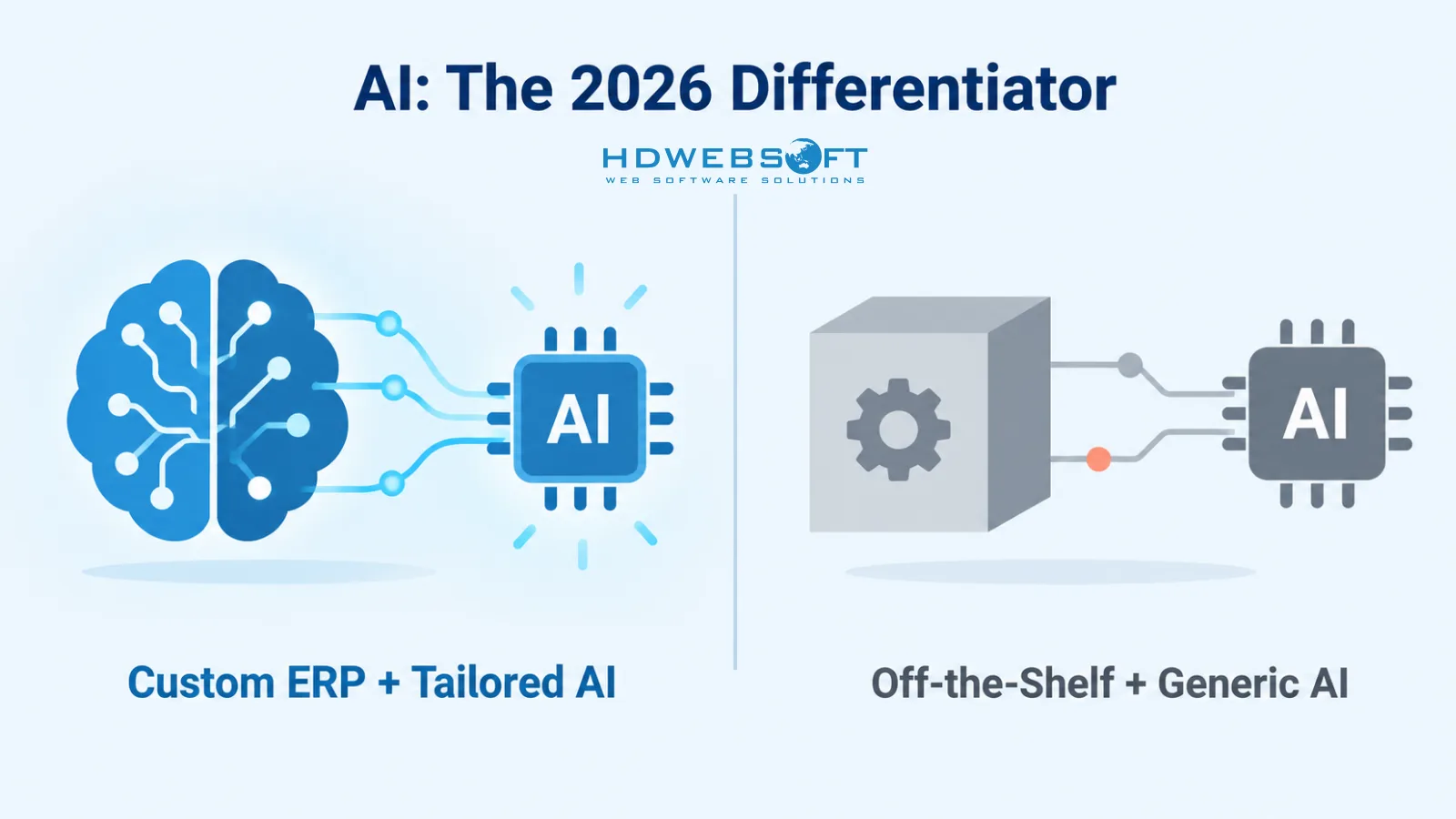
AI integration comparison: custom ERP with tailored AI vs off-the-shelf with generic AI.
Disadvantages of bespoke ERP systems
While custom ERP software offers significant advantages, it also comes with certain challenges:
Higher Initial Costs
One of the primary drawbacks of a tailored system is its higher initial cost compared to off-the-shelf solutions. Developing an ERP system requires significant investment in terms of time, resources, and expertise. The cost of custom development can be a barrier for smaller businesses or those with limited budgets.
Longer Development Time
Bespoke enterprise systems take longer to develop and implement than off-the-shelf solutions. The process involves detailed analysis, design, development, testing, and deployment phases, all of which require considerable time. For businesses that need a quick solution, the extended development timeline of custom ERP software can be a disadvantage.
Maintenance and Upkeep
Once a custom solution is implemented, ongoing maintenance and updates are necessary to ensure the software remains functional, secure, and up-to-date with the latest technologies. Unlike off-the-shelf solutions, which receive regular updates from the vendor, the ERP software requires dedicated support from the development team or an external service provider, which can add to the overall cost.
Risk of Over-Customization
While customization is a significant advantage of tailor-made ERP solutions, there is a risk of over-customization. If the system becomes too complex or tailored, it can be challenging to maintain, update, or scale. Ultimately, over-customization can also lead to difficulties in onboarding new users or integrating with new technologies.
Applicability across industries
Custom ERP software is designed to perfectly align with a specific organization’s unique processes and needs. However, its effectiveness hinges on the depth of understanding of the business requirements and the ability to translate them into functional software.
Healthcare
The healthcare industry often requires highly specialized ERP systems to manage patient records, billing, regulatory compliance, and medical inventory. Custom solutions can be developed to meet healthcare providers’ stringent requirements, ensuring that the system is secure and compliant with industry regulations such as HIPAA.
Finance
Financial institutions and services often need tailored solutions to manage complex financial transactions, risk management, compliance with regulatory standards, and customer relationship management. Custom ERP software allows these institutions to implement unique financial models, integrate with other financial systems, and adapt to changing regulatory environments.
Retail and E-commerce
In the retail and e-commerce sectors, custom ERP software can provide a significant advantage. It offers personalized features such as advanced inventory management, dynamic pricing, customer loyalty programs, and integration with various sales channels. Service teams can also connect ERP workflows with call center optimization best practices so customer records, routing, and support metrics stay aligned. This level of customization helps businesses optimize their operations and provide a better customer experience.
Custom ERP vs Off-the-Shelf ERP at a Glance
| Factor | Off-the-Shelf ERP | Custom ERP |
|---|---|---|
| Upfront cost | Lower — subscription pricing spreads cost across customers | Higher — dedicated development investment |
| Time to deploy | Weeks to a few months | 6–18 months (shorter with cloud-native architecture) |
| Customization | Limited to vendor-configured options | Full — built to exact processes and workflows |
| Scalability | Available but often at additional per-user cost | Built-in; modules scale independently with microservices |
| AI integration | Vendor-added AI trained on generic data | AI tailored to your proprietary data and workflows |
| Integration | Standard integrations for common apps | Frictionless integration with any system via custom APIs |
| Vendor dependency | High — tied to vendor roadmap and pricing | None — you own the code and roadmap |
| Total cost of ownership | Climbs with per-user licensing and add-ons | Stabilizes after build; no recurring license fees |
| Best for | Standard processes, SMEs, fast deployment | Unique processes, complex industries, strategic AI automation |
Key Factors in Choosing an ERP Solution for Business
Selecting the right ERP software solution is a critical decision for any business as it’s the foundation for a successful ERP implementation. There are several key factors to keep in mind to make an informed decision:
Business Process Compatibility
- Off-the-Shelf ERPs: These systems cater to a broad range of businesses, so they might not perfectly align with the specific needs of individual companies. This can result in missing features or added complexity.
- Custom ERPs: Custom ERP systems allow businesses to fully address their specific needs, which is especially crucial for industries with complex and specialized operations.
Financial Considerations
- Off-the-Shelf ERPs: Subscription-based ERP software typically requires lower upfront costs. However, ongoing maintenance and support fees can add to the total expenditure over time.
- Custom ERPs: While requiring a larger initial investment, custom ERP systems can potentially lower operational costs in the long run by decreasing reliance on external software solutions.
When comparing costs, businesses should look beyond initial pricing and evaluate the total cost of ownership (TCO), which includes licensing, implementation, customization, training, integration, maintenance, and eventual migration or upgrade expenses. Off-the-shelf ERP TCO can climb significantly as per-user licensing scales and customization add-ons accumulate, while custom ERP TCO is more predictable once the system is built, since there are no recurring vendor license fees.
Data Protection
- Off-the-Shelf ERPs: When using a pre-built ERP system, both the vendor and the business share responsibility for security. The vendor primarily handles system security by implementing protective measures and regular updates.
- Custom ERPs: Custom ERP systems offer stronger data protection by including security features tailored to your business. While this provides enhanced security, it requires continuous investment in updates and security checks.
System Integration
- Off-the-Shelf ERPs: Provide standard integrations for common applications, helping businesses with limited tech expertise.
- Custom ERPs: Custom ERP solutions effortlessly integrate with various business and third-party systems through adaptable APIs.
Check out how HDWEBSOFT integrated ERP systems to an All-in-one Seller Workspace.
Future Growth Support
- Off-the-Shelf ERP: Scalability is often an option, but it might come with additional costs, especially for more users.
- Custom ERP: Enable strategic scalability planning that aligns with business growth objectives, avoiding unexpected costs.
Conclusion
ERP software is undeniably a cornerstone of modern business operations. It is a powerful tool that can transform your business operations, but the right solution varies from one company to another. As AI, cloud-native architecture, and composable ERP reshape the landscape in 2026, the decision is no longer simply “buy vs. build” — it is about choosing the approach that best fits your data, workflows, and growth trajectory. Ultimately, selecting the right ERP solution involves a careful evaluation of many factors. For organizations already running a legacy ERP, ERP cloud migration using the Strangler Fig Pattern offers a structured path to modernize without operational downtime.
Ready to build your custom ERP solution? Contact our expert team for a free consultation to discuss your specific business requirements and get a tailored implementation plan. HDWEBSOFT specializes in ERP development services and tailored enterprise solutions that perfectly align with your business objectives. Our expert team combines industry knowledge with cutting-edge technology to create efficient, scalable, and secure ERP systems. By partnering with HDWEBSOFT, you can unlock your business’s full potential and gain a competitive edge.
Remember, the ERP system is not just a software tool; it’s a strategic investment that can significantly impact your organization’s performance.
Frequently Asked Questions
What is the difference between custom ERP and off-the-shelf ERP?
Custom ERP is built from scratch to fit a specific business’s processes, workflows, and industry requirements, offering full customization and scalability. Off-the-shelf ERP is a pre-built, vendor-supported solution designed for broad use across multiple industries, offering faster deployment and lower upfront costs but limited customization.
Which is cheaper — custom ERP or off-the-shelf ERP?
Off-the-shelf ERP is cheaper upfront, with subscription-based pricing spreading costs across many customers. Custom ERP requires a larger initial investment in development. However, over the total cost of ownership, custom ERP can become more cost-effective because it eliminates recurring vendor license fees and reduces reliance on third-party add-ons.
How long does it take to implement a custom ERP system?
Custom ERP implementation typically takes 6 to 18 months depending on the scope, number of modules, integrations required, and complexity of business processes. Off-the-shelf ERP can deploy in weeks to a few months. Modern cloud-native and microservices-based custom ERP architectures can shorten this timeline by allowing incremental module releases.
When should a business choose custom ERP over off-the-shelf?
Choose custom ERP when your business has unique processes that off-the-shelf solutions cannot accommodate, when you need deep integration with existing specialized systems, when data sovereignty or compliance requires full control, or when AI-driven automation tailored to your proprietary data is a strategic priority. Off-the-shelf is better for standard processes and fast deployment.
Can AI be integrated into both custom and off-the-shelf ERP?
Yes, but with different outcomes. Off-the-shelf vendors are adding AI features like copilots and predictive analytics, but their models are trained on generic data. Custom ERP can embed AI tailored to your specific data and workflows — predictive demand forecasting, automated invoice processing, and GenAI copilots that understand your business terminology — giving it a significant intelligence advantage.
What is composable ERP and how does it compare to custom and off-the-shelf?
Composable ERP is an approach where businesses assemble best-of-breed modules from different vendors rather than committing to a single monolithic system. It sits between custom and off-the-shelf: you get off-the-shelf speed for individual modules but can customize the overall architecture through APIs and integration layers. It suits enterprises that want flexibility without full custom development.