Outsourcing and offshoring are often used as if they mean the same thing. They do not — and the difference matters when you are deciding how to scale an engineering organization. Outsourcing is about who does the work: a third party takes it over. Offshoring is about where the work is done: another country. The two are independent choices that combine into four operating models, and most software companies eventually use more than one of them.
This outsourcing vs offshoring guide defines each term and shows how they overlap. It maps the four combinations with software examples, and ends with the decision factors that separate outsourcing from building your own offshore operation. The precision pays off in vendor conversations. A brief that says “offshore” tells a vendor where; one that says “outsourcing” tells them who — and you usually need to communicate both.
The Core Difference in One Table
| Dimension | Outsourcing | Offshoring |
|---|---|---|
| Question it answers | Who does the work? | Where is the work done? |
| What changes | The performer — a third party takes over a function or project | The location — work moves to another country |
| Counterpart | A vendor, agency, or contractor | A foreign subsidiary, branch, or vendor |
| Can exist without the other? | Yes — onshore outsourcing is common | Yes — captive offshore centers are common |
| Typical cost driver | Vendor rates and contract structure | Labor cost differences between countries |
| Typical risk | Vendor dependency, quality variance | Distance, time zones, management overhead |
Read the table row by row and the confusion dissolves: outsourcing changes the who, offshoring changes the where. Everything else follows from that.
Why People Confuse Them
The terms overlap in practice for four reasons.

- Both reduce cost. The most common motivation for each is the same — getting work done at a lower total cost than doing it in-house at home. Cost reduction remains the top-cited driver in industry research such as Deloitte’s Global Outsourcing Survey.
- Both move work outside the original team. In both cases, work that used to sit with internal staff is now performed elsewhere, so from the manager’s chair they can look identical.
- The most common combination is both at once. When a company hires a vendor in another country — the standard offshore software development arrangement — it is outsourcing and offshoring simultaneously. People shorten that to “outsourcing” or to “offshoring” depending on which aspect they are thinking about.
- The marketplace blurs the line on purpose. Many offshore vendors market themselves as “outsourcing companies”, and many outsourcing firms advertise “offshore teams”. The labels are used to sell, not to classify, so buyers absorb the confusion from vendor websites.
The overlap is real, but the outsourcing vs offshoring distinction is not interchangeable: a company can change one without changing the other.
Outsourcing Explained
Outsourcing means obtaining goods or services from an outside supplier instead of producing them internally. In software, three forms dominate:
- Project outsourcing — a vendor delivers a defined outcome: a product, a module, a migration. The client defines scope and acceptance criteria; the vendor owns the execution.
- Staff augmentation — a vendor supplies individual engineers who work inside the client’s team and process. The client keeps management; the vendor handles employment, retention, and replacement.
- Managed services — a vendor operates a function continuously: QA, DevOps, support, maintenance — against agreed service levels.
Outsourcing says nothing about geography. A US company can outsource to a vendor in the same city, the same country, or another continent. For how to evaluate and select the vendor itself, see our guide on choosing the right software outsourcing company.
Three misconceptions travel with the term. Outsourcing does not mean firing — most companies outsource capacity they never had, not roles they eliminate. It does not mean abdicating management — the client still owns priorities, standards, and acceptance. And it is not only a cost play. Access to specialized skills — a security practice, a mobile team, a QA bench that would take a year to build — is often the stronger reason than the rate card.
Offshoring Explained
Offshoring means relocating work — a service, a process, or production — to another country. The defining change is location, not ownership. Two forms exist:
- Offshoring through a third party. The company contracts a vendor abroad to do the work. This is the overlap zone: offshoring via outsourcing. A US SaaS company hiring a Vietnamese firm to build and maintain its product is offshoring through outsourcing.
- Offshoring through own operations. The company opens its own entity abroad — a captive development center — and staffs it with its own employees. The work moves abroad, but no third party is involved. The company carries the entity cost, the hiring, and the local compliance, in exchange for direct control.
The second form is why “offshoring” cannot simply mean “outsourcing”: a company can move work to another country while keeping every worker on its own payroll. For where offshore delivery is heading in 2026 — including AI-augmented teams and agent-shoring — see our offshore software development trends.
What offshoring does not change is ownership and accountability. Whether the work moves through a vendor or a captive center, the client company still owns the outcome. The product decisions, the quality bar, and the customer relationship stay with you. Offshoring relocates execution; it does not relocate responsibility. That distinction is what separates a well-run offshore arrangement from an abdication dressed up as one.
The Four Combinations
Cross the two questions — who does the work, and where — and four operating models appear:
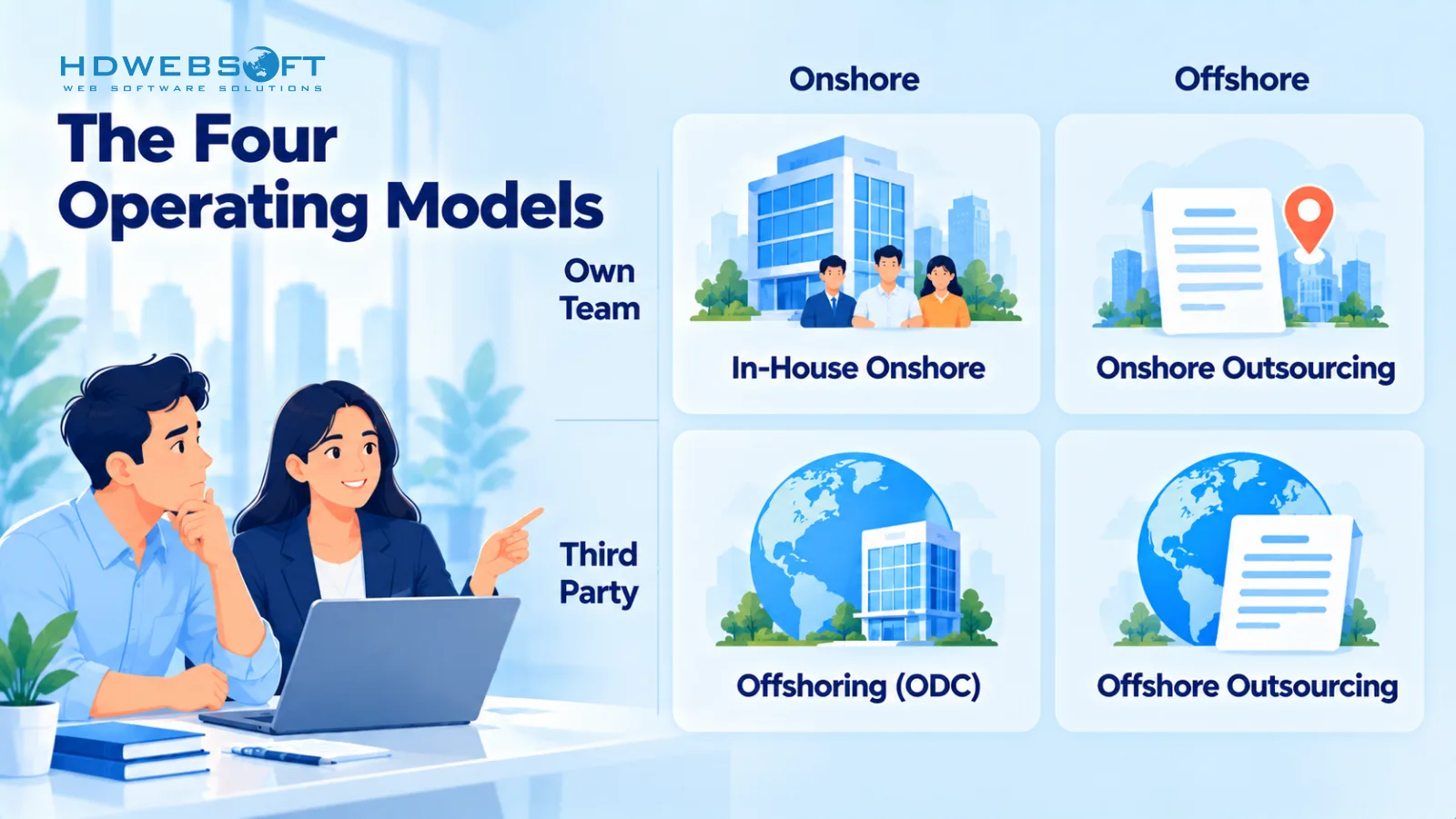
| Work done onshore | Work done offshore | |
|---|---|---|
| Own employees | In-house team | Offshoring (captive center / ODC) |
| Third party | Onshore outsourcing | Offshore outsourcing |
- In-house onshore — the default model: your employees, your country, your management.
- Onshore outsourcing — a local vendor does the work. Maximum collaboration convenience, highest rates.
- Offshoring without outsourcing — your own entity abroad: a captive center or offshore development center. Direct control, highest setup cost.
- Offshore outsourcing — a foreign vendor does the work. The most common arrangement in software: vendor rates plus offshore economics, without the entity overhead.
Companies rarely stay in one box. A common trajectory: start with an in-house team, add onshore outsourcing to close a skill gap, then move the repeatable work to offshore outsourcing for cost. If the offshore function becomes strategic and large, graduate part of it into a captive center. Each move changes one variable at a time, which keeps the risk manageable. Treat the matrix as a map of positions, not a one-time choice.
Three neighboring terms complete the map. Nearshoring moves work to a nearby country with similar or adjacent time zones — trading some cost advantage for easier real-time collaboration. Onshoring (or reshoring) brings work back to the home country. An offshore development center (ODC) describes the location model — a dedicated development operation abroad. It can be either captive (your company owns it) or vendor-operated (a provider runs a dedicated team exclusively for you).
Which Term to Use in Software Development
The software industry uses a cluster of terms that mix the two concepts. Use each precisely:

- Software outsourcing / IT outsourcing — emphasizes the who: a third party delivers software work. Location unspecified.
- Offshore software development — emphasizes the where: software work performed in another country. Performer unspecified.
- Offshore development team / offshore development center — a dedicated software operation located abroad; specifies neither ownership nor vendor relationship by itself.
- Offshore outsourcing — the full combination: a third party abroad delivers the work.
When writing a job post, a contract, or a vendor brief, precision pays. “Outsourcing” without a location qualifier does not tell a candidate where they will work. “Offshore” without an ownership qualifier does not tell a partner whether you are building a captive center or hiring a vendor.
In practice, the terms combine in one sentence. “We are outsourcing our QA to an offshore vendor” communicates both decisions at once. “We are offshoring our QA” leaves the listener guessing whether you hired a vendor or opened a subsidiary — a difference that changes the contract, the management model, and the risk profile.
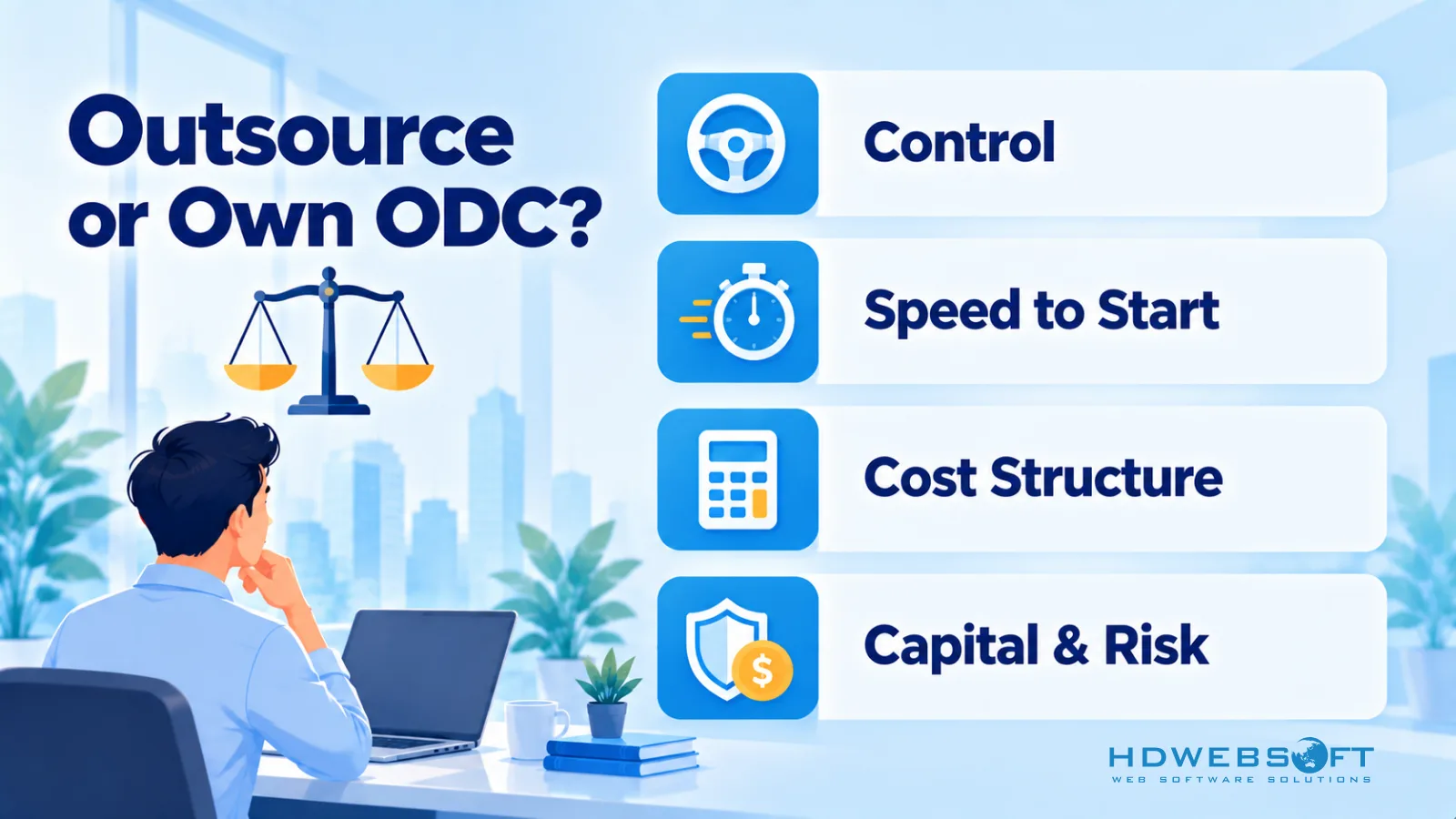
How to Choose: Outsource or Open Your Own ODC?
The four combinations are options, not a sequence — but most companies face the classic outsourcing vs offshoring fork: hire a vendor offshore, or build a captive center offshore. Four factors decide it.
- Control. A captive center gives direct control over hiring, priorities, and culture. A vendor gives contractual control — service levels, dedicated teams, audit rights — with less day-to-day management burden.
- Speed to start. A vendor can staff a team in weeks because the hiring engine already exists. A captive center needs entity setup, local HR, and a first hiring wave before the first sprint.
- Cost structure. Vendor rates are higher per hour than captive salaries, but the captive carries fixed costs — entity, office, HR, compliance — that continue regardless of workload.
- Capital and risk appetite. A captive center is an investment with a break-even horizon. A vendor contract is an operating expense with an exit clause.
Most mature engineering organizations end up hybrid. The core product stays in-house onshore, a specialized function runs with an offshore vendor, and — at scale — a captive center takes over the largest, most stable workstream. The outsourcing vs offshoring fork is not a one-time decision; it is a dial you adjust as the work changes.
If the choice lands on hiring a vendor, the hiring checklist applies in full — see our checklist to hire an offshore software development team for the stage-by-stage process.
Why Choose HDWEBSOFT
HDWEBSOFT is an ISO 9001 and ISO/IEC 27001 certified software company with 14+ years of experience and 750+ projects delivered worldwide. We operate on the offshore outsourcing model — dedicated teams and project delivery from Vietnam — and also run software outsourcing services for clients who need flexible engagement structures. Explore our offshore software development services to see how the model works in practice.
FAQ
What is the difference between outsourcing and offshoring?
Outsourcing is about who does the work — a third party takes over a function or project. Offshoring is about where the work is done — production or services move to another country. The two choices are independent: you can outsource onshore, offshore without outsourcing, or combine both.
Can a company offshore without outsourcing?
Yes. When a company opens its own development center or factory in another country and staffs it with its own employees, it is offshoring without outsourcing. The work moves abroad, but no third party is involved.
What is offshore outsourcing?
Offshore outsourcing is the combination of both: a third party in another country does the work. A US company hiring a Vietnamese software vendor to build a product is offshore outsourcing — the most common model in software development.
What is nearshoring?
Nearshoring moves work to a nearby country, usually in a similar or adjacent time zone — for example, a US company working with a team in Latin America. It trades some cost advantage for easier real-time collaboration compared to farshoring.
Which is better, outsourcing or offshoring?
Neither is universally better — they answer different questions. Outsourcing answers who should do the work; offshoring answers where it should be done. The right choice depends on control requirements, speed to start, cost targets, and capital availability. Many companies combine both as offshore outsourcing.
What is an offshore development center?
An offshore development center (ODC) is a dedicated development operation located in another country. It can be a company-owned captive center or a vendor-operated dedicated team that works exclusively for one client. The term describes the location model, not the ownership model.
Is offshoring the same as outsourcing?
No. Offshoring describes where work is performed; outsourcing describes who performs it. A company can offshore without outsourcing — a captive center staffed with its own employees — or outsource without offshoring — a local vendor. They only overlap in offshore outsourcing, where a foreign vendor does the work.
What is farshoring?
Farshoring moves work to a distant country — typically far away in time zone as well as geography. Think of a European company working with a team in Southeast Asia. It maximizes cost advantage and talent access at the price of less real-time overlap; nearshoring is its counterpart.
Conclusion

The outsourcing vs offshoring distinction answers two different questions — who does the work, and where it is done. Confusing them leads to vague briefs and wrong vendor conversations. Separating them gives you a clean map of the four operating models — and a clear basis for choosing between hiring a vendor and building your own offshore operation.
Ready to discuss which model fits your roadmap? Contact HDWEBSOFT — we will walk through your options with real numbers, not terminology.